Advertisement






What really powers the cloud? Behind every Google search, A...
A lot of what defines a home isn’t visible at handover. I...
Private equity has played a significant role in shaping Indi...
Luxury real estate is one of the most talked-about segments ...
Airports play a much bigger role than just enabling travel -...
Indian Railways has approved a INR 135 crore project to construct a 4.59-km rail flyover between Bondamunda 'A' Cabin and Bondamunda Link 'B' Cabin under the South Eastern Railway to decongest the busy Rourkela-Bondamunda section. The flyover will separate freight and passenger train operations, reducing crossing conflicts, improving operational efficiency and enhancing network capacity on the industrial corridor. Once commissioned, the project is expected to enable the movement of an additional 8 million tonnes per annum (MTPA) of freight, supporting growing mining and steel production in the region.
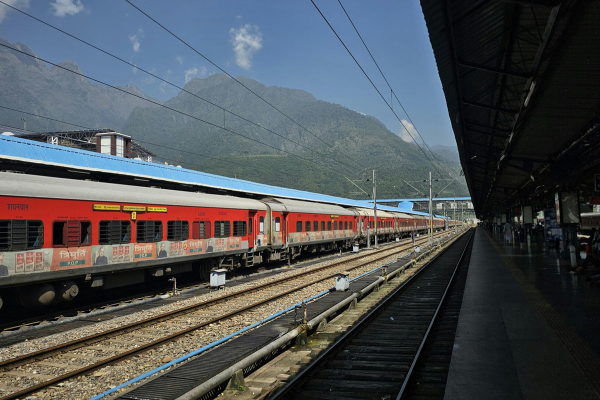
Indian Railways has approved a INR 135 crore project to construct a 4.59-kilometre rail flyover between Bondamunda 'A' Cabin and Bondamunda Link 'B' Cabin under the South Eastern Railway. The project aims to decongest the strategically important Rourkela-Bondamunda rail section, a key industrial corridor witnessing rapidly increasing freight traffic due to the expansion of mining and steel production in Odisha.
The proposed flyover has been designed to separate freight train operations from passenger traffic, thereby reducing operational conflicts and improving the efficiency of train movements. Currently, heavy freight traffic shares infrastructure with passenger services, creating congestion and limiting the corridor's ability to handle growing rail volumes. By eliminating these crossing conflicts, the project is expected to improve punctuality, operational reliability and overall network performance.
The approval comes in response to the anticipated rise in freight movement generated by the expansion of SAIL's Barsua–Taldih–Kalta mining complex, increased production at the Rourkela Steel Plant, and the planned doubling of this High-Density Network (HDN) route. These developments are expected to significantly increase demand for rail transportation of minerals and finished steel products over the coming years, making capacity augmentation essential.
According to Indian Railways, the new flyover will substantially improve operations at Bondamunda Yard, one of the region's critical railway junctions. The segregation of freight and passenger services will allow smoother train handling, reduce bottlenecks and create additional line capacity for future traffic growth. Once operational, the project is expected to facilitate the movement of an additional 8 million tonnes per annum (MTPA) of freight, strengthening the evacuation of minerals and industrial cargo from the region.
The flyover has been approved under Indian Railways' Energy, Mineral and Cement Corridor, a national initiative aimed at expanding rail infrastructure to support industries that rely heavily on bulk freight movement. The programme focuses on improving connectivity between mining regions, manufacturing hubs and logistics networks while increasing the railway system's freight-carrying capacity.
Infrastructure experts believe projects such as the Bondamunda flyover are essential for meeting India's growing freight transportation requirements. Dedicated infrastructure for freight movement not only improves logistics efficiency but also enables passenger trains to operate with fewer delays by reducing operational interference between different categories of rail traffic.
The project also aligns with the government's broader objective of strengthening multimodal logistics and enhancing the competitiveness of India's industrial sector through improved transport infrastructure. As steel production, mining activity and manufacturing continue to expand in eastern India, railway capacity enhancement will remain a key priority for sustaining economic growth.
Source- PIB
Advertisement













 Facebook
 Whatsapp
