Advertisement






The Gulf conflict has disrupted global supply chains, pushed...
REITs have changed the way commercial real estate is owned a...

What does it take to preserve a real estate legacy while bui...
What really powers the cloud? Behind every Google search, A...
A lot of what defines a home isn’t visible at handover. I...
India's longest bridges are far more than engineering achievements—they have transformed connectivity, reduced travel time, strengthened trade corridors and improved access to remote regions. Stretching across mighty rivers, seas and wetlands, these structures have reshaped local economies by linking towns, boosting tourism and supporting national infrastructure. While some have become strategic lifelines for border states, others have unlocked entirely new growth corridors. Here are ten of India's longest bridges and why each continues to play a crucial role in the country's transportation and economic development.
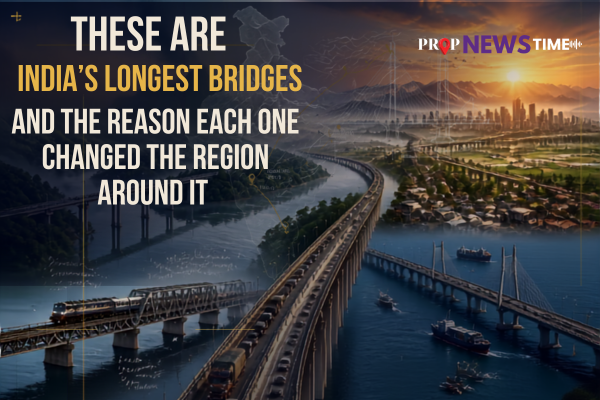
Building a bridge is often about more than crossing a river. Across India, some of the country's longest bridges have redefined how people travel, how goods move and how cities expand. They have connected islands with the mainland, shortened journeys that once took hours, strengthened border infrastructure and opened new economic opportunities for millions. Several have also become architectural landmarks, showcasing advances in engineering while overcoming challenging geographical conditions. Together, these bridges demonstrate how infrastructure can reshape entire regions, making them among India's most significant public investments.
1. Bhupen Hazarika Setu (Dhola–Sadiya Bridge), Assam
Stretching 9.15 kilometres, the Bhupen Hazarika Setu is India's longest river bridge, spanning the Lohit River, a major tributary of the Brahmaputra. Completed in 2017, it dramatically reduced travel time between Assam and Arunachal Pradesh while strengthening connectivity in India's northeastern frontier. According to the Ministry of Road Transport and Highways (MoRTH), the bridge has significantly improved civilian movement, logistics and emergency access in a strategically important region.
Beyond transportation, the bridge has boosted agricultural trade, encouraged tourism and improved access to healthcare and education for nearby communities. It is also designed to carry heavy military vehicles, making it an important strategic asset near India's eastern border. Its construction has opened up economic opportunities in previously isolated districts, demonstrating how infrastructure can accelerate regional development.
2. Atal Setu (Mumbai Trans Harbour Link), Maharashtra
At 21.8 kilometres, the Atal Setu is India's longest sea bridge and one of the country's most ambitious infrastructure projects. Connecting Sewri in Mumbai with Nhava Sheva in Navi Mumbai, it has substantially reduced travel time across Mumbai Harbour. According to the Mumbai Metropolitan Region Development Authority (MMRDA), the bridge is expected to become a catalyst for regional economic growth.
The project supports the development of Navi Mumbai International Airport, the Jawaharlal Nehru Port and surrounding industrial corridors. It is also expected to ease congestion within Mumbai while encouraging residential and commercial development across Navi Mumbai. With advanced engineering features and intelligent traffic systems, Atal Setu represents a new era in India's coastal infrastructure.
3. Bogibeel Bridge, Assam
The Bogibeel Bridge, measuring 4.94 kilometres, is India's longest combined rail-and-road bridge. Crossing the Brahmaputra River, it connects Dibrugarh and Dhemaji, significantly improving transportation across Upper Assam. According to Indian Railways, the bridge has enhanced both civilian connectivity and defence logistics in the Northeast.
It has reduced journey times by several hours while improving access to healthcare, education and commercial markets. Farmers and traders now transport agricultural products more efficiently, benefiting local economies. The bridge also strengthens connectivity to Arunachal Pradesh, making it strategically important for national security and regional integration.
4. Vikramshila Setu, Bihar
Commissioned in 2001, the Vikramshila Setu spans approximately 4.7 kilometres across the Ganga River, connecting Bhagalpur with Naugachia. For eastern Bihar, it remains one of the region's most important transportation links. According to the National Highways Authority of India (NHAI), the bridge plays a vital role in facilitating passenger and freight movement across northern Bihar.
It supports agricultural supply chains, regional trade and interstate transport while serving thousands of commuters daily. Over the years, the bridge has contributed to the economic integration of districts that were once separated by lengthy ferry journeys. Plans for parallel infrastructure also reflect its continuing importance.
5. Mahatma Gandhi Setu, Bihar
For decades, the Mahatma Gandhi Setu was India's longest river bridge, extending 5.75 kilometres across the Ganga between Patna and Hajipur. Built in 1982, it transformed transportation across Bihar by connecting the state's northern and southern regions. According to NHAI, the bridge continues to serve as one of eastern India's busiest transport corridors.
Its construction accelerated trade, improved access to educational institutions and expanded business opportunities across multiple districts. Recent rehabilitation works have significantly enhanced traffic movement and structural safety, ensuring that the bridge continues serving millions of commuters each year.
6. Dibang River Bridge, Arunachal Pradesh
Stretching approximately 6.2 kilometres, the Dibang River Bridge is among India's longest river crossings in the Northeast. It improves connectivity between remote parts of Arunachal Pradesh while supporting movement along strategically important routes. Information from the Border Roads Organisation (BRO) highlights its importance for both civilian access and defence preparedness.
The bridge reduces travel time across the Dibang River, enabling faster movement of essential supplies and public services. Improved connectivity has also encouraged tourism and facilitated economic development in remote communities that previously depended on seasonal crossings.
7. Bandra–Worli Sea Link, Mumbai
The Bandra–Worli Sea Link, measuring 5.57 kilometres, transformed travel along Mumbai's western coastline when it opened in 2009. According to MMRDA, the bridge reduced travel time between Bandra and Worli from nearly an hour during peak traffic to around 10–15 minutes under normal conditions.
Apart from easing congestion, the sea link has become an architectural icon of Mumbai. It has supported commercial growth, improved urban mobility and increased the attractiveness of western suburbs for residential and business developments. Its cable-stayed design remains one of India's engineering landmarks.
8. Arrah–Chhapra Bridge (Veer Kunwar Singh Setu), Bihar
The Veer Kunwar Singh Setu, spanning around 4.35 kilometres, connects Arrah and Chhapra across the Ganga River. According to MoRTH, the bridge has significantly shortened travel distances between western and northern Bihar.
It has improved freight movement, strengthened agricultural supply chains and enhanced access to education and healthcare. Local businesses have benefited from increased connectivity, while reduced travel times have supported tourism and regional commerce. The bridge continues to play a key role in Bihar's expanding road network.
9. Godavari Bridge (Rajahmundry), Andhra Pradesh
The Godavari Bridge at Rajahmundry remains one of India's most recognisable railway bridges. Measuring approximately 4.1 kilometres, it has served as a crucial transportation link across one of India's widest rivers. According to Indian Railways, the bridge continues supporting passenger and freight movement despite the addition of newer crossings.
It strengthened rail connectivity across coastal Andhra Pradesh and contributed to regional industrial and agricultural development. The bridge also remains an engineering landmark that played an important role in expanding southern India's railway network.
10. Naranarayan Setu, Assam
Completed in 1998, the Naranarayan Setu stretches approximately 2.3 kilometres across the Brahmaputra near Jogighopa. While shorter than several bridges on this list, it remains strategically significant because it combines both rail and road connectivity. According to Indian Railways, the bridge has substantially improved transportation across western Assam.
It facilitates movement of goods to neighbouring states, supports regional trade and strengthens connectivity to northeastern India. The bridge has also reduced dependence on ferry services, making year-round travel safer and more reliable for local communities.
India's longest bridges have done far more than connect two pieces of land. They have shortened journeys, strengthened border security, supported regional industries and unlocked new opportunities for economic growth. Whether crossing mighty rivers or vast coastal waters, these engineering marvels continue to influence how millions of people live, work and travel. As India continues investing in large-scale infrastructure, these bridges stand as lasting examples of how connectivity can reshape entire regions.
Sources: Ministry of Road Transport and Highways (MoRTH), National Highways Authority of India (NHAI), Border Roads Organisation (BRO)
Advertisement













 Facebook
 Whatsapp
