Advertisement






What really powers the cloud? Behind every Google search, A...
A lot of what defines a home isn’t visible at handover. I...
Private equity has played a significant role in shaping Indi...
Luxury real estate is one of the most talked-about segments ...
Airports play a much bigger role than just enabling travel -...
Residential real estate across India's top 11 cities is witnessing simultaneous growth in both capital values and rental yields, indicating a shift in market dynamics, according to ANAROCK Research. Covering the period from 2019 to the second quarter of 2026, the report found that stronger rental demand is now supporting rising property prices, driven by employment growth, infrastructure development and urban migration. Noida and Gurugram recorded the highest capital appreciation, while Bengaluru and Hyderabad posted the sharpest improvement in rental yields. The findings suggest that India's housing market is increasingly offering investors a combination of long-term capital appreciation and stronger rental income, reflecting improving market fundamentals across both emerging and established residential markets.
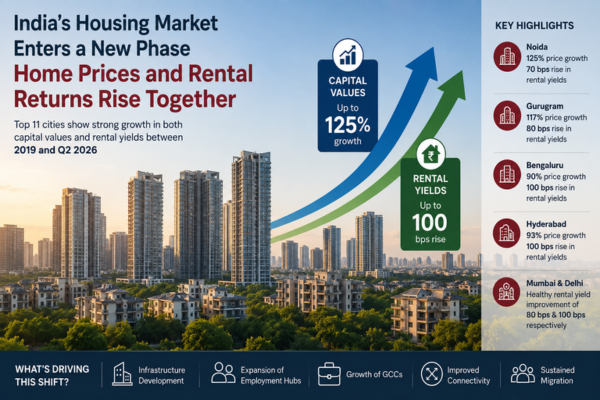
India's residential property market is showing a notable shift in investment dynamics, with home prices and rental yields rising simultaneously across the country's top 11 housing markets between 2019 and the second quarter of 2026, according to the latest ANAROCK Research report. The findings indicate that residential price growth is increasingly being supported by stronger rental demand, underpinned by employment expansion, infrastructure development and continued urban migration.
Among the cities analysed, Noida and Gurugram recorded the strongest capital appreciation during the period. Average residential prices in Noida increased by 125%, rising from INR 4,795 per sq ft in 2019 to INR 10,780 per sq ft in the second quarter of 2026. Gurugram registered a 117% increase, with average prices climbing from INR 6,150 per sq ft to INR 13,350 per sq ft over the same period.
The report noted that both markets also recorded higher rental returns despite the sharp increase in capital values. Rental yields in Noida improved from 3.2% to 3.9%, while Gurugram witnessed an increase from 3.5% to 4.3%, indicating that robust rental demand has accompanied rising property prices rather than being constrained by them.
The trend was also evident across southern markets. Bengaluru and Hyderabad registered the largest improvement in rental yields, with both cities recording a 100-basis-point increase between 2019 and the second quarter of 2026. During the same period, residential prices rose by 90% in Bengaluru and 93% in Hyderabad. ANAROCK attributed this performance to sustained employment generation, the expansion of Global Capability Centres (GCCs), continued office leasing activity and strong demand for housing from working professionals.
Established residential markets also recorded improvements in investment fundamentals. Mumbai posted a 64% rise in residential capital values while rental yields increased by 80 basis points. Delhi registered comparatively lower price appreciation of 47%, although rental yields improved by 100 basis points, reflecting strengthening rental demand in mature urban markets. Pune, Navi Mumbai and Thane also reported concurrent growth in property prices and rental returns, albeit at a more moderate pace.
According to ANAROCK, infrastructure investment, expanding employment centres, enhanced connectivity and sustained migration into major urban centres have collectively supported this trend. The report stated that improved transport infrastructure has expanded residential catchments around commercial districts, allowing new micro-markets to emerge as both residential destinations and investment locations. It further noted that economic growth drives employment, employment encourages migration, migration supports rental demand and sustained housing demand contributes to long-term capital appreciation.
Commenting on the findings, Ashok Singh Jaunapuria, Managing Director and Chief Executive Officer of SS Group, said the report highlighted the changing nature of India's residential property market. He observed that while residential investments had traditionally been driven primarily by capital appreciation, markets such as New Gurugram now demonstrated that strong price growth and healthy rental demand could coexist. He attributed this trend to the city's economic base, corporate presence and infrastructure development, which continue to attract professionals and families, sustaining both end-user purchases and rental demand.
Jaunapuria further stated that infrastructure projects, including the Dwarka Expressway, Southern Peripheral Road, the proposed Gurugram-Rewari Highway and the Delhi-Gurugram-SNB-Alwar Regional Rapid Transit System (RRTS), are expected to strengthen connectivity across New Gurugram. He added that these developments could enable investors to benefit from both capital appreciation and rental income.
The report concludes that India's residential sector is increasingly evolving beyond a capital appreciation-led investment model, with stronger rental cash flows complementing long-term value growth. For homebuyers, the trend reflects sustained end-user demand supported by economic and infrastructure development, while for investors it indicates improving investment fundamentals across the country's leading residential markets.
Advertisement













 Facebook
 Whatsapp
