Advertisement






What really powers the cloud? Behind every Google search, A...
A lot of what defines a home isn’t visible at handover. I...
Private equity has played a significant role in shaping Indi...
Luxury real estate is one of the most talked-about segments ...
Airports play a much bigger role than just enabling travel -...
The Reserve Bank of India (RBI) has kept the repo rate unchanged at 5.25% and retained its 'neutral' monetary policy stance during the third bi-monthly Monetary Policy Committee (MPC) meeting for FY27. While the real estate industry had anticipated a rate reduction to improve home loan affordability, developers and property consultants said the decision provides financial stability amid global economic uncertainty and inflationary risks. Industry stakeholders believe unchanged borrowing costs, coupled with the RBI's upward revision of India's GDP growth forecast to 6.7%, will continue to support residential demand, maintain buyer confidence and provide developers with greater financial certainty for project planning.
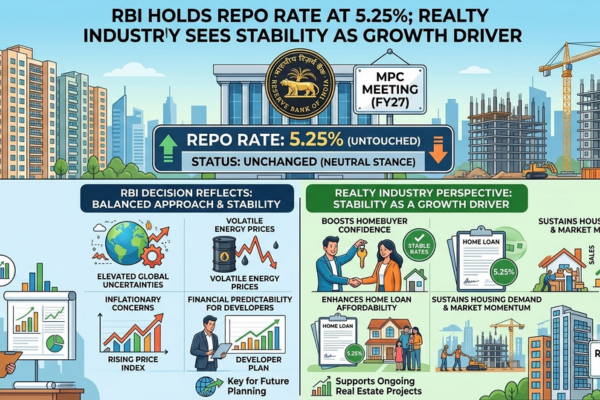
The Reserve Bank of India (RBI) has retained the repo rate at 5.25% and maintained its 'neutral' monetary policy stance during the third bi-monthly meeting of the Monetary Policy Committee (MPC) for FY27. Announced in the past week, the decision comes against the backdrop of global economic uncertainty, volatile energy prices and inflationary pressures. Although the real estate sector had expected a rate cut to improve housing affordability, industry participants said the unchanged policy rate provides stability for both developers and homebuyers.
The decision means lending rates linked to the repo rate are expected to remain broadly unchanged, allowing borrowers greater certainty over home loan repayments. Industry representatives noted that stable financing costs are likely to sustain demand across the residential market while enabling developers to plan projects with improved financial visibility.
Kamlesh Thakur, President of NAREDCO Maharashtra, said the RBI had adopted a prudent approach in balancing inflation management with economic growth amid uncertain global conditions. He observed that while the industry had hoped for lower interest rates, policy stability itself would support confidence among developers and homebuyers. He added that housing demand is expected to remain resilient, particularly in the mid-income and premium housing segments, while the RBI's upward revision of India's GDP growth forecast to 6.7% reflects the strength of the domestic economy. He also noted that moderation in inflation could create scope for a more accommodative monetary policy in the future, improving affordability and supporting investment across residential and commercial real estate.
Kaushal Agarwal, Chairman of The Guardians Real Estate Advisory, said the RBI's decision provides continuity at a time of geopolitical uncertainty and inflationary concerns. He stated that stable interest rates would keep home loan equated monthly instalments (EMIs) broadly unchanged, enabling prospective buyers to make purchasing decisions with greater certainty. He added that sustained end-user demand, rising incomes and improving economic confidence are expected to continue supporting housing demand across key markets.
Shilpin Tater, Managing Director of Superb Realty, said policy stability is important for the property sector as it allows developers to plan projects while offering buyers predictable borrowing costs. He added that demand for quality residential and commercial developments, particularly in well-connected urban locations, is expected to remain healthy, with future monetary easing potentially providing additional support for investment activity.
Shraddha Kedia-Agarwal, Director of Transcon Developers, said the RBI had adopted a measured approach by prioritising macroeconomic stability while monitoring inflation and global developments. She observed that although lower interest rates would have improved affordability, unchanged financing costs should continue supporting buyer confidence. She also noted that premium and luxury housing continue to witness healthy demand alongside sustained end-user activity in the wider residential market.
Dhruman Shah, Promoter of Ariha Group, said the decision reflects the central bank's focus on balancing economic growth with inflation management. He added that stable financing conditions, combined with continued infrastructure investment and urbanisation, are expected to support residential sales while providing developers with greater financial predictability.
Advertisement













 Facebook
 Whatsapp
