Advertisement






The Gulf conflict has disrupted global supply chains, pushed...
REITs have changed the way commercial real estate is owned a...

What does it take to preserve a real estate legacy while bui...
What really powers the cloud? Behind every Google search, A...
A lot of what defines a home isn’t visible at handover. I...
Mumbai One, the common mobility application developed by the Mumbai Metropolitan Region Development Authority (MMRDA), has crossed 1 crore cumulative ticket transactions, with 1,04,11,824 tickets booked across public transport services in the Mumbai Metropolitan Region (MMR). Launched in October 2025, the platform has recorded 8,16,402 downloads in about 10 months, with Android users accounting for 74% and iOS users for 26%. Metro services have generated the largest share of transactions, followed by suburban railway and municipal bus services. The platform currently connects 11 public transport operators and services through a single digital ticketing interface.
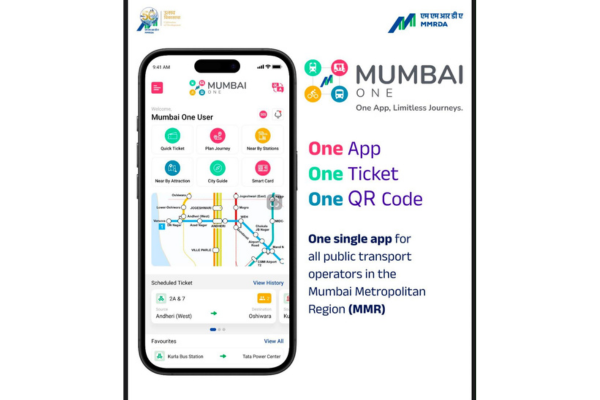
Mumbai One, MMRDA’s common mobility application, has crossed 1 crore cumulative ticket transactions, marking a major milestone for integrated digital ticketing across the Mumbai Metropolitan Region.
The platform has recorded 1,04,11,824 ticket transactions across Metro, suburban railway and municipal bus services. It was launched by Prime Minister Narendra Modi in October 2025 with the aim of bringing multiple public transport systems onto a single digital platform.
In around 10 months since its launch, Mumbai One has recorded 8,16,402 downloads. Android users account for 74% of the downloads, while iOS users make up the remaining 26%.
Metro services have contributed the largest share of ticket transactions on the platform. Metro Lines 2A, 7, 2B and 9 together recorded 30,10,554 tickets. Metro Line 1 recorded another 28,47,682 tickets, while Metro Line 3 accounted for 24,30,370 tickets.
Together, these Metro services generated 82,88,606 tickets, which is nearly 80% of the total transactions recorded through Mumbai One. Navi Mumbai Metro Line 1 added 3,38,718 tickets.
The suburban railway network recorded 15,70,906 tickets through the application. The integration gives commuters a common digital interface for journeys involving Mumbai’s suburban trains and Metro services.
The platform has also recorded transactions across municipal bus networks. BEST accounted for 1,53,323 tickets, followed by TMT with 33,706 tickets, NMMT with 16,698, MBMT with 7,553 and KDMT with 2,314 tickets.
Mumbai One currently brings together 11 public transport operators and services covering Metro, suburban railway, Monorail and municipal bus networks. The idea is to allow commuters to access different transport services without having to use separate ticketing applications for each operator.
The development comes as MMR’s public transport network continues to expand. Several Metro corridors are being added to the existing network, while connectivity is also improving between Mumbai and adjoining areas such as Thane, Mira-Bhayander and Navi Mumbai.
Chief Minister Devendra Fadnavis said the 1 crore-ticket milestone reflects the adoption of integrated mobility by commuters. He said bringing suburban railway, Metro and bus services together through one application supports the broader objective of creating a seamlessly connected MMR.
Deputy Chief Minister and MMRDA Chairman Eknath Shinde said the platform brings different transport systems together through a common ticketing system. He said the number of transactions recorded in about 10 months indicates strong commuter acceptance of the integrated approach.
MMRDA Metropolitan Commissioner Dr Sanjay Mukherjee said the milestone was primarily a result of commuters using the platform. He said the response shows that commuters are willing to use digital solutions that make travel across different public transport systems easier, and added that efforts would continue to improve the platform.
The growth in Mumbai One usage comes at a time when MMR is moving towards a larger and more interconnected public transport network. As new Metro corridors become operational, commuters are expected to increasingly combine different modes of transport during a single journey.
A common ticketing platform can make these multimodal journeys easier by reducing the need to switch between multiple applications and ticketing systems. This is particularly relevant in a region where suburban railway, Metro and bus networks operate across different parts of the metropolitan area.
The transaction figures also highlight the growing contribution of Metro services to the platform. The three major Mumbai Metro groups together account for the overwhelming majority of Mumbai One transactions, while suburban railway remains the second-largest contributor.
The inclusion of BEST, TMT, NMMT, MBMT and KDMT also extends the platform beyond rail-based transport. This gives Mumbai One a wider role in connecting different forms of public transport across the MMR rather than functioning only as a Metro ticketing application.
As MMR’s physical transport network expands, the effectiveness of its digital integration will become increasingly important. Mumbai One’s next phase will depend on bringing more commuters and services onto the platform while maintaining reliable ticketing and smooth access across operators.
Source MMRDA
Advertisement













 Facebook
 Whatsapp
