Advertisement






What really powers the cloud? Behind every Google search, A...
A lot of what defines a home isn’t visible at handover. I...
Private equity has played a significant role in shaping Indi...
Luxury real estate is one of the most talked-about segments ...
Airports play a much bigger role than just enabling travel -...
Delhi's decision to increase the Floor Area Ratio (FAR) and expand Transit-Oriented Development (TOD) norms has renewed discussions around the city's ability to accommodate higher-density development while maintaining urban liveability. The policy is intended to optimise land use and address housing demand, but urban planners and architects have highlighted the need for parallel investments in infrastructure, including water supply, sewage networks, transport systems and public spaces. They argue that higher density can only be sustained through integrated planning rather than isolated high-rise construction. Mixed-use developments with residential, commercial and open spaces are increasingly being cited as examples of how vertical growth can be combined with supporting infrastructure to create more balanced urban environments.
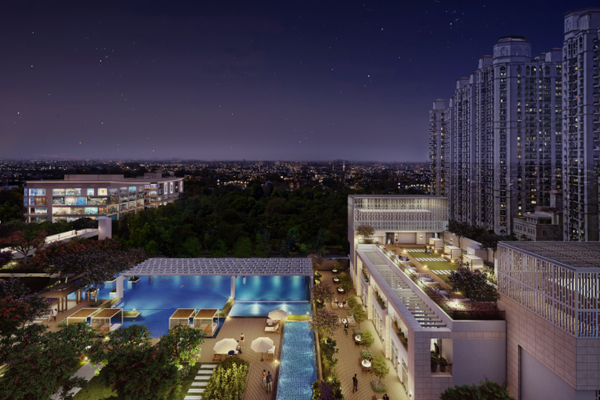
Delhi's revised urban planning framework, which provides for a higher Floor Area Ratio (FAR) and expanded Transit-Oriented Development (TOD) norms, has intensified discussions on how the Capital should accommodate future growth while ensuring that civic infrastructure keeps pace with increasing development density.
The policy seeks to optimise land utilisation and increase the supply of residential and commercial space in a city where land availability remains constrained. By permitting higher-density development, particularly around public transport corridors, the government aims to support more compact urban growth and improve access to housing and employment.
Urban planners and architects, however, have cautioned that increasing building heights alone will not address the challenges associated with rapid urbanisation. They point to the need for corresponding upgrades in water supply, sewerage systems, transport infrastructure, drainage networks and public amenities to ensure that higher-density neighbourhoods remain functional and liveable.
According to industry experts, the success of Delhi's vertical expansion strategy will depend on whether infrastructure development progresses alongside new construction. Without coordinated planning, increased residential density could place additional pressure on already constrained civic services, potentially affecting mobility, utility networks and the overall quality of urban living.
The debate has also shifted towards the design of integrated urban communities rather than standalone high-rise developments. Mixed-use projects that combine residential, commercial and recreational spaces with public amenities and open areas are increasingly being viewed as models capable of reducing dependence on external infrastructure by enabling residents to access a wider range of daily services within the same development.
Projects developed as integrated townships demonstrate how residential buildings can be planned alongside commercial facilities, landscaped open spaces, community infrastructure and transport connectivity. Such developments seek to create self-contained urban environments where housing, workplaces and recreational facilities coexist, reducing travel demand and supporting more efficient land utilisation.
As Delhi implements the revised FAR and TOD framework, the emphasis is expected to shift from simply permitting taller buildings to ensuring that higher-density developments incorporate adequate public spaces, transport integration and supporting social infrastructure. The effectiveness of the policy will ultimately depend on how future projects balance development intensity with long-term urban planning objectives.
With demand for housing and commercial space continuing to rise, Delhi's approach to vertical development is entering a new phase. The coming years are likely to determine whether higher-density construction can be supported by corresponding improvements in urban infrastructure and integrated planning, allowing the Capital to accommodate growth while maintaining the quality of its built environment.
Advertisement













 Facebook
 Whatsapp
