Advertisement






What really powers the cloud? Behind every Google search, A...
A lot of what defines a home isn’t visible at handover. I...
Private equity has played a significant role in shaping Indi...
Luxury real estate is one of the most talked-about segments ...
Airports play a much bigger role than just enabling travel -...
India's urban growth has been shaped not only by expanding cities but also by large residential townships designed as self-contained communities. Developed across thousands of acres, these projects brought together housing, schools, hospitals, workplaces and recreational spaces within a single master plan. Some emerged from industrial needs, while others were created to accommodate rising populations and changing lifestyles. From company towns to modern mixed-use developments, these townships have played an important role in redefining urban living and influencing the country's real estate landscape.
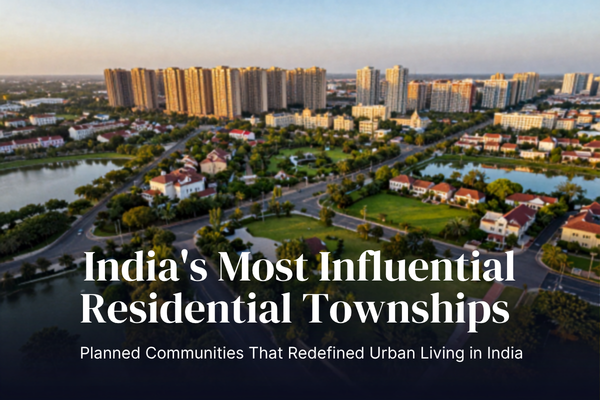
As Indian cities grew and populations increased, the need for planned communities gave rise to large residential townships that extended beyond conventional housing projects. Designed to offer a mix of homes, workplaces and social infrastructure, these developments introduced a more organised approach to urban living. Many of them were built with the aim of reducing pressure on existing cities, supporting industries or creating integrated communities where residents could access essential services within close proximity. Spread across vast areas and home to thousands of people, these townships have become important examples of how large-scale planning has shaped India's urban and residential landscape.
Jamshedpur, Jharkhand
Founded by Tata Steel in the early 20th century, Jamshedpur is widely regarded as one of India's earliest planned industrial townships. Conceived by Jamsetji Tata and developed to support the country's growing steel industry, the township was designed with housing, roads, parks, schools and hospitals at a time when such integrated planning was uncommon in India. Over the decades, it has evolved into a major urban centre while retaining its identity as a company town. Its emphasis on civic infrastructure and quality of life has made it an important example of planned urban development in the country.
Navi Mumbai, Maharashtra
Developed by the City and Industrial Development Corporation (CIDCO) in the 1970s, Navi Mumbai was envisioned as a satellite city to ease the pressure on Mumbai's overcrowded island city. Spread across multiple nodes including Vashi, Nerul, Belapur and Kharghar, it was planned with residential neighbourhoods, commercial districts, industrial areas and transport infrastructure. Today, it is home to millions of residents and continues to grow with the addition of metro rail and the upcoming Navi Mumbai International Airport. Its development demonstrated how satellite cities could help support the expansion of large metropolitan regions.
DLF City, Gurugram
DLF City played a significant role in transforming Gurugram from a largely agricultural landscape into one of India's leading business and residential destinations. Developed in phases over several decades, the township includes housing complexes, office towers, retail centres and supporting infrastructure. Its growth coincided with the rise of multinational companies and the IT sector in the National Capital Region. DLF City's integrated approach to development helped shape modern Gurugram and established a model for large-scale private urban development.
Hiranandani Gardens, Powai, Mumbai
Built on land that once consisted largely of abandoned quarries, Hiranandani Gardens changed the character of Powai and turned it into one of Mumbai's most sought-after residential locations. The township combined apartments, schools, hospitals, commercial buildings and retail spaces within a planned environment. Inspired by international urban design principles, it offered residents access to both housing and employment opportunities. Its success encouraged the development of integrated communities in other parts of the country and played a major role in redefining suburban living in Mumbai.
Magarpatta City, Pune
Magarpatta City stands out because it was developed by a group of farming families who chose to pool their land instead of selling it. Spread across hundreds of acres, the township combines residential areas, information technology parks, educational institutions and recreational facilities. The project transformed agricultural land into a self-sustaining urban community and generated long-term economic benefits for the original landowners. It is often cited as an example of community-driven development and sustainable urban planning.
Amanora Park Town, Pune
Developed on more than 400 acres, Amanora Park Town was planned as a self-contained township with housing, schools, shopping centres, offices and entertainment facilities. The project aimed to reduce dependence on the city centre by bringing daily necessities closer to residents. Its emphasis on open spaces, integrated infrastructure and mixed-use development reflected changing preferences among homebuyers seeking a live-work-play environment. The township has become one of Pune's prominent residential destinations.
Palava City, Maharashtra
Developed by Lodha Group near Mumbai, Palava City is among India's largest greenfield private townships. Spread over thousands of acres, it has been planned as a smart city with residential districts, schools, hospitals, business spaces and recreational areas. The project was conceived to address the growing demand for organised urban development in the Mumbai Metropolitan Region. With its focus on digital infrastructure and long-term planning, Palava represents a new generation of large-scale township development in India.
Shantigram, Ahmedabad
Spread across more than 600 acres, Shantigram is one of India's largest integrated township developments. Developed by Adani Realty, the project includes residential communities, educational institutions, commercial spaces and recreational facilities. Located along Ahmedabad's SG Highway corridor, it has benefited from the city's rapid economic growth and expanding infrastructure. The township reflects the increasing preference for large mixed-use communities that offer both convenience and access to modern amenities within a single development.
Large residential townships have played a significant role in India's urban growth by creating communities that extend beyond housing. From industrial settlements like Jamshedpur to modern smart developments such as Palava City, these projects have combined residential spaces with education, healthcare, employment and recreation. Their scale and integrated planning have influenced the way cities expand and how people experience urban living. As India's population and urbanisation continue to grow, township developments are expected to remain an important part of the country's residential and infrastructure landscape.
Source - Tata Steel UISL (Jamshedpur), CIDCO (Navi Mumbai), DLF Limited (DLF City), Hiranandani Group (Hiranandani Gardens), Magarpatta Township Development & Construction Co. Ltd. (Magarpatta City), City Corporation Ltd. (Amanora Park Town), Lodha Group (Palava City), Adani Realty (Shantigram), along with industry insights from Knight Frank India, JLL India, and Anarock Research.
Advertisement













 Facebook
 Whatsapp
