Advertisement






What really powers the cloud? Behind every Google search, A...
A lot of what defines a home isn’t visible at handover. I...
Private equity has played a significant role in shaping Indi...
Luxury real estate is one of the most talked-about segments ...
Airports play a much bigger role than just enabling travel -...
Mumbai's waterfront is undergoing one of its most significant transformations in decades. From the Coastal Road and Atal Setu to the INR 22,672 crore Eastern Waterfront redevelopment programme, major projects are changing how the city uses its coastline. Transport infrastructure, maritime facilities, public promenades and commercial districts are emerging alongside traditional port operations. Together, these initiatives are expanding public access, strengthening connectivity and redefining the role of Mumbai's waterfront in the city's economic and urban development story.
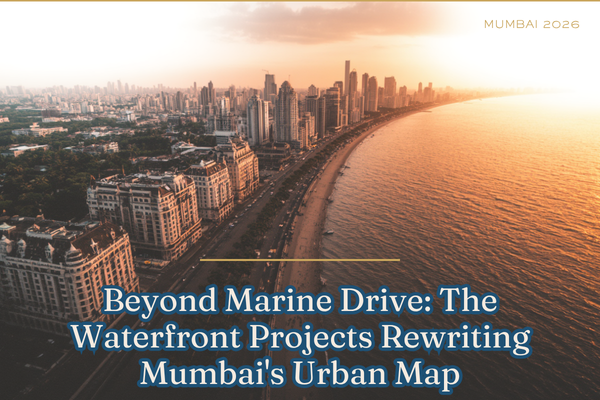
For much of its history, Mumbai's coastline was dominated by ports, industry and transport infrastructure. Today, a new generation of projects is opening stretches of the waterfront to commuters, businesses and the public. These developments are reshaping mobility, maritime activity and urban development across both the eastern and western shores.
Coastal Road Creates Mumbai's Largest New Public Waterfront
The Coastal Road is no longer just a transport corridor. The project has introduced a new 5.25-kilometre promenade between Marine Lines and Worli, creating one of Mumbai's largest public waterfront spaces. The wider master plan includes parks, cycling tracks, recreational zones and landscaped open spaces across reclaimed land. In June 2026, the Supreme Court cleared the way for development of the project's 130-acre seafront public space, removing a key hurdle for further waterfront amenities.
Eastern Waterfront Emerges as a INR 22,672 Crore Transformation Zone
The eastern seafront is moving from industrial back-end infrastructure towards mixed maritime and urban development. In February 2026, the Union Ministry of Ports, Shipping and Waterways announced a INR 22,672 crore transformation programme for the Eastern Waterfront. Plans include a marina, convention centre, cruise facilities, tourism infrastructure and commercial development while retaining core port functions. The initiative represents one of India's largest waterfront redevelopment programmes currently under implementation.
Mumbai Port Is Expanding While Redeveloping
Unlike many waterfront regeneration projects globally, Mumbai's port activity continues to grow alongside redevelopment efforts. Mumbai Port Authority recorded its highest-ever cargo throughput of 75.15 million metric tonnes during FY2025-26, reflecting the continued importance of maritime logistics within the city. Authorities are pursuing a dual-track strategy of strengthening cargo operations while unlocking underutilised waterfront land for commercial, tourism and public infrastructure.
Atal Setu Has Repositioned Mumbai Harbour
The Atal Setu has significantly altered the geography of Mumbai's waterfront by improving connectivity between Mumbai and Navi Mumbai across the harbour. The sea bridge has strengthened links between the island city, JNPA, Navi Mumbai International Airport and emerging commercial districts in the Mumbai Metropolitan Region. Its impact extends beyond mobility, reinforcing the strategic role of the harbour waterfront in regional economic activity.
Cruise Infrastructure Is Creating A New Maritime Economy
Mumbai's waterfront is increasingly serving tourism alongside trade. Investments in cruise terminals and passenger facilities are supporting the city's ambition to strengthen its position as a cruise tourism destination. Cruise infrastructure forms a key component of the Eastern Waterfront redevelopment programme, complementing existing maritime operations and creating new economic activity linked to hospitality, tourism and services.
Marine Drive's Next Chapter Is Already Underway
Even Mumbai's most iconic waterfront is being reshaped. As part of the Orange Gate-Marine Drive tunnel project, authorities are planning an extension of the promenade through reclamation works while widening surrounding road infrastructure to integrate with the new tunnel network. The project illustrates how mobility upgrades are increasingly being combined with public waterfront improvements rather than developed as standalone transport assets.
The Waterfront Is Becoming A New Commercial Frontier
Mumbai Port Authority has initiated plans to lease 28 plots across more than 217 acres along the eastern waterfront. The sites are earmarked for corporate offices, trade centres, IT parks, logistics facilities and tourism-related developments. The move signals a broader shift in how waterfront land is being utilised, with commercial and business activity becoming increasingly integrated into redevelopment plans.
Mumbai's waterfront is evolving into a network of transport corridors, maritime facilities, public spaces and commercial districts. From the Coastal Road and Atal Setu to the Eastern Waterfront programme, these projects demonstrate how infrastructure is reshaping the city's relationship with its coastline while supporting both economic activity and urban development.
Sources: Union Ministry of Ports, Shipping and Waterways announcements on the Eastern Waterfront redevelopment; Mumbai Port Authority annual reports, cargo traffic data and land monetisation plans; MMRDA, BMC and Government of Maharashtra project documents on Atal Setu, Coastal Road and Orange Gate–Marine Drive Tunnel. Media reports from The Indian Express, The Times of India, Business Standard and The Economic Times.
Advertisement













 Facebook
 Whatsapp
