Advertisement






What really powers the cloud? Behind every Google search, A...
A lot of what defines a home isn’t visible at handover. I...
Private equity has played a significant role in shaping Indi...
Luxury real estate is one of the most talked-about segments ...
Airports play a much bigger role than just enabling travel -...
Mumbai's real estate market is witnessing a shift towards decentralised growth, with emerging micro-markets increasingly driving residential and commercial activity across the Mumbai Metropolitan Region (MMR). Improved connectivity through metro rail, the Mumbai Trans Harbour Link (MTHL), the Coastal Road and other transport projects is reshaping buyer and occupier preferences beyond traditional business districts. According to ANAROCK's Residential Market Viewpoints Q2 2026 report, the average residential price in MMR reached INR 17,780 per sq. ft. during the second quarter of 2026, up 4% year-on-year, while the region recorded around 28,700 housing sales, accounting for nearly 32% of India's residential demand. Industry stakeholders say locations including Mulund, Thane, Mira Road, Sion-Matunga, Goregaon East and Andheri are emerging as key beneficiaries of this infrastructure-driven transformation.
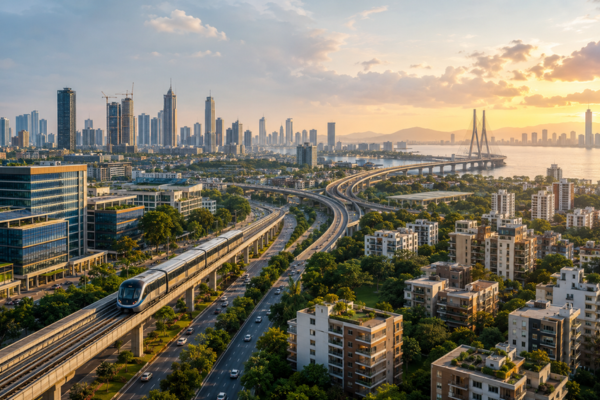
Mumbai's next phase of real estate growth is increasingly being shaped by the emergence of multiple infrastructure-led micro-markets rather than the city's traditional business districts, as improved connectivity, decentralised employment centres and redevelopment activity reshape residential and commercial demand across the Mumbai Metropolitan Region (MMR).
According to ANAROCK's Residential Market Viewpoints Q2 2026 report, the average residential price across MMR rose to INR 17,780 per sq. ft. during the second quarter of 2026, representing a 4% year-on-year increase. The report also noted that MMR remained India's largest residential market, recording nearly 28,700 housing sales during the quarter and contributing around 32% of total residential sales across the country. The consultancy attributed the region's continued expansion to the growing influence of emerging micro-markets alongside established commercial districts.
Industry participants said the city's expanding transport network, including metro rail corridors, the Coastal Road, the Mumbai Trans Harbour Link (MTHL) and several new road projects, is improving accessibility across the metropolitan region. As connectivity strengthens, homebuyers and businesses are increasingly evaluating locations based on proximity to employment hubs, social infrastructure and long-term liveability rather than traditional central business district addresses.
Mulund has emerged as one of the residential locations benefiting from this shift. Chintan Sheth, Chairman and Managing Director of Sheth Realty, said the suburb's combination of infrastructure development, established civic amenities and strong connectivity had enabled it to evolve into one of Mumbai's prominent residential growth corridors. He added that homebuyers were increasingly seeking neighbourhoods capable of delivering both quality of life and long-term value.
Developers believe similar trends are visible across other parts of MMR, with each micro-market being influenced by a different combination of infrastructure, employment generation and housing demand. Nishant Deshmukh, Founder and Managing Partner of Sugee Group, said Mumbai's growth was increasingly being distributed across multiple self-sustaining residential and commercial hubs rather than concentrated within a single business district.
Referring to Thane, Deshmukh stated that while the city had established itself as a residential destination, its commercial ecosystem was expanding alongside housing demand, with increasing requirements for Grade A office developments. He said integrating high-quality commercial projects would be essential in supporting balanced urban growth.
Along the western corridor, Mira Road continues to attract homebuyers and investors owing to improving connectivity and relatively affordable property prices. Aditya N. Shah, Director at Mayfair Housing, said the suburb's strategic location and ongoing infrastructure improvements had strengthened its long-term residential and investment appeal, positioning it among the region's emerging growth corridors.
Redevelopment is also reshaping established central Mumbai neighbourhoods. Rajendra M. Rajan, Founder of TransIndia Group, said the Sion-Matunga corridor was witnessing renewed residential interest because it combined central connectivity, established social infrastructure and contemporary housing created through redevelopment. He noted that the area's extensive transport links, heritage landmarks, recreational facilities and mature community infrastructure continued to differentiate it from newer suburban locations.
Developers also highlighted the decentralisation of Mumbai's commercial market following significant transport upgrades. Gagan Mehta, Director of AGM Vijaylaxmi Group, said improved connectivity through Metro Line 3, together with the upcoming Versova-Bandra Sea Link and the wider Coastal Road network, had accelerated the emergence of office clusters along the Andheri-Goregaon corridor while encouraging professionals to live closer to their workplaces. He added that Goregaon East was experiencing simultaneous growth in residential and commercial demand as enhanced connectivity elevated its position within Mumbai's office market.
Andheri continues to illustrate the impact of infrastructure investment on commercial real estate. Rohit Garodia, Founder and Managing Partner of Pecan Realty, said enhanced metro connectivity, upgraded road infrastructure and convenient access to the airport had strengthened the suburb's attractiveness for businesses. He added that companies were increasingly prioritising accessibility and operational convenience, reinforcing Andheri's role as one of Mumbai's leading commercial destinations.
Developers maintain that while rising property values reflect growing market confidence, the long-term success of these emerging corridors will depend on their ability to evolve into integrated urban centres where residents can access housing, employment, transport and essential social infrastructure within well-connected neighbourhoods.
Advertisement













 Facebook
 Whatsapp
