Advertisement






What really powers the cloud? Behind every Google search, A...
A lot of what defines a home isn’t visible at handover. I...
Private equity has played a significant role in shaping Indi...
Luxury real estate is one of the most talked-about segments ...
Airports play a much bigger role than just enabling travel -...
fischer has validated a seismic retrofitting solution for reinforced concrete buildings through full-scale earthquake tests conducted in collaboration with Purdue University, USA. The research focused on improving the structural performance of existing buildings constructed before modern earthquake-resistant design standards were introduced. The tested system combines bonded anchors, injection mortar and haunch elements to strengthen beam-column joints, enabling structures to better withstand seismic forces. The findings demonstrated improved structural stability and controlled load transfer under earthquake loading conditions. The company said the research supports the development of practical retrofitting solutions for ageing infrastructure, with relevance for earthquake-prone regions such as India, where strengthening existing buildings is becoming an increasingly important aspect of infrastructure resilience.
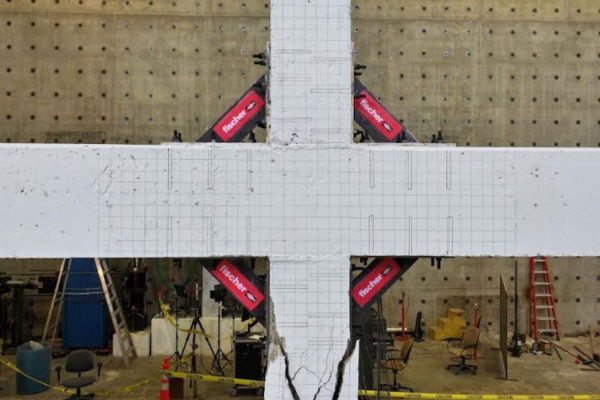
fischer has completed full-scale seismic testing of a retrofitting solution designed to improve the earthquake resistance of existing reinforced concrete buildings. The tests, undertaken in collaboration with Purdue University in the United States, evaluated a strengthening system intended for buildings constructed before the adoption of modern seismic design standards, with the objective of enhancing structural safety in earthquake-prone regions.
According to the company, around 500,000 earthquakes are recorded globally each year, citing data from the United States Geological Survey (USGS). Regions including the Pacific Ring of Fire, the Himalayas, the Mediterranean, Central America and the Caribbean remain particularly susceptible to seismic activity due to tectonic movement. The company also noted that activities such as oil and gas extraction, hydraulic fracturing, geothermal drilling and the construction of large reservoirs can induce seismic events in certain locations.
The research programme focused on the performance of beam-column joints, which are considered among the most critical structural components during an earthquake because they experience significant horizontal forces. Failure at these junctions can compromise the stability of an entire building, making them a priority for structural reinforcement.
The retrofitting system tested by fischer and Purdue University combines bonded anchors, haunch elements, fischer injection mortar and threaded rods to reinforce beam-column joints. According to the research findings, the bonded anchor system demonstrated minimal deformation under loading while effectively transferring seismic forces through adjacent structural elements. The system modifies the distribution of loads between beams and columns, allowing predefined failure mechanisms to prevent the progressive collapse of the structure during seismic events.
Dr Margaritis Tonidis, former PhD candidate at Purdue University and lead project engineer, stated that beam-column joints are subjected to particularly high stresses during earthquakes, making them essential components for assessing the effectiveness of seismic strengthening systems.
Professor Akanshu Sharma, Associate Professor at Purdue University and former Endowed Professor at the Institute of Materials Science at the University of Stuttgart, said the injection mortar performed as a reliable adhesive anchor for post-installed structural strengthening under high seismic demands. He noted that comparative testing showed substantially greater damage in unstrengthened beam-column joints, while structures reinforced with the fischer system demonstrated improved performance under simulated seismic loading. He also stated that the bonded anchor system can be installed while buildings remain occupied, reducing disruption during retrofit works.
Dr Erik Johannes Stehle, Head of Development FiXperience at fischer, said the project provided an opportunity to evaluate previous research under realistic conditions. He added that the testing confirmed the importance of anchorage performance in seismic retrofitting, with the bonded anchor system demonstrating high rigidity and limited deformation under significant structural loads.
The research was carried out through collaboration between fischer and Purdue University, with both organisations highlighting the role of international partnerships in advancing structural engineering. Professor Sharma noted that the project included what the collaborators described as the first full-scale seismic test using a post-installed reinforcement solution with haunch elements for beam-column joints.
Commenting on the relevance of the technology for India, Mayank Kalra, Managing Director of fischer India, said several parts of the country are vulnerable to seismic activity despite the adoption of modern earthquake-resistant design practices in new construction. He stated that strengthening existing buildings remains equally important and added that the validated retrofitting solution could help improve structural safety, extend the operational life of ageing infrastructure and support the development of more resilient urban environments.
Advertisement













 Facebook
 Whatsapp
