Advertisement






The Gulf conflict has disrupted global supply chains, pushed...
REITs have changed the way commercial real estate is owned a...

What does it take to preserve a real estate legacy while bui...
What really powers the cloud? Behind every Google search, A...
A lot of what defines a home isn’t visible at handover. I...
Kolkata's growth has been inseparable from the bridges that span the Hooghly River, connecting the city with Howrah and beyond. From the first permanent crossing at Vivekananda Setu to the iconic Howrah Bridge, the elegant Vidyasagar Setu and the modern Nivedita Setu, each structure was built to solve the challenges of its time. Together, these bridges transformed trade, transport and urban expansion, making them far more than engineering landmarks they became the backbone of one of India's oldest and busiest metropolitan regions.
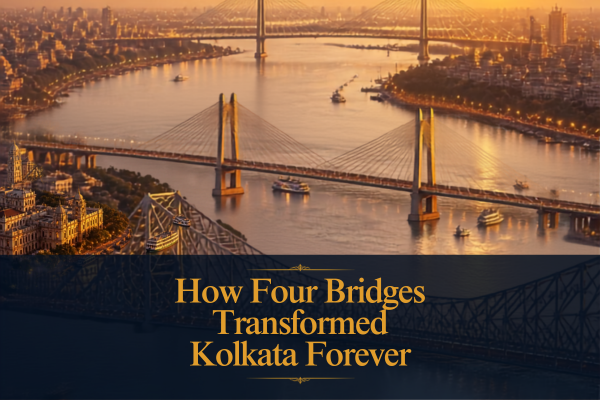
Every great city has landmarks that define its identity, but some of the most important are those people use every day without a second thought. In Kolkata, that distinction belongs to the bridges crossing the Hooghly River. They have carried millions of commuters, connected industries with ports, enabled neighbourhoods to expand and supported the city's transformation from a colonial trading hub into a modern metropolis. Built across different decades and under very different circumstances, each bridge tells a story of engineering ambition, economic necessity and urban evolution.
Vivekananda Setu: The city's first permanent link
Before Kolkata had a permanent bridge across the Hooghly, movement between the two banks relied largely on ferries and a floating pontoon bridge. That changed in 1931 with the opening of Vivekananda Setu, then known as Willingdon Bridge. Connecting Bally in Howrah with Dakshineswar in Kolkata, it became the city's first permanent river crossing and one of India's earliest road-and-rail bridges. The structure significantly improved connectivity for industries located around Howrah and Bally, allowing goods and passengers to move more efficiently while strengthening links with Kolkata's commercial districts and port.
Howrah Bridge: The symbol of Kolkata
No bridge is more closely associated with Kolkata than the Howrah Bridge, officially renamed Rabindra Setu in 1965. Opened in 1943 during the Second World War, the cantilever bridge replaced the ageing pontoon crossing that had become inadequate for the city's rapidly growing traffic. Built largely with steel produced in India, the bridge was a remarkable engineering achievement for its time. Decades later, it continues to rank among the busiest cantilever bridges in the world, carrying enormous volumes of vehicles and pedestrians every day while remaining one of Kolkata's most recognisable landmarks.
Vidyasagar Setu: Meeting the demands of a growing metropolis
By the second half of the twentieth century, traffic volumes had increased to a point where a single major crossing could no longer support Kolkata's expanding population and economy. To ease congestion, construction of Vidyasagar Setu began after years of planning, with the bridge finally opening to traffic in 1992. Named after social reformer Ishwar Chandra Vidyasagar, it became India's first cable-stayed bridge and remained the country's longest of its kind for several years. Its elegant profile and strategic location created an additional high-capacity corridor between Kolkata and Howrah, significantly reducing pressure on Howrah Bridge.
Nivedita Setu: A modern solution for modern traffic
As traffic continued to rise, even Vivekananda Setu began showing signs of age after decades of heavy use. To accommodate growing vehicle volumes, Nivedita Setu was constructed just downstream and inaugurated in 2007. Designed as India's first single-plane cable-stayed extradosed bridge, it was engineered to handle heavier traffic while preserving the visual prominence of the nearby Dakshineswar Kali Temple. The new crossing enabled the older Vivekananda Setu to continue serving lighter traffic while ensuring smoother movement along one of the region's busiest transport corridors.
More than bridges: Catalysts of urban growth
Each of Kolkata's major bridges was built to solve a pressing challenge, whether replacing outdated infrastructure, supporting industrial expansion or easing growing congestion. Yet their impact extended far beyond transportation. They influenced patterns of urban development, encouraged investment, improved access to employment and strengthened connections between residential neighbourhoods, manufacturing centres and trade hubs. Together, they reshaped the metropolitan region's geography and economic landscape.
The story of modern Kolkata cannot be told without its bridges. Each generation responded to the limitations of the previous one by building a stronger, larger or more efficient crossing across the Hooghly. What began with a single permanent bridge evolved into a network that keeps one of India's busiest metropolitan regions moving. While they are often admired for their engineering and architecture, these structures have played an even greater role as silent enablers of Kolkata's commerce, culture and daily life, continuing to bind the city together one crossing at a time.
Advertisement













 Facebook
 Whatsapp
