Advertisement






What really powers the cloud? Behind every Google search, A...
A lot of what defines a home isn’t visible at handover. I...
Private equity has played a significant role in shaping Indi...
Luxury real estate is one of the most talked-about segments ...
Airports play a much bigger role than just enabling travel -...
From Brazil's ambitious inland capital to India's post-Partition administrative centre, governments have occasionally chosen to build entirely new cities instead of expanding existing ones. Brasília, Chandigarh, Naypyidaw and Masdar City were each conceived to fulfil a specific national objective, whether political, administrative or environmental. While their architectural visions differed, all four projects became large-scale experiments in planned urban development. Their journeys reveal the opportunities and challenges of creating cities from a blank canvas, where ambitious masterplans often evolve differently once people begin to live, work and grow within them.
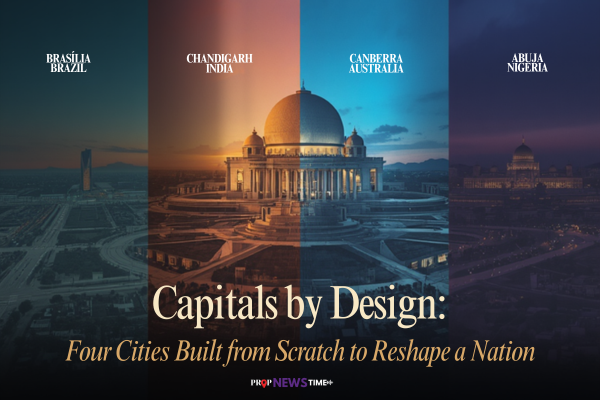
Most of the world's great cities have evolved gradually over centuries, shaped by trade, migration and culture. A select few, however, began with a blueprint rather than history. Designed from the ground up, these planned capitals were created to achieve a single national goal moving a political centre, rebuilding administrative identity or demonstrating a new model of sustainable urban development. Brasília in Brazil, Chandigarh in India, Naypyidaw in Myanmar and Masdar City in the United Arab Emirates stand among the most prominent examples. Though separated by geography and decades, each offers valuable lessons on how vision, planning and reality intersect in city building.
Brasília: Brazil's bold move to the interior
Brasília was conceived to shift Brazil's political and economic focus away from the crowded Atlantic coast and towards the country's interior. Commissioned by President Juscelino Kubitschek in the 1950s, the city was masterplanned by urban planner Lúcio Costa, while architect Oscar Niemeyer designed its monumental government buildings. Completed in just over three years and inaugurated in 1960, Brasília became a global symbol of modernist planning and was later recognised as a UNESCO World Heritage Site. Despite its architectural acclaim, the rapid construction programme also exposed challenges, including uneven development and limited housing for the workforce that built the city.
Chandigarh: India's post-Partition capital
Following the Partition of India in 1947, Punjab lost its historic capital, Lahore, to Pakistan. To establish a new administrative centre, the Indian government commissioned Chandigarh as an entirely planned city. Swiss-French architect Le Corbusier led the design after an earlier planning team withdrew, creating a city organised into self-contained sectors linked by a carefully structured road hierarchy. The Capitol Complex remains one of Le Corbusier's most celebrated works and is now part of UNESCO's World Heritage listing. Chandigarh continues to be regarded as one of India's most successful examples of planned urban development, balancing governance, residential neighbourhoods and public spaces.
Naypyidaw: Myanmar's administrative shift
Myanmar surprised much of the world in 2005 by relocating its capital from Yangon to the newly built city of Naypyidaw. Developed primarily as an administrative and political centre, the city features expansive government complexes, wide boulevards and extensive infrastructure built well in advance of population growth. While the relocation achieved the government's objective of establishing a new seat of administration, the city has frequently drawn attention for its unusually broad roads, low population density and vast public spaces that remain underutilised compared with older urban centres.
Masdar City: A blueprint for sustainable living
Unlike the other three cities, Masdar City was not designed as a national capital but as a model for sustainable urban development. Announced by Abu Dhabi in 2006, the project was planned by Foster and Partners with the ambitious vision of creating one of the world's first zero-carbon, zero-waste cities. The masterplan incorporated renewable energy systems, energy-efficient buildings, shaded streets and innovative transport concepts, including driverless personal rapid transit vehicles. Although the project's original completion target and investment estimates have since been revised, Masdar City continues to serve as a global testing ground for sustainable technologies and climate-responsive urban planning.
A shared lesson in planned urban development
Despite their different purposes, these four cities reveal common themes. Each was backed by strong political intent, guided by renowned planners or architects and supported by substantial public investment. Yet every project also encountered practical realities that altered its original trajectory. Construction timelines extended, costs evolved and patterns of occupation differed from initial expectations. The experience of these cities demonstrates that while masterplans can shape infrastructure and governance, the character of a city ultimately emerges through the people who inhabit it.
Brasília, Chandigarh, Naypyidaw and Masdar City illustrate four distinct approaches to building a city from scratch, each reflecting the priorities of its era. Whether driven by national integration, administrative necessity or environmental innovation, these planned settlements remain important case studies in urban development. Their stories show that creating a city involves far more than constructing buildings—it requires adapting ambitious designs to changing economic realities, social needs and the unpredictable ways in which communities evolve over time.
Sources UNESCO World Heritage Centre, BBC News, Chandigarh Administration, Fondation Le Corbusier, Masdar City site, Reuters and The National
Advertisement













 Facebook
 Whatsapp
