Advertisement






What really powers the cloud? Behind every Google search, A...
A lot of what defines a home isn’t visible at handover. I...
Private equity has played a significant role in shaping Indi...
Luxury real estate is one of the most talked-about segments ...
Airports play a much bigger role than just enabling travel -...
India is home to architectural wonders that go far beyond grand palaces and modern skyscrapers. Hidden across forests, mountains and rocky landscapes are extraordinary homes that have been carved into caves, built around ancient trees or seamlessly blended into hillsides. Many were created centuries ago, while others are modern marvels inspired by nature. These unique homes tell stories of survival, tradition, craftsmanship and sustainable living. Here are eight remarkable Indian homes that prove some of the country's most fascinating residences are those built in harmony with nature.
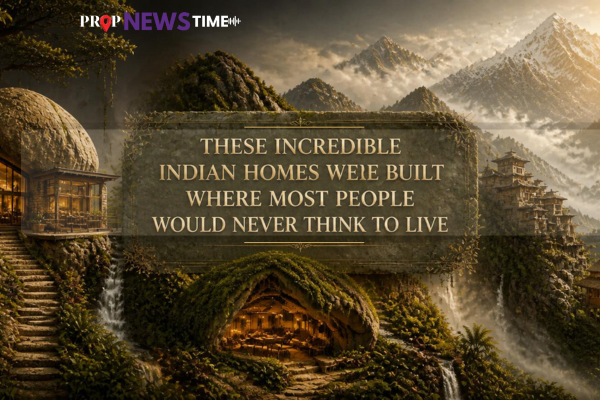
When we think of remarkable homes, glass villas and luxury penthouses often come to mind. But across India, there are homes that challenge every idea of conventional architecture. Some are carved directly into massive rock formations, others are tucked into mountain slopes, while a few have grown around centuries-old trees instead of cutting them down. These extraordinary homes are not simply architectural curiosities they are stories of adaptation, heritage and a deep respect for nature. Every wall, courtyard and pathway reflects the landscape that shaped it. Here are eight incredible Indian homes where nature wasn't an obstacle it became part of the blueprint.
1. The Rock House, Hyderabad
Long before sustainable architecture became a global trend, a remarkable home in Hyderabad embraced the city's ancient granite landscape instead of replacing it. The Rock House was designed around massive boulders estimated to be billions of years old, allowing the natural rock formations to become part of the living spaces rather than being removed.
Walking through the home feels like exploring a landscape where architecture and geology coexist. Natural stone walls, open courtyards and thoughtfully designed interiors blur the line between indoors and outdoors, creating a residence that celebrates Hyderabad's unique rocky heritage instead of hiding it.
2. Cave House, Arambol, Goa
Hidden away near Goa's northern coastline is a cave-inspired residence that appears almost invisible from a distance. Built into the natural contours of the hillside, the home uses earth-covered walls and locally sourced materials to stay naturally cool throughout the year.
Instead of dominating the landscape, the structure quietly becomes part of it. Surrounded by dense greenery and overlooking the Arabian Sea, the home offers a peaceful retreat where birdsong replaces city traffic and nature shapes everyday life.
3. Stone House, Spiti Valley, Himachal Pradesh
High in the cold deserts of Spiti Valley, traditional homes have been built into mountain slopes for centuries to survive one of India's harshest climates. Thick stone walls, compact interiors and flat mud roofs help protect families from freezing winters and strong Himalayan winds.
Every part of these homes reflects generations of practical wisdom. Rather than standing apart from the mountains, they appear to emerge from them, creating villages that blend almost seamlessly into the rugged Himalayan landscape.
4. Living Root Homesteads, Meghalaya
In parts of Meghalaya, homes are often built alongside ancient rubber trees whose sprawling roots have shaped village life for generations. Instead of clearing forests, communities have learned to live around them, creating settlements where nature remains the central feature.
Many houses are carefully planned to preserve existing trees, allowing roots, canopies and surrounding vegetation to remain untouched. The result is a landscape where homes and forests have evolved together, reflecting the region's deep connection with its natural environment.
5. Mountain Homes of Kalpa, Himachal Pradesh
The village of Kalpa is known for traditional wooden and stone homes built directly into steep mountain terrain overlooking the Kinnaur Kailash range. These residences use local deodar wood and stone to withstand heavy snowfall while remaining warm during long winters.
Generations of families have adapted their homes to the mountains rather than trying to reshape them. Narrow pathways, terraced layouts and panoramic Himalayan views make these homes feel like natural extensions of the landscape itself.
6. Rock-Cut Homes Near Badami, Karnataka
The rocky terrain surrounding Badami has inspired architecture for centuries. While the region is famous for its ancient cave temples, several traditional dwellings in nearby villages continue to utilise natural rock formations as part of their construction.
Large boulders often serve as structural walls or protective barriers, reducing the need for additional building materials. These homes reflect an age-old understanding of the landscape, where architecture responds to the environment rather than competing with it.
7. Hillside Homes of Ziro Valley, Arunachal Pradesh
Nestled among the rolling hills of Ziro Valley, traditional tribal homes are built along mountain slopes using bamboo, timber and locally available materials. Elevated on stilts, they adapt perfectly to the uneven terrain while protecting against moisture and seasonal rains.
These homes showcase sustainable building practices that have been refined over centuries. Their simple design, surrounded by forests and terraced fields, highlights how indigenous communities have long balanced comfort with environmental harmony.
8. The Whispering Rocks House, Lonavala, Maharashtra
Hidden within the hills near Lonavala is a contemporary residence designed to preserve the site's natural rock formations. Instead of flattening the terrain, architects incorporated enormous basalt boulders into courtyards, gardens and interior spaces.
The result is a home where nature remains the main attraction. Large glass openings frame the surrounding hills, while exposed rocks become part of the living experience, demonstrating how modern architecture can work with the landscape instead of against it.
India's most extraordinary homes aren't always found in luxury neighbourhoods or towering skylines. Sometimes they're hidden inside mountains, shaped by ancient rocks or built around trees that have stood for centuries. These remarkable residences remind us that great architecture isn't just about design it's about understanding the land, respecting nature and allowing the environment to become part of the story. In a rapidly urbanising world, these homes continue to prove that living with nature can be just as inspiring as living above it.
Sources: Indian National Trust for Art and Cultural Heritage, Laurie Baker Centre for Habitat Studies
Advertisement













 Facebook
 Whatsapp
