Advertisement






What really powers the cloud? Behind every Google search, A...
A lot of what defines a home isn’t visible at handover. I...
Private equity has played a significant role in shaping Indi...
Luxury real estate is one of the most talked-about segments ...
Airports play a much bigger role than just enabling travel -...
Buildings account for nearly 37% of global energy- and process-related carbon emissions, placing the real estate sector at the centre of climate and resource-efficiency discussions worldwide. In India, sustainability is increasingly influencing how projects are designed, constructed and operated, with developers adopting measures ranging from energy-efficient systems and water conservation technologies to low-carbon materials and renewable energy solutions. Sustainable real estate is no longer limited to obtaining green certifications; it is becoming a broader approach to reducing environmental impact, improving operational efficiency and enhancing occupant well-being. Understanding its scope is essential as sustainability becomes an increasingly important consideration across the property sector.
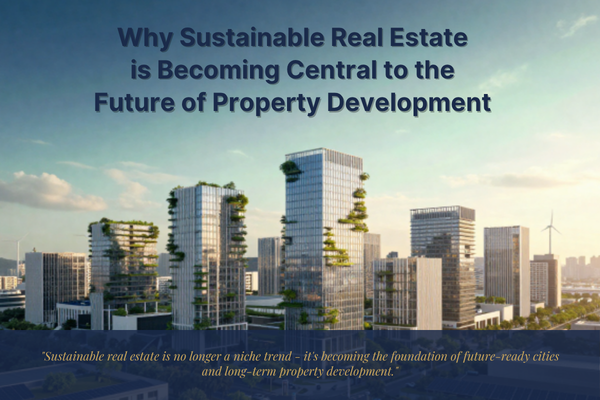
The buildings people live, work and shop in have become a critical part of the global sustainability conversation. According to the World Green Building Council, buildings account for approximately 37% of energy- and process-related carbon emissions worldwide, making the built environment one of the largest contributors to climate-related impacts.
For the real estate industry, this has created a challenge that extends beyond environmental responsibility. Buildings consume vast amounts of electricity and water throughout their lifecycle, generate construction and demolition waste, and influence the health and productivity of the people who occupy them. As a result, sustainability is increasingly being viewed not as an optional feature but as a core component of modern real estate development.
The shift is visible across India's property market. Developers are incorporating solar power systems, rainwater harvesting infrastructure, energy-efficient cooling technologies and recycled construction materials into projects that would have been considered conventional a decade ago. Corporate occupiers are also placing greater emphasis on environmental performance when selecting office space, while investors are paying closer attention to sustainability credentials as part of their decision-making process.
This evolving approach has given rise to what is broadly described as sustainable real estate.
What exactly is sustainable real estate?
At its core, sustainable real estate refers to the development, construction, operation and management of buildings in a way that reduces environmental impact while improving the efficient use of resources over the life of an asset.
The concept extends far beyond installing solar panels or securing a green certification. It influences decisions ranging from building orientation and material selection to water management, energy consumption, indoor air quality and waste disposal. The objective is to create assets that consume fewer resources, generate lower emissions and provide healthier spaces for occupants without compromising functionality or economic viability.
In practical terms, a sustainable building is designed to use less energy, conserve water, minimise waste and reduce reliance on carbon-intensive materials. Increasingly, developers are also focusing on occupant comfort through measures such as improved ventilation, natural daylight access and the use of low-emission materials that contribute to better indoor air quality.
Sustainability is not a new idea
While sustainable real estate is often associated with modern technologies and certification systems, many of its underlying principles have existed for centuries.
Traditional Indian architecture frequently incorporated courtyards, shaded spaces, thick walls and natural ventilation to manage heat and improve comfort without mechanical cooling systems. According to Deben Moza, Senior Executive Director at Knight Frank India, sustainability has been ingrained in Indian building practices for generations. He notes that traditional structures often relied on materials such as rammed earth and lime mortar, while design elements prioritised ventilation and climatic responsiveness long before sustainability became a formal industry concept.
What has changed is the scale of urbanisation, the growing pressure on natural resources and the availability of technologies capable of improving building performance.
The four pillars of sustainable real estate
Although sustainability strategies vary across projects, most green developments are built around four key pillars: energy efficiency, water conservation, sustainable materials and occupant well-being.
Energy efficiency and carbon reduction
Energy consumption remains one of the largest environmental challenges associated with buildings. Consequently, reducing energy demand is often the starting point for sustainable design.
Developers are increasingly using passive design strategies such as optimising building orientation, reducing solar heat gain through high-performance glazing and reflective surfaces, and maximising access to natural daylight. These measures reduce dependence on artificial lighting and air-conditioning systems while improving occupant comfort.
The impact can be substantial. High-efficiency HVAC systems, variable refrigerant flow technology, LED lighting and occupancy sensors can reduce building energy consumption by 30% to 50% compared with conventional developments. Variable Voltage Variable Frequency (VVVF) elevators, now common in modern commercial projects, can deliver energy savings of up to 40% during operation.
Renewable energy is becoming another important component of the equation. Large residential and mixed-use developments are increasingly integrating rooftop solar installations and solar water-heating systems, reducing dependence on grid electricity while lowering long-term operating costs.
Advertisement













 Facebook
 Whatsapp
