Advertisement






What really powers the cloud? Behind every Google search, A...
A lot of what defines a home isn’t visible at handover. I...
Private equity has played a significant role in shaping Indi...
Luxury real estate is one of the most talked-about segments ...
Airports play a much bigger role than just enabling travel -...
Before India’s cities became defined by glass towers, metro networks and dense skylines, urban life was slower, more personal and deeply community-driven. Streets were less congested, homes were mostly low-rise, and neighbourhoods shaped everyday routines more than infrastructure did. From industrial centres like Coimbatore and Nagpur to emerging state capitals such as Bhubaneswar and Raipur, most cities were still evolving at ground level. This list revisits 10 Indian cities and how life, culture and movement functioned before skyscrapers reshaped their identity.
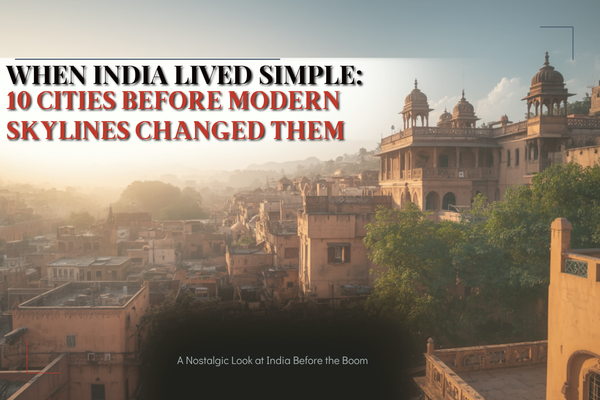
India’s urban transformation is often measured in skylines today, but just a few decades ago, its cities functioned in a completely different rhythm. Life unfolded at street level—closer homes, shorter commutes and stronger neighbourhood bonds defined everyday existence.
Before vertical expansion changed how cities looked and behaved, urban India was quieter, slower and far more rooted in local communities.
1. Mumbai Suburbs (Bandra–Andheri Belt)
Before high-rise towers dominated the skyline, Bandra and Andheri were a mix of fishing villages, open plots and scattered low-rise homes. Large parts of the suburbs were still developing, and the sea-facing landscape felt more accessible and less crowded.
Daily life revolved around walking routes, BEST buses and local trains, with neighbourhood shops forming the centre of social interaction. Markets were deeply personal, where shopkeepers and residents shared long-standing relationships. According to Mumbai urban heritage archives, this era reflected a city where community identity mattered more than real estate height.
2. Hyderabad, Telangana
Before IT corridors and modern skyscrapers, Hyderabad was anchored in its Old City, where narrow lanes and heritage markets shaped daily life. Low-rise residential clusters surrounded cultural and historical landmarks.
Commerce, culture and community life revolved around bazaars near Charminar, where trade and tradition blended seamlessly. According to Telangana State Archives, the city’s earlier structure was compact and culturally dense, with limited expansion beyond its historic core and minimal modern vertical development.
3. Ahmedabad, Gujarat
Before large-scale redevelopment, Ahmedabad was primarily a textile-driven industrial city. Mill compounds, workshops and trade centres defined its economic rhythm, while housing remained closely tied to work zones.
Neighbourhoods were tightly knit, with daily life revolving around factories and local markets rather than corporate offices. Gujarat State Archives note that the city functioned as a manufacturing ecosystem, where community and industry were physically and socially interconnected at ground level.
4. Kolkata, West Bengal
Before modern redevelopment reshaped parts of the city, Kolkata was a dense but largely low-rise urban centre defined by colonial architecture and tram networks. The skyline was dominated by heritage buildings rather than commercial towers.
Life revolved around cultural institutions, neighbourhood cafés and street markets that served as social hubs. According to West Bengal State Archives, the city retained a strong horizontal identity where history and daily life blended into a uniquely layered urban experience.
5. Indore, Madhya Pradesh
Before emerging as a modern urban benchmark, Indore was a traditional trading town known for its strong commercial bazaars like Sarafa. Economic life was built around local merchants and regional trade routes.
Residential areas were modest and low-rise, with most people living close to business centres. According to Madhya Pradesh urban development records, Indore’s early identity was shaped by commerce and community networks rather than infrastructure-led expansion or skyline growth.
6. Bhubaneswar, Odisha
Before its planned urban expansion, Bhubaneswar was largely a temple-centric town with scattered settlements and open land. Daily life moved at a calm pace, deeply influenced by heritage and religious activity.
Housing was simple and low-rise, spread across small clusters connected by basic road infrastructure. Odisha State Archives highlight that the city’s earlier identity was defined more by culture and spirituality than by commercial or vertical urban development.
7. Nagpur, Maharashtra
Before becoming a logistics and central India hub, Nagpur was a modest regional city known for its orange trade and railway junction importance. The city had wide open stretches and minimal vertical construction.
Life was shaped by seasonal trade, railway movement and local markets that served nearby regions. According to Maharashtra regional planning records, Nagpur’s early urban structure was functional and spread out, with a calm pace of life compared to today’s expanding cityscape.
8. Coimbatore, Tamil Nadu
Before evolving into a major industrial centre, Coimbatore was a quieter manufacturing town built around textiles and small engineering units. Factory-based communities played a central role in shaping daily routines.
Neighbourhoods were low-rise and closely connected to workplaces, reducing travel distances significantly. According to Tamil Nadu industrial archives, the city’s identity was once deeply rooted in production ecosystems and strong worker communities before modern commercial growth reshaped parts of it.
9. Raipur, Chhattisgarh
Before state formation accelerated its growth, Raipur was a small administrative town with limited infrastructure and low-rise development. It primarily served governance and regional coordination functions.
Daily life was simple, with compact neighbourhoods and minimal commercial expansion. According to Chhattisgarh State planning archives, Raipur’s early urban character was modest and functional, with growth concentrated around administrative needs rather than large-scale urbanisation.
10. Chennai, Tamil Nadu
Before modern expansion and IT corridors, Chennai was a coastal city defined by open landscapes, colonial planning and low-rise residential zones. Marina Beach and surrounding areas were far less urbanised than today.
Neighbourhood life played a central role, with markets, temples and local transport shaping routines. According to Tamil Nadu State Archives, the city’s earlier structure prioritised community-based living and functional zoning over vertical expansion.
Before skyscrapers reshaped India’s urban identity, cities were defined by closeness, simplicity and community interaction. Life was slower, movement was easier, and neighbourhoods played a far stronger role in daily existence. As India continues its rapid vertical growth, these glimpses into the past highlight just how dramatically its cities,and the lives within them have transformed over time.
Sources Referenced: Government of India Urban Development Historical Studies, Mumbai Urban Heritage Archives, Gujarat State Archives (Urban Development Records), Maharashtra Regional Planning Records, Tamil Nadu Industrial & Urban Archives
Advertisement













 Facebook
 Whatsapp
