Advertisement






What really powers the cloud? Behind every Google search, A...
A lot of what defines a home isn’t visible at handover. I...
Private equity has played a significant role in shaping Indi...
Luxury real estate is one of the most talked-about segments ...
Airports play a much bigger role than just enabling travel -...
Long before apartments and gated communities became India's default address, every region developed its own idea of home. Some were designed to withstand earthquakes, others cooled entire households without electricity, while a few functioned like miniature cities for joint families. Today, these remarkable home types are disappearing as lifestyles change and urbanisation accelerates. Yet scattered across India, a handful still survive preserved in heritage villages, palaces, museums, and family estates. These are not just old houses; they are living blueprints of a forgotten way of life and a reminder that architecture once evolved with climate, culture, and community.
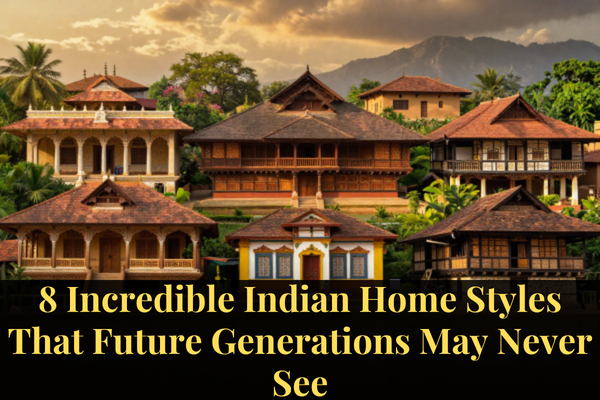
Before identical apartment blocks and glass towers became the norm, Indian homes reflected the landscapes, climates, and lifestyles around them. A house was more than four walls and a roof it was a carefully crafted ecosystem. Courtyards brought in light and rainwater, thick walls kept rooms cool, and entire communities lived within spaces designed for togetherness. Over time, changing family structures, rising land prices, and modern construction practices pushed many of these traditions to the brink. Yet a few remarkable examples still survive, offering a glimpse into a time when homes were designed to work with nature rather than against it.
1. Pol Houses, Gujarat
Hidden inside the old quarters of Ahmedabad are the famous Pol houses, compact residential clusters that emerged during periods of political uncertainty in the 18th century. Built around narrow lanes and shared courtyards, these homes created entire neighbourhoods protected by common gates and secret exits. Shared walls helped keep interiors cool, while bird feeders, wells, temples, and communal spaces encouraged a strong sense of community. Although many residents have moved away and several structures have been replaced, hundreds still survive within the UNESCO-listed old city. Areas such as Mandvi ni Pol and Lambeshwar ni Pol offer some of the finest surviving examples of this unique urban design.
2. Nalukettu Houses, Kerala
Traditional Kerala homes were designed around the idea of family and climate. The Nalukettu, literally meaning "four blocks", consists of rooms arranged around an open courtyard called the nadumuttam, allowing natural light and ventilation to flow throughout the house. Built largely from teak and jackfruit wood, these homes comfortably housed generations under one roof. Wealthier families expanded them into larger Ettukettus and Pathinarukettus with multiple courtyards. Rising costs, shrinking family sizes, and the disappearance of skilled craftsmen have made such houses increasingly rare, though beautifully preserved examples can still be found in Thrissur, Palakkad, Kottayam, and heritage properties around Kumarakom.
3. Chettinad Mansions, Tamil Nadu
Among India's grandest residences are the Chettinad mansions built by the prosperous Nattukottai Chettiar merchant community between the 19th century and World War II. These sprawling homes combined local Tamil architecture with materials sourced from across the globe, including Burma teak, Belgian glass, Italian marble, and Athangudi tiles. Multiple courtyards, intricately carved doors, and enormous halls once accommodated large joint families. Economic changes and migration gradually emptied many of these mansions, leaving thousands abandoned. However, towns like Karaikudi and Kanadukathan still retain magnificent examples, some of which have been restored into heritage hotels and museums.
4. Wadas, Maharashtra
The Wada was the architectural symbol of the Maratha era, flourishing under the Peshwas and their successors. These multi-storeyed homes were organised around a sequence of courtyards that separated public, semi-private, and family spaces, creating an elegant balance between hospitality and privacy. A visitor could move only as far into the house as social customs permitted. With the decline of the joint family system and the fragmentation of inherited properties, many Wadas have fallen into neglect. Yet structures such as Vishrambaug Wada and Nana Wada in Pune, along with several surviving riverside Wadas in Wai, continue to showcase this distinctive style.
5. Rajbaris, West Bengal
Once the residences of Bengal's zamindars, Rajbaris represented wealth, power, and cultural refinement. These palatial mansions combined European influences with Bengali traditions and often included music halls, ceremonial courtyards, and grand reception areas. After the abolition of the zamindari system and the economic decline of aristocratic families, many Rajbaris slipped into decay. Their fading glory inspired works such as Satyajit Ray's Jalsaghar, which immortalised the decline of Bengal's landed elite. Today, restored properties such as Rajbari Bawali and Itachuna Rajbari allow visitors to experience a world that once dominated Bengal's social landscape.
6. Indo-Portuguese Houses, Goa
Goa's historic homes tell stories of a global past shaped by Portuguese influence and maritime trade. Distinguished by colourful facades, large balconies, private chapels, and translucent oyster-shell windows that filtered sunlight beautifully, these residences blended European aesthetics with tropical Indian practicality. Many belonged to affluent Catholic families whose connections stretched from Lisbon to Mozambique and Macau. Migration and real estate pressures have caused numerous houses to disappear, but villages like Chandor, Loutolim, and Batim still preserve some remarkable examples, including the famous Menezes Braganza House and Casa Menezes.
7. Kath-Kuni Houses, Himachal Pradesh
In the mountains of Himachal Pradesh, generations perfected a building technique that modern engineers still admire. Kath-Kuni houses were constructed by stacking alternating layers of stone and deodar wood without nails or cement. This ingenious method created structures flexible enough to withstand earthquakes while also providing insulation against harsh winters. Some have stood for several centuries despite repeated seismic activity. Strict regulations on timber use and the rise of concrete construction have made the technique increasingly rare. Villages in Kinnaur, Sangla, Chitkul, and Sarahan still preserve beautiful examples of this Himalayan architectural tradition.
8. Stepwell-Linked Havelis of Rajasthan and Gujarat
In the arid landscapes of western India, homes evolved around water. Merchant havelis and stepwells formed interconnected social and architectural systems where daily life revolved around the collection and management of precious water resources. Painted facades, internal courtyards, and nearby baolis created environments that were both functional and beautiful. As piped water systems replaced traditional sources, the social importance of stepwells diminished, and many havelis were abandoned when trading families migrated to larger cities. Nevertheless, the Shekhawati region remains home to some of India's finest surviving havelis, with restored examples in Mandawa, Nawalgarh, and Dundlod offering a glimpse into this lost way of life.
What We Lose When These Homes Disappear
The disappearance of these homes represents more than the loss of heritage. Each structure embodied centuries of accumulated knowledge about climate, materials, and community living. Courtyards provided natural cooling, thick walls reduced heat, and local materials made construction sustainable long before energy efficiency became a global concern. In an era when modern homes rely heavily on air conditioning and imported materials, these traditional designs offer valuable lessons in sustainability. Preserving them is not simply about protecting the past, it is also about rediscovering ideas that may help shape the future of housing in India.
Advertisement













 Facebook
 Whatsapp
