Advertisement






What really powers the cloud? Behind every Google search, A...
A lot of what defines a home isn’t visible at handover. I...
Private equity has played a significant role in shaping Indi...
Luxury real estate is one of the most talked-about segments ...
Airports play a much bigger role than just enabling travel -...
As competition for talent intensifies, organisations are increasingly recognising that workplace quality plays a critical role in attracting, engaging and retaining employees. Factors such as indoor air quality, ventilation, natural lighting, thermal comfort and sustainability credentials are becoming key considerations in office selection. Developers and occupiers alike are prioritising healthier, wellness-focused work environments that support productivity, employee satisfaction and long-term business performance, driving a significant shift in India's commercial real estate landscape.
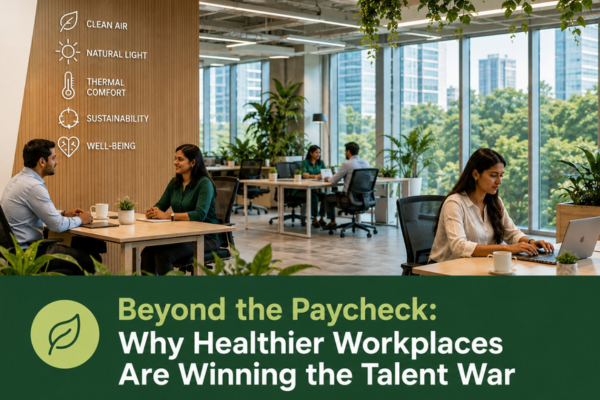
The modern workplace has emerged as a powerful differentiator in today's competitive talent market. While compensation and flexible work arrangements remain important, organisations are increasingly finding that workplace quality directly influences employee well-being, productivity and long-term engagement.
The post-pandemic era has fundamentally reshaped employee expectations. Professionals today are far more conscious of the environments in which they spend a significant portion of their day. Indoor air quality, ventilation efficiency, natural lighting, thermal comfort and sustainability credentials are no longer viewed as optional amenities but as essential workplace attributes. As a result, developers and occupiers are increasingly prioritising office spaces that support both physical and mental well-being.
The growing focus on workplace wellness is supported by a substantial body of research. According to the World Green Building Council, improved indoor air quality and higher ventilation rates can increase productivity among office workers by 8 to 11 per cent. Research conducted by the Harvard T.H. Chan School of Public Health has also found that employees working in high-performing, well-ventilated buildings demonstrate significantly higher cognitive function scores compared to those working in conventional office environments.
According to Shilpin Tater, Managing Director, Superb Realty, the increasing emphasis on workplace wellness is fundamentally changing the way commercial spaces are designed and evaluated.
"The definition of a premium workplace has evolved significantly. Today, organisations evaluate office spaces not just on location or efficiency, but on how they support employee health, engagement and performance. As the workplace becomes an extension of a company's talent strategy, factors such as indoor air quality, ventilation, thermal comfort and access to healthier environments are playing a critical role in productivity and well-being.
At Superb Realty, we see sustainability and wellness as intrinsically linked. Features such as advanced air purification, low-emission materials, intelligent ventilation and real-time air quality monitoring are becoming essential elements of future-ready workspaces. As businesses compete for top talent, healthier indoor environments are emerging as a key driver of productivity, retention and long-term resilience. The workplaces that will lead in the future are those that support both business growth and employee well-being."
This shift is also accelerating demand for green-certified office buildings as occupiers seek spaces that align with both ESG goals and employee wellness objectives. Sustainable workplaces not only reduce environmental impact but also enhance comfort, engagement, satisfaction and long-term business outcomes.
Shraddha Kedia Agarwal, Director, Transcon Developers, believes the workplace has evolved into a strategic reflection of organisational values.
"The workplace today is far more than a functional office; it is a reflection of an organisation's culture, values and commitment to its people. Employees are increasingly evaluating workplaces through the lens of wellness, sustainability, flexibility and overall experience, making the quality of the work environment a key factor in talent attraction and retention.
As competition for skilled professionals intensifies, workplaces that foster collaboration, well-being and engagement are emerging as a strategic differentiator. Developers must therefore create people-centric spaces that seamlessly integrate sustainable design, wellness-focused features and future-ready infrastructure, enabling organisations to strengthen their employer brand while supporting a more productive and resilient workforce."
Industry experts observe that healthy workplace environments are increasingly influencing measurable business outcomes. Studies across global markets consistently indicate that better indoor environmental quality can improve concentration, reduce fatigue and increase overall employee satisfaction. As organisations compete for skilled professionals, workplace quality is becoming an increasingly important component of employer branding.
The business case for healthier workplaces continues to strengthen. Harvard research has shown that cognitive performance scores can improve by as much as 61 per cent in environments featuring enhanced ventilation and lower levels of indoor pollutants, demonstrating the direct relationship between workplace design, decision-making and productivity.
Jayesh Rathod, Co-Founder and Director, The Guardians Real Estate Advisory, notes that environmental conditions are becoming a growing consideration in workplace planning.
"The delayed arrival of the monsoon in Mumbai this year has once again highlighted how closely our daily lives and workplaces are connected to environmental conditions. Rising temperatures, deteriorating outdoor air quality and increasing climate unpredictability are making employees more sensitive to the quality of indoor environments where they spend most of their working hours.
This is prompting businesses to look beyond conventional office infrastructure and prioritise buildings that can provide cleaner air, better thermal comfort and resilience against external environmental stressors. As climate-related challenges become more frequent, workplaces that can offer a healthier and more controlled environment will play a significant role in supporting employee well-being, productivity and long-term business continuity."
His observations reflect a broader transformation taking place across the commercial real estate sector, where resilience, sustainability and employee wellness are becoming increasingly interconnected.
As India's office market continues to evolve, the workplace is no longer simply a place where employees perform their duties. It has become a strategic asset that influences talent attraction, workforce productivity and business growth. Developers that successfully integrate wellness, sustainability and advanced building technologies into their projects are setting new benchmarks for the future of work. In an increasingly competitive labour market, healthier workplaces are emerging as one of the most effective tools for attracting and retaining talent.
Disclaimer:
The views, opinions, and information expressed in this article are solely those of the author and
do not necessarily reflect the views of Prop News Time. The content has not been independently
verified or endorsed by Prop News Time. Readers are advised to exercise their own discretion and
seek professional advice if required.
Advertisement













 Facebook
 Whatsapp
