Advertisement






What really powers the cloud? Behind every Google search, A...
A lot of what defines a home isn’t visible at handover. I...
Private equity has played a significant role in shaping Indi...
Luxury real estate is one of the most talked-about segments ...
Airports play a much bigger role than just enabling travel -...
India's expanding data centre sector is emerging as a major force influencing urban land use, commercial development and investment patterns. As demand for digital infrastructure accelerates, developers are increasingly competing for power-rich, well-connected sites traditionally used for offices and industrial projects. The trend is also driving growth in tier-II cities, supporting ancillary real estate such as warehousing, telecom infrastructure and workforce housing. While data centres present new investment opportunities, they also raise critical planning challenges around power, water and land allocation, making them an increasingly important consideration in the future development of India's cities.
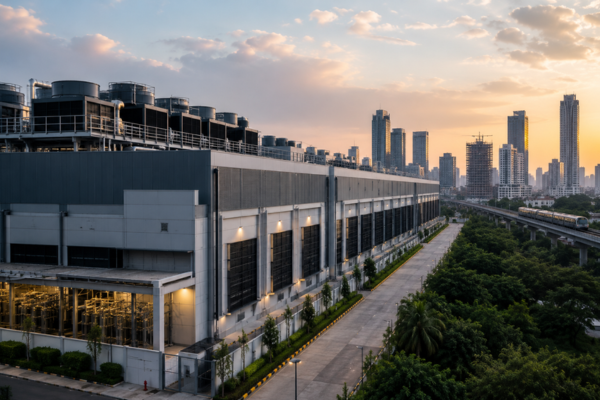
India's digital economy is creating an unexpected winner in the real estate market: the data centre. Once viewed as a specialised infrastructure asset, data centres are increasingly influencing where cities expand, how commercial corridors evolve and which locations emerge as the next investment destinations. As cloud computing, artificial intelligence, digital payments and enterprise technology accelerate demand for data storage, the requirement for large, power-intensive facilities is beginning to reshape land use across the country.
The numbers illustrate the scale of the shift. India's data centre market is projected to grow from USD 10 billion in 2025 to approximately USD 22 billion by 2030. Operational capacity has already reached around 1.6 GW, while another 3.1 GW is under development, making India the second-largest data centre market in the Asia-Pacific region. Mumbai alone is expected to exceed 1 GW of operational capacity by the end of 2026, while Hyderabad has emerged as the region's leading secondary data centre market.
Behind these figures lies a fundamental real estate story.
Unlike conventional commercial developments, data centres require large contiguous land parcels, uninterrupted power supply, robust fibre connectivity and proximity to major urban markets. These requirements place them in direct competition with traditional office parks, logistics hubs and industrial developments for strategically located land.
The flow of institutional capital reflects this changing landscape. Between the first and third quarters of 2025, data centres accounted for 31% of global private real estate funding, more than double the five-year average of 15%. As investors increasingly allocate capital towards digital infrastructure, land once earmarked for conventional commercial development is being reconsidered for data centre projects, particularly in markets where suitable sites with reliable power infrastructure remain limited.
Contrary to concerns that data centres could replace office demand, India's Grade A office market continues to perform strongly, supported by global capability centres (GCCs), technology companies, financial institutions and flexible workspace operators. Rather than competing directly, the two sectors are becoming complementary components of the digital economy. Offices accommodate the workforce driving digital businesses, while data centres provide the infrastructure enabling those businesses to operate.
The influence of data centres extends well beyond commercial real estate. Although these facilities generate fewer direct on-site jobs than office campuses, they stimulate broader economic activity through construction, engineering, facility management, telecommunications, logistics, energy infrastructure and equipment maintenance. Over time, these supporting industries create demand for residential developments, retail services and social infrastructure around established data centre clusters.
This pattern is becoming increasingly evident in India's tier-II cities. Locations such as Visakhapatnam and Naya Raipur are emerging as attractive destinations because they offer relatively affordable land, greater scope for large-scale horizontal development and the ability to expand power infrastructure more efficiently than densely developed metropolitan areas. As data centre operators establish campuses in these markets, associated demand for warehousing, logistics facilities, telecom infrastructure, substations and workforce housing is beginning to create new industrial and residential ecosystems.
Power availability has become one of the defining considerations in this transformation. A hyperscale data centre can consume electricity comparable to that of a small town, making dedicated substations, high-capacity transmission networks and reliable grid infrastructure essential prerequisites for development. Cities that proactively designate power-rich zones and integrate renewable energy into planning strategies are likely to be better positioned to accommodate future investment without placing excessive pressure on municipal infrastructure.
Water management presents an equally significant challenge. Large facilities can consume up to five million gallons of water each day for cooling, placing considerable strain on already stressed urban water systems. In cities such as Chennai, where water availability remains a persistent concern, operators are increasingly adopting recycled water, treated sewage, hybrid cooling technologies and, in some coastal regions, desalination as part of their sustainability strategies. Incorporating these solutions into planning frameworks from the outset will become increasingly important as capacity expands.
The growing appetite for data centres is already influencing land values. During the second half of 2025, prices for sites considered suitable for data centre development rose sharply as developers prioritised pre-zoned land with established access to power and fibre networks. Hyperscale operators and real estate investment trusts have been actively acquiring parcels capable of supporting phased expansion, often paying significant premiums for locations offering regulatory certainty and infrastructure readiness. In established corridors, land values linked to data centre development have been appreciating at an estimated 15% to 25% annually.
Perhaps the most significant change is that data centres are no longer viewed as niche industrial facilities. They have evolved into a mature institutional asset class, characterised by long-term leases of 10 to 20 years, stable rental income and renewal rates exceeding 90% at well-performing facilities. With India's land-stage development pipeline now exceeding 10.5 GW, their influence on urban planning is only expected to increase.
For planners, architects and developers, the implications extend beyond digital infrastructure. Decisions about land use can no longer focus solely on transport connectivity, residential demand or commercial viability. Access to reliable power, fibre connectivity and environmental resources is becoming equally important in determining where future urban growth takes place. As India's digital economy expands, data centres are set to become not just consumers of land, but key drivers of how cities are planned, where investment flows and how the country's next generation of real estate development unfolds.
Disclaimer:
The views, opinions, and information expressed in this article are solely those of the author and do not necessarily reflect the views of Prop News Time. The content has not been independently verified or endorsed by Prop News Time. Readers are advised to exercise their own discretion and seek professional advice if required.
Advertisement













 Facebook
 Whatsapp
