Advertisement






What really powers the cloud? Behind every Google search, A...
A lot of what defines a home isn’t visible at handover. I...
Private equity has played a significant role in shaping Indi...
Luxury real estate is one of the most talked-about segments ...
Airports play a much bigger role than just enabling travel -...
Modern architecture has been shaped by a number of buildings that introduced new design ideas, construction methods and ways of using space. From early skyscrapers and glass structures to cultural centres and sustainable office buildings, these projects influenced how architects and engineers approached future developments. Their impact can still be seen in cities around the world through office towers, public buildings and mixed-use developments. Here are some notable buildings that played an important role in the evolution of modern architecture.
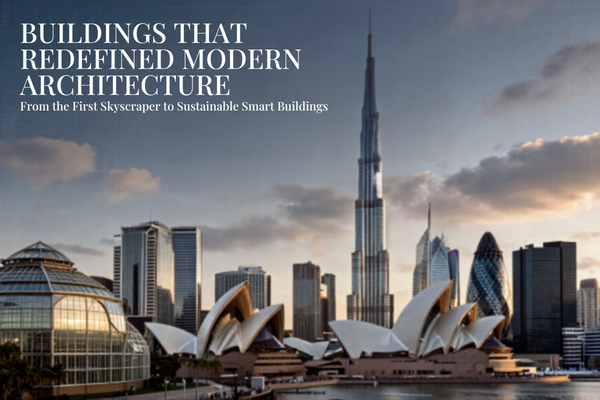
The development of modern architecture has been influenced by a series of buildings that introduced new approaches to design and construction. Some made it possible to build taller structures, while others explored new materials, layouts or engineering techniques. Over time, many of these ideas became standard features in buildings across the world. The projects featured in this article are recognised not only for their design but also for their contribution to the way modern buildings are planned, constructed and used today.
Crystal Palace, London (1851)
Built for the Great Exhibition of 1851, Crystal Palace showed how iron and glass could be used on a large scale. Its prefabricated design allowed it to be assembled quickly and efficiently. The building demonstrated new possibilities for exhibition halls, railway stations and other large public structures, influencing architecture during the industrial era.
Home Insurance Building, Chicago (1885)
The Home Insurance Building is widely regarded as the world's first skyscraper. Its steel-frame structure reduced the need for thick load-bearing walls and allowed buildings to reach greater heights. This approach became the foundation of modern high-rise construction and influenced urban development in cities across the world.
Villa Savoye, France (1931)
Designed by architect Le Corbusier, Villa Savoye introduced ideas that became closely associated with modern residential architecture. Its open interior layout, large windows and simple geometric form reflected a shift towards functional design. Many of its principles continue to influence residential projects today.
Seagram Building, New York (1958)
The Seagram Building became an important example of modern office architecture. Its steel-and-glass appearance, simple design and efficient use of space influenced the development of commercial buildings worldwide. Similar design approaches can still be seen in office districts across major cities.
Sydney Opera House, Sydney (1973)
Known for its distinctive roof structure, the Sydney Opera House demonstrated how complex architectural forms could be combined with practical use. The project required innovative engineering solutions and showed that public buildings could serve both cultural and architectural purposes.
Centre Pompidou, Paris (1977)
The Centre Pompidou took an unusual approach by placing many of its structural and mechanical systems on the exterior of the building. This freed up interior space and created a flexible layout for exhibitions and public activities. The project influenced later developments in public and cultural architecture.
Guggenheim Museum Bilbao, Spain (1997)
The Guggenheim Museum Bilbao highlighted the growing use of digital design tools in architecture. Its complex form would have been difficult to create using traditional design methods. The museum also demonstrated how a major cultural project could contribute to urban renewal and tourism.
Burj Khalifa, Dubai (2010)
As the world's tallest building, Burj Khalifa pushed the limits of high-rise construction. The project introduced engineering solutions to address challenges such as wind resistance, structural stability and vertical transportation. It remains an important reference for tall-building design.
The Shard, London (2012)
The Shard brought together offices, residences, hotel space and public facilities within a single tower. Its mixed-use approach reflected changing urban needs and demonstrated how different functions could be integrated into one building in densely populated cities.
The Edge, Amsterdam (2015)
The Edge is recognised for its focus on sustainability and smart-building technology. The building uses energy-efficient systems and digital tools to improve workplace performance and reduce environmental impact. It reflects the growing importance of sustainability in modern architecture.
The development of modern architecture has been shaped by buildings that introduced new approaches to design, construction and urban development. Many of the concepts first seen in these projects later became common features in buildings around the world. From steel-frame structures and glass façades to mixed-use developments and sustainable design, their influence remains visible in today's built environment. Together, these buildings illustrate how architectural ideas evolve over time and continue to inform future projects.
Advertisement













 Facebook
 Whatsapp
