Advertisement






The Gulf conflict has disrupted global supply chains, pushed...
REITs have changed the way commercial real estate is owned a...

What does it take to preserve a real estate legacy while bui...
What really powers the cloud? Behind every Google search, A...
A lot of what defines a home isn’t visible at handover. I...
The Noida–Greater Noida Expressway is evolving from a key transport corridor into a residential market supported by expanding infrastructure, public transport and new housing development. The southern stretch, particularly Sectors 148, 150 and 151, is emerging as a connected residential belt with distinct development characteristics. Sector 148 benefits from the Aqua Line metro station, while Sector 151 has attracted developer interest following Noida Authority’s auction of two residential land parcels to Godrej Properties and VRC Construction. Sector 150 remains differentiated by its planned low-density development, with around 80% of its 600-acre area designated for green cover, parks and recreational infrastructure. ANAROCK data places its average quoted rate at INR 14,780 per sq ft in Q2 2026.
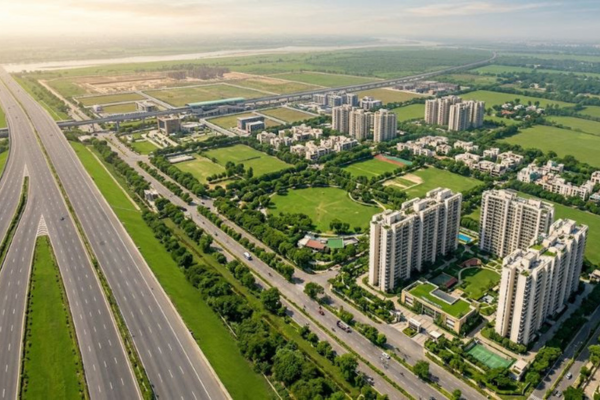
The Noida–Greater Noida Expressway is developing into a broader residential and lifestyle corridor as infrastructure expansion, improving public transport and new housing projects strengthen the southern stretch of Noida. Sectors 148, 150 and 151 are emerging as a connected residential belt, with Sector 150 increasingly positioned within the premium housing market because of its low-density planning, extensive green areas and access to major employment and urban infrastructure.
Sector 148 has developed as an important mobility point for the corridor, supported by its Aqua Line metro station. The station provides a public transport connection between Noida and Greater Noida and improves accessibility for residential and commercial developments in its surrounding catchment.
Developer interest is also increasing in Sector 151. Noida Authority recently auctioned two residential land parcels in the sector to Godrej Properties and VRC Construction. The transactions reflect continued development activity in an area supported by expressway access, planned connectivity and proximity to the wider airport-led development belt.
Sector 150 has a different development profile. Spread across approximately 600 acres, the sector was planned with nearly 80% of its land allocated to green cover, parks and recreational infrastructure, with construction restricted to the remaining area. The planning framework also includes a 42-acre park and a Sports City.
This land-use pattern has contributed to the sector’s positioning as a lower-density residential market. Rather than relying primarily on building height or development intensity, its residential proposition is centred on open spaces, green buffers and larger surroundings. These characteristics are gaining relevance in Delhi-NCR, where land availability is constrained and established residential locations face increasing density.
The sector is attracting end-users and investors, including senior professionals, CXOs, families and NRIs seeking larger residences in relatively less congested surroundings while remaining connected to employment centres, schools, healthcare facilities and other metropolitan services. According to ANAROCK’s Q2 2026 Residential Market Viewpoints, Sector 150 recorded an average quoted residential rate of INR 14,780 per sq ft, representing a 1% quarter-on-quarter increase. Average quoted monthly rents were reported at INR 23,500–INR 35,000.
Prateek Group was among the early developers to establish a presence in the micro-market with Prateek Canary. The project occupies 12.55 acres and comprises 664 residences, reflecting the sector’s emphasis on open spaces and relatively limited residential density.
The developer’s established presence has also generated market interest around its future activity on the Noida Expressway. Industry expectations have grown following a recent event hosted by the group, although details of the development referred to in the source have not been disclosed.
The proposed 32-km New Noida Expressway could further influence connectivity in the southern belt. Planned along the Yamuna Pushta route, the proposed road is expected to provide an alternative connection between the Delhi border near Kalindi Kunj and the airport region, linking Sector 150 onwards to the Yamuna Expressway while potentially reducing pressure on the existing Noida–Greater Noida Expressway.
With housing, transport infrastructure and green planning developing alongside one another, Sector 150 is gaining a more defined position within Noida’s premium residential market. Its emergence reflects the wider evolution of the expressway from a transit corridor into a residential market where connectivity, space and planned urban development increasingly influence housing demand.
Source - PTI
Advertisement













 Facebook
 Whatsapp
