Advertisement






The Gulf conflict has disrupted global supply chains, pushed...
REITs have changed the way commercial real estate is owned a...

What does it take to preserve a real estate legacy while bui...
What really powers the cloud? Behind every Google search, A...
A lot of what defines a home isn’t visible at handover. I...
India’s residential real estate market is seeing a shift towards premium housing, larger living spaces and lifestyle-oriented developments. While apartments continue to account for the largest share of housing transactions in major metropolitan markets, plotted developments are gaining attention for their land ownership and potential capital appreciation. Independent villas remain concentrated in the luxury segment, while managed and branded residences are emerging as an option for buyers seeking rental income and professional property management. The performance of each format therefore varies depending on whether the priority is transaction volume, appreciation, lifestyle, rental yield or convenience.
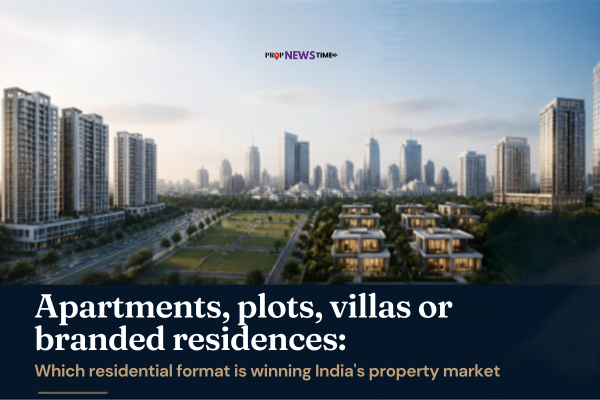
Apartments, The volume leader
Apartments remain the dominant residential format across India's major metropolitan markets, accounting for an estimated 65%–70% of housing sales volume across the top seven cities. High land costs and limited availability in established urban areas have made vertical development the practical choice for a large section of buyers. Gated communities also provide security, shared amenities and organised maintenance. Demand has increasingly shifted towards larger 3BHK and 4BHK homes, particularly in premium projects, while demand for standalone apartments priced below INR 1 crore has moderated in some markets.
Plotted developments, The appreciation contender
Gated plotted developments are gaining traction among buyers who want direct land ownership while retaining access to planned infrastructure and community facilities. Although they account for a smaller estimated 15%–20% of sales, the format has attracted significant developer interest, particularly in emerging suburban and peripheral corridors. Buyers can construct homes according to their requirements, while developers can monetise land without waiting for a lengthy construction cycle. The segment is particularly relevant for HNIs, NRIs and end-users looking at locations such as the Yamuna Expressway, Devanahalli, Ayodhya and other growth corridors.
Independent villas, The luxury choice
Independent villas occupy a relatively small share of urban residential transactions, estimated at around 5%–8%, largely because of high land costs and limited availability within established city markets. The format appeals to buyers seeking privacy, larger plots, private outdoor areas and lower-density living. Villas are particularly prominent in luxury and second-home markets such as Goa, Lonavala, Kasauli and Alibaug. However, ticket sizes can range from around INR 4 crore to more than INR 20 crore in premium locations, while maintenance responsibilities are also substantially higher than those associated with apartments.
Managed and branded residences, The yield and convenience segment
Managed and branded residences represent a smaller emerging segment, estimated at around 3%–5% of sales volume, but are gaining visibility in business and resort markets. These properties are operated or managed by hospitality brands or professional property management companies, with services covering leasing, maintenance and, in some cases, guest management. The format has particular appeal for NRIs and investors who want exposure to residential real estate without directly handling tenants and day-to-day operations. The supplied market assessment places rental yields for such properties at around 5%–7%, compared with approximately 2.5%–3.5% for conventional residential apartments.
Market positioning, Different formats, different advantages
The four formats occupy distinct positions in the residential market. Apartments lead on transaction volume and remain closely linked to urban density and location advantages. Plotted developments have a stronger proposition for buyers prioritising land ownership and long-term appreciation. Villas cater to a narrower luxury end-user market, where privacy and space are more important than transaction liquidity. Managed residences, meanwhile, combine residential ownership with professional services and are positioned towards buyers prioritising rental income and convenience.
Investment outlook, Choosing depends on the objective
The supplied market comparison suggests that there is no single residential format that can be considered the winner across all parameters. Apartments remain the strongest option for buyers seeking established urban locations and a broader range of housing choices. Plotted developments offer greater exposure to land value and may appeal to investors with a longer holding period. Villas are primarily lifestyle and luxury assets, while managed residences are better suited to investors seeking professionally managed rental income. The appropriate format ultimately depends on the buyer's budget, location preference, investment horizon and intended use.
A market divided by buyer priorities
India's residential market is increasingly moving beyond a simple apartment-versus-house choice. Premiumisation, demand for larger homes, interest in land ownership and the growing preference for professionally managed assets are creating space for multiple residential formats. Apartments are likely to retain their dominance in terms of overall sales volume, while plotted developments could remain attractive to buyers focused on land appreciation. Villas will continue to serve the luxury segment, and managed residences may expand as more investors look for rental income without operational responsibilities.
Sources: Apartments, plots, villas or branded residences: Which residential format is winning India’s property market
Advertisement













 Facebook
 Whatsapp
