Advertisement






The Gulf conflict has disrupted global supply chains, pushed...
REITs have changed the way commercial real estate is owned a...

What does it take to preserve a real estate legacy while bui...
What really powers the cloud? Behind every Google search, A...
A lot of what defines a home isn’t visible at handover. I...
The growth of quick-commerce, same-day delivery and changing consumer expectations is pushing logistics operators to position warehouses closer to urban demand centres. Facilities located within or near cities can reduce last-mile distances, improve delivery speeds and lower transportation costs. The shift is also encouraging the development of micro-fulfilment centres, automated storage systems and adaptive reuse of underutilised urban properties. While urban warehousing comes with significantly higher real estate costs and space constraints, operators are increasingly balancing these challenges against the operational benefits of faster and more efficient deliveries.
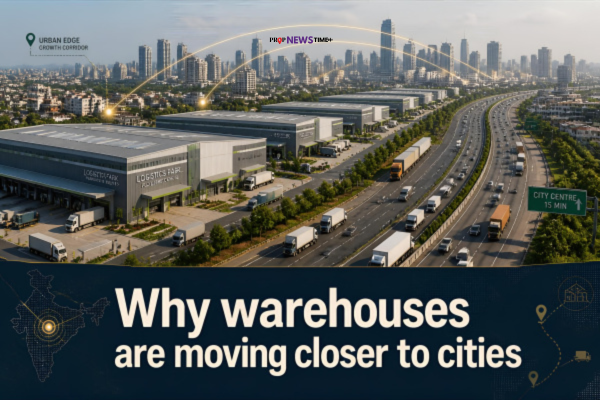
The traditional logistics model was built around large warehouses located on relatively inexpensive land outside major cities, from where goods were transported to urban distribution points. That model is being reassessed as delivery expectations become faster and more localised. The expansion of quick-commerce, e-commerce and same-day delivery has increased the importance of placing inventory closer to consumers. As a result, logistics networks are increasingly combining large regional warehouses with smaller urban facilities designed to handle high-demand products and shorten the final leg of delivery.
1. Faster delivery is changing warehouse locations
The biggest factor behind the shift is the shrinking delivery window. Consumers who once accepted deliveries over several days are increasingly expecting orders to arrive on the same day, within a few hours or, in the case of quick-commerce, within minutes. A warehouse located 40-50 km from a dense urban market may have sufficient inventory but still struggle to meet these timelines because of congestion and unpredictable road conditions. Placing fulfilment facilities within roughly 5-10 km of major consumption clusters allows operators to keep frequently ordered products closer to customers and begin fulfilment almost immediately after an order is placed.
2. Urban warehouses can reduce last-mile costs
The final movement from a distribution facility to the customer's address is among the more expensive stages of logistics. Vehicle operating costs, fuel, driver expenses, traffic delays and unsuccessful delivery attempts can increase the cost of every shipment. By reducing the distance travelled for individual deliveries, urban fulfilment facilities can lower vehicle utilisation and delivery time. Shorter routes also create greater scope for using electric vans, two-wheelers and cargo bikes instead of larger vehicles designed for longer-distance transportation.
3. Micro-fulfilment centres make limited urban space usable
High land and rental costs make conventional large warehouses difficult to establish within city limits. This has contributed to the emergence of micro-fulfilment centres, which are designed to operate from substantially smaller footprints. These facilities typically focus on fast-moving products rather than maintaining the broad inventory found in regional warehouses. Automation is increasingly important in this model. Automated storage and retrieval systems, robotic picking and software-driven inventory management can make greater use of vertical space and improve the efficiency of compact facilities.
4. Existing properties are being converted into logistics hubs
The movement of warehouses towards cities does not necessarily mean that every facility has to be newly constructed. Logistics companies can also make use of properties that are no longer serving their original commercial purpose. Vacant retail units, underused commercial buildings, former large-format stores and other suitable properties can be adapted for local fulfilment. Multi-level buildings and other spaces with appropriate access and loading arrangements can also provide opportunities where land availability is limited.
5. Electrification strengthens the case for urban fulfilment
The transition towards electric delivery fleets is another factor supporting the urban warehousing model. Shorter delivery routes make electric two-wheelers and vans more practical because vehicles can complete multiple trips without the same range requirements associated with longer-distance routes. Urban fulfilment hubs can also support smaller delivery formats, including cargo bikes and other compact vehicles. These vehicles can be better suited to congested streets and dense neighbourhoods, while potentially reducing dependence on larger delivery trucks for the final leg of a shipment.
6. Urban and remote warehouses serve different purposes
The movement towards city-based warehouses does not mean that large regional warehouses are becoming obsolete. Instead, logistics networks are increasingly using different types of facilities for different functions. Large peripheral warehouses remain suitable for bulk storage, slower-moving products and long-distance distribution because land costs are generally lower and larger plots are available. Urban micro-warehouses, meanwhile, are better suited to high-velocity products where delivery speed is more important than maintaining a large inventory range.
The shift towards urban warehousing reflects a broader change in how logistics networks are designed. Speed, delivery economics and proximity to consumers are becoming as important as the cost of warehouse space. Rather than replacing traditional distribution centres, urban micro-fulfilment facilities are emerging as a complementary layer within logistics networks. For real estate markets, this is creating demand for strategically located industrial, commercial and adaptable properties in and around major consumption centres. The challenge will be to balance this demand with high urban land costs, traffic management, zoning requirements and the competing needs of city development.
Sources Knight Frank India, CBRE South Asia, JLL India
Advertisement













 Facebook
 Whatsapp
