Advertisement






The Gulf conflict has disrupted global supply chains, pushed...
REITs have changed the way commercial real estate is owned a...

What does it take to preserve a real estate legacy while bui...
What really powers the cloud? Behind every Google search, A...
A lot of what defines a home isn’t visible at handover. I...
Land does not depreciate, does not need a tenant to exist, and rewards patience in a way flats and offices rarely do. But "investing in land" is not one strategy, it is at least four, each with its own timeline, risk and exit. This piece looks at how Indian investors currently approach land: buying and holding it raw, building on it, leasing it out, and, increasingly in cities like Mumbai, redeveloping what already stands on it.
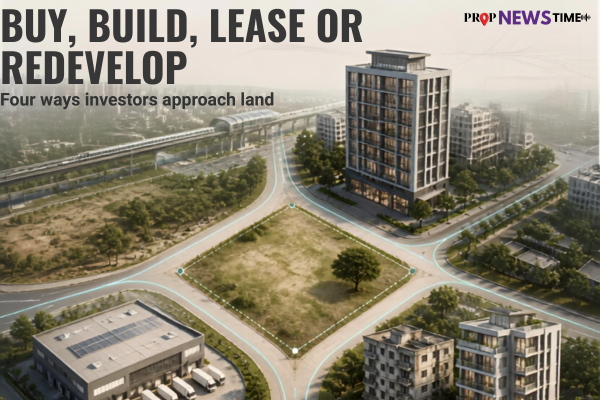
Ask property investors why they like land, and most give the same answer: it cannot be built more of. Every other real estate asset, an apartment, an office floor, a warehouse, is a structure built on land, so its value is partly borrowed from the plot beneath it. Land sits at the bottom of that chain, the one input nobody can manufacture, which is why it has stayed near the top of the asset list for as long as there has been a list.
But "invest in land" hides four genuinely different bets. One investor buys a plot and holds it for eight years; another buys similar land and puts a warehouse on it within eighteen months. A third buys nothing at all, leasing someone else's plot instead. A fourth skips raw land entirely, unlocking value from land that already has an ageing structure on it. Each approach, buy, build, lease, redevelop, suits a different investor, risk appetite and definition of return. Here is how each one works.
1. Buy and hold: betting on the corridor before it arrives
The oldest instinct in Indian real estate: buy a plot, do nothing to it, and let infrastructure do the work. Land needs almost no maintenance and offers the flexibility to build, sell or lease later without committing today, and in infrastructure-driven corridors, near an upcoming metro exit, expressway interchange, or industrial park, plots have re-rated quickly once connectivity plans are confirmed, often before construction even begins nearby. The trade-off is illiquidity and risk: land typically takes longer to sell than a flat, earns nothing while it sits idle, and carries greater legal exposure through unclear titles or missing sanctions, while banks tend to demand larger down payments for raw land than for a completed property. It is, in effect, a bet on a city's master plan, one that tends to pay off only after five years or more, and only with real due diligence on title, water access and approvals.
2. Build to unlock: turning a plot into an income-generating asset
For investors unwilling to sit on dead capital, the next step is to build, converting raw land into rent, yield or resale value faster than buy-and-hold allows, whether through residential construction on a well-located plot or industrial and warehousing development in a logistics-linked zone. Land within industrial parks, SEZs and warehousing corridors is especially attractive here, since it draws demand directly from businesses looking to set up or expand, giving the investor a more predictable buyer or tenant base than speculative residential land. Building carries materially higher risk than holding, construction capital, an approvals process, and a far more active role, but it converts an idle plot into something with cash flow or a clearer resale value, which is usually the entire point, and tends to suit investors with either construction expertise or a trusted developer partner.
3. Lease it out: income without giving up ownership
The third approach skips construction and treats land as a rentable asset in its own right. Ground leases let an investor retain ownership while earning steady income from a tenant who builds or operates on the plot, a model long common in agricultural land, where buy-to-lease arrangements let an owner earn from farming without managing it, and equally established in commercial land leased for retail, office or industrial use. Leasing solves land's biggest weakness, that a vacant plot earns nothing on its own, without construction risk, letting the owner collect recurring income while the land appreciates in the background. The trade-off is that returns tend to be steadier but lower than a successful build, and the investor is dependent on a tenant's rent discipline and lease terms in a way a purely passive landholder is not.
4. Redevelop: unlocking value from land that already has a building on it
The fourth approach does not start with raw land at all, it starts with an old structure sitting on land now worth far more than the building on it, the model currently reshaping Mumbai. Cooperative housing societies in ageing buildings, many over thirty years old, are increasingly signing redevelopment agreements with private developers, unlocking land that would otherwise sit underused because a comparable fresh plot in the same location has become prohibitively expensive. Knight Frank data shows the scale: redevelopment agreements in Mumbai grew sharply through 2025 and into 2026, with more than a thousand societies now under redevelopment, unlocking hundreds of acres locked inside decades-old buildings. A newer variant has investors backing societies directly under Maharashtra's self-redevelopment framework, where one private fund reported an internal rate of return of roughly 21 per cent exiting a project in Ghatkopar, a return drawing more funds toward this pathway. Redevelopment offers what the other three cannot, land in an already-established, high-demand location, but its complications are equally structural: resident negotiations, rehabilitation costs, and approval timelines that can run well beyond a typical construction schedule.
None of these four approaches is objectively best, each answers a different question. Buy-and-hold suits a long horizon and high tolerance for illiquidity; building suits an investor who wants income sooner and will take on construction risk to get it; leasing suits someone who wants land's appreciation without giving up cash flow; and redevelopment suits an investor drawn to the paradox that the most valuable Indian land often already has something standing in the way of its own potential. What ties all four together is simple: the asset is finite, but the ways of putting it to work are not. Choosing between them comes down to how much time, capital and risk an investor is prepared to commit, and, increasingly in cities like Mumbai, whether the smartest land play left isn't a new plot at all, but the one already sitting under an old building down the road.
Sources: Farmonaut, Mahalaxmi Infra, Totl Realty, Whalesbook, Rustomjee, Mumbai Live, Outlook Money, PropNewz, Business Standard
Advertisement













 Facebook
 Whatsapp
