Advertisement






The Gulf conflict has disrupted global supply chains, pushed...
REITs have changed the way commercial real estate is owned a...

What does it take to preserve a real estate legacy while bui...
What really powers the cloud? Behind every Google search, A...
A lot of what defines a home isn’t visible at handover. I...
By 2035, India's urban population is projected to reach 675 million, up from 483 million in 2020, an addition roughly equal to the current population of the United States, absorbed into cities over a single decade. That scale of change does not arrive overnight, and much of it is already visible: metro lines under construction, heat action plans now standard in two dozen cities, and smaller towns quietly overtaking the metros in consumer growth. This piece traces eight shifts already underway that will define what an Indian city looks like a decade from now
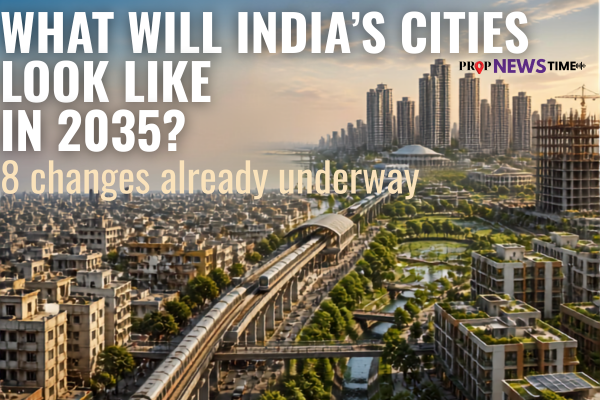
Every minute, roughly 30 people migrate from rural India into its cities. Cities already generate 63 per cent of the country's GDP, a share projected to climb to 75 per cent by 2036. By 2030, at least two Indian cities, Mumbai and Delhi, are expected to rank among the five largest urban regions in the world, with the Mumbai Metropolitan Region's economy alone projected to outgrow the GDP of Portugal or Colombia.
None of this is a distant hypothetical. The metro corridor being dug near your office, the heat alert your phone buzzed with last April, the friend who moved from Bengaluru to Coimbatore for a better quality of life, these are the early, visible edges of the city India is becoming. What follows are eight changes already in motion, each a preview of India's urban future.
1. The metro map keeps filling in
Roughly 1,159 kilometres of metro and regional rapid transit are now operational across 26 cities, having crossed the 1,000-km mark only in 2025, meaning much of the network was built in the last two or three years alone. Nearly 1,000 kilometres more are under construction, from Chennai's second phase to new lines in Bhopal, Indore and Surat, backed by a fresh 30,942 crore central allocation this year. By 2035, a resident of a mid-sized Indian city will be far more likely to commute by rail than they are today.
2. Cities are growing up, not just out
Indian cities have historically expanded outward, but that pattern is being challenged by a deliberate shift toward vertical growth, as planners confront a population expected to cross 600 million city-dwellers by 2030. Government transit-oriented development policy is accelerating this directly, encouraging denser construction within a short walk of metro stations, with the area roughly 500 metres from a station now treated as the zone for highest-intensity development. The skyline of 2035 will be taller specifically in the rings around thousands of new transit stops.
3. The action is moving to tier-2 and tier-3 cities
The assumption that Mumbai, Delhi, Bengaluru, Chennai, Hyderabad and Kolkata decide India's urban future is already outdated. Economic activity is shifting toward tier-2 and tier-3 cities as cost pressure builds in the largest metros and employers realise they can access talent without paying metro-city premiums. By 2035, India is projected to have 499 "consumer cities," more than double today's number, with growth spreading across hundreds of emerging centres rather than a familiar second tier of five or six names.
4. Extreme heat has become a planning input, not an afterthought
Over 250 cities and districts across 23 heat-prone states now have operational Heat Action Plans, using colour-coded alerts, rescheduled construction hours and hospital preparedness that were largely absent a decade ago. States are institutionalising this through standing policy rather than emergency improvisation, Telangana's Cool Roof Policy and Maharashtra's Urban Green Policy, promoting Miyawaki forests and sponge parks, are early examples. Experts still flag a gap between plans and implementation, but by 2035, heat-responsive planning is likely to be as routine as traffic management is today.
5. Flood and climate resilience is being built into master plans
Chennai has folded its Climate Action Plan directly into its Third Master Plan covering 2027 to 2046, mapping citywide risk before infrastructure gets built rather than after. Kolkata has strengthened drainage and installed early flood-warning systems with Asian Development Bank support, while Mumbai's own plan has flagged flooding and coastal risk among its top threats. Analysts now argue every rupee of urban spending needs to be stress-tested against these risks, suggesting resilience will become the lens city planning runs through by 2035, not a separate chapter within it.
6. Urban infrastructure spending is about to scale up sharply
Nearly 70 per cent of the urban infrastructure India will need by 2047 has not been built yet, and by 2036 the country is estimated to require roughly $840 billion in infrastructure investment, an average of $55 billion, or 1.2 per cent of GDP, every year. That is double the 0.6 per cent of GDP India actually spent between 2011 and 2018. Closing this gap may be the single biggest swing factor in how 2035's cities turn out.
7. Millions more residential units are on the way, mostly not luxury ones
Housing 675 million urban residents by 2035 will require roughly 230 million additional residential units, a construction scale India's housing sector has never delivered before. Luxury housing has posted strong sales in markets like the NCR, Mumbai and Bengaluru, but rising land and construction costs are pushing developers toward mid-income and affordable housing instead, simply because that is where the volume of demand sits. The city of 2035 will likely be defined less by luxury towers than by a much larger, quieter expansion of mid-market housing.
8. Cities are becoming India's primary engine of jobs and income
Cities are set to generate around 70 per cent of India's net new jobs by 2030 and produce over 70 per cent of national GDP, with per capita incomes expected to rise nearly fourfold as a result. Handled well, urbanisation at this scale could add a full percentage point or more to annual GDP growth, which matters for a country absorbing roughly 270 million additional working-age people by 2030. This is the underlying reason the other seven changes are happening together: they are facets of the same shift, cities becoming the country's primary engine of prosperity.
None of these eight changes is speculative. Each is already measurable, in kilometres of track under construction, in heat alerts issued last summer, in crore allocated this budget, in migration numbers moving toward tier-2 cities. What makes 2035 hard to picture is not whether these shifts will happen, but the scale at which they are compounding: a metro network multiplying, a population climbing past 675 million, a housing sector building faster than it ever has. India's cities in 2035 will be the sum of thousands of decisions already being made now, about where to lay a rail line, how high to let a building rise, and how seriously to take a heatwave.
Sources: Metro Rail News, Adsmunch,Down To Earth,Observer Research Foundation,World Bank, Construction Business,McKinsey Global Institute, DevelopmentAid
Advertisement













 Facebook
 Whatsapp
