Advertisement






The Gulf conflict has disrupted global supply chains, pushed...
REITs have changed the way commercial real estate is owned a...

What does it take to preserve a real estate legacy while bui...
What really powers the cloud? Behind every Google search, A...
A lot of what defines a home isn’t visible at handover. I...
India's biggest cities are increasingly developing smaller economic ecosystems within their boundaries. These districts are no longer just office clusters surrounded by residential neighbourhoods; they are evolving into self-contained destinations with workplaces, hotels, restaurants, retail, housing, healthcare and entertainment. Bandra-Kurla Complex in Mumbai has become a major financial hub, while GIFT City is building an international financial ecosystem almost from scratch. Similar transformations are underway in Hyderabad, Bengaluru, Gurugram, Kolkata and Pune. Together, these districts show how India's urban growth is moving from a single city centre towards multiple specialised economic centres.
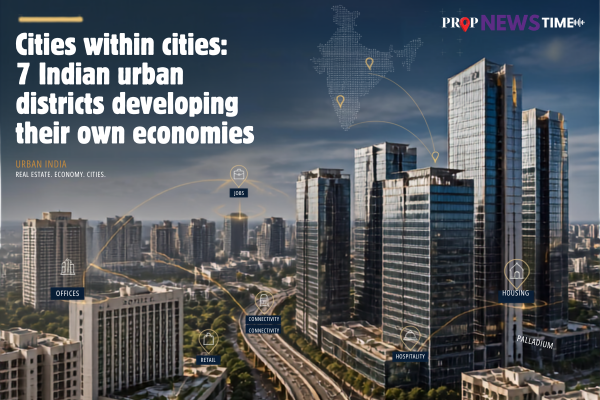
A city does not always grow evenly. Sometimes, one part of it begins attracting so many companies, workers, homes, hotels, restaurants and services that it starts functioning almost like a separate city. India's metropolitan regions are increasingly experiencing this phenomenon. What began as planned business districts, technology corridors or satellite developments is turning into something much larger. Offices create jobs, jobs attract residents, residents create demand for services and those services bring in more businesses. Eventually, the district develops its own economic rhythm. From Mumbai's BKC to Hyderabad's western corridor and Bengaluru's technology belt, these districts reveal how India's next generation of urban centres is taking shape.
1. Bandra-Kurla Complex, Mumbai: The business district that became an economic centre
Bandra-Kurla Complex was originally planned to reduce the concentration of commercial activity in South Mumbai. The Mumbai Metropolitan Region Development Authority (MMRDA), which has been the planning authority for BKC since 1977, says the complex covers about 370 hectares and was designed to accommodate financial services, information technology and other commercial activities. Today, its skyline includes major banks, technology companies, professional services firms and government institutions, while the authority says BKC provides more than two lakh jobs. The presence of companies such as Google, Amazon, Apple, Netflix, Deutsche Bank and Standard Chartered has further strengthened its corporate ecosystem. What was conceived as a decentralisation project has effectively become another downtown for Mumbai.
2. GIFT City, Gandhinagar: A financial economy being built almost from scratch
GIFT City is different because its economic identity was planned before the district itself matured. Developed as India's international financial and technology hub, it brings banking, capital markets, insurance, fund management, fintech, aircraft leasing and other specialised financial activities into one ecosystem. According to GIFT City's official development agency, more than 1,000 entities are operational, with over 20,000 jobs generated and more than 29 million sq ft allotted. The government's own data also puts the number of registered entities in GIFT IFSC at more than 1,034, including 38 banks with a combined asset base of about USD 100 billion as of November 2025. With global banks and financial institutions continuing to enter the district, GIFT City is increasingly developing an economy of its own.
3. HITEC City–Financial District, Hyderabad: When an IT corridor became a complete urban ecosystem
Hyderabad's western corridor began its transformation with HITEC City, but the story did not stop with office towers. Development gradually spread through Madhapur, Gachibowli, Nanakramguda and the Financial District, creating a huge employment and residential ecosystem. Technology companies and global capability centres brought thousands of professionals into the area, while housing, hotels, restaurants, schools, healthcare and retail followed the workforce. Infrastructure such as Hyderabad's Outer Ring Road further connected the corridor with the rest of the metropolitan region. The result is a part of Hyderabad where employment itself has become a driver of urbanisation: workers live nearby, businesses cluster around one another and entire residential markets have developed around the technology economy.
4. Outer Ring Road, Bengaluru: The technology corridor that became a city within the city
Bengaluru's Outer Ring Road is no longer simply a transport corridor. The belt around Bellandur, Devarabeesanahalli and Marathahalli has evolved into one of the city's most important employment concentrations, with large technology campuses and multinational companies creating demand far beyond office space. As companies moved in, residential developments, serviced apartments, restaurants, shopping centres, hotels and everyday services followed. This is the classic pattern of an urban economy reproducing itself: employment attracts people, people attract housing and consumption, and that consumption attracts more businesses. The corridor's importance is also being reshaped by Bengaluru's continuing expansion of Metro and road infrastructure, strengthening its relationship with the wider city.
5. Cyber City–Golf Course Road, Gurugram: The corporate district that pulled a neighbourhood economy behind it
Gurugram's transformation from a peripheral settlement into one of the NCR's major corporate centres can be traced through districts such as Cyber City and the surrounding Golf Course Road belt. Large office campuses attracted multinational corporations, financial services companies and technology firms, while high-rise housing developed around the workforce. Hotels, restaurants, shopping centres, healthcare facilities and entertainment venues followed, creating an ecosystem that operates well beyond conventional office hours. The district's influence has also spread into surrounding micro-markets such as Golf Course Extension Road and parts of Sohna Road. Gurugram therefore illustrates how a concentrated employment centre can reshape not only commercial real estate but the residential geography of an entire metropolitan region.
6. New Town, Kolkata: A planned extension developing its own economic identity
New Town was conceived as a major planned urban extension of Kolkata, but it has gradually become much more than a residential satellite. The West Bengal Housing Infrastructure Development Corporation (HIDCO) has overseen development involving residential neighbourhoods, IT and business districts, educational institutions, healthcare, hospitality and civic infrastructure. Its eastern location has also helped create a new employment corridor alongside the established Sector V technology district. The combination of offices and housing is particularly important because it allows people to live closer to their workplaces instead of depending entirely on Kolkata's older central districts. New Town's evolution demonstrates how planned urban expansion can create a new economic centre rather than simply adding another suburb to an existing city.
7. Hinjawadi–Wakad, Pune: The IT park that changed an entire side of the city
Pune's western expansion provides another clear example of an employment district creating its own urban economy. The Rajiv Gandhi Infotech Park in Hinjawadi, developed by the Maharashtra Industrial Development Corporation (MIDC), attracted technology companies and generated a large employment base. Housing development subsequently spread through Wakad, Tathawade, Punawale and neighbouring areas as professionals sought homes closer to work. Schools, hospitals, restaurants, retail centres and hospitality businesses followed the population. The transformation is therefore larger than Hinjawadi's office parks alone: an employment centre has helped create an entire residential and consumption ecosystem around it. What was once Pune's relatively peripheral western edge is now one of its most recognisable growth corridors.
India's next urban story may not be about expanding one central business district indefinitely. Instead, cities are developing multiple economic centres, each with its own workforce, property market, infrastructure and lifestyle ecosystem. BKC has become a major commercial centre for Mumbai, GIFT City is building a specialised international finance economy, while Hyderabad, Bengaluru, Gurugram, Kolkata and Pune are seeing employment corridors evolve into much larger urban districts.
For real estate, the shift is significant. When jobs, transport, housing, retail and social infrastructure begin concentrating in one location, the district can develop its own demand cycle. In that sense, India's future cities may increasingly look less like one large metropolis and more like several smaller cities operating within the same metropolitan boundary.
Sources: Mumbai Metropolitan Region Development Authority (MMRDA)- Bandra-Kurla Complex, GIFT City- official development information, International Financial Services Centres Authority (IFSCA)
Advertisement













 Facebook
 Whatsapp
