Advertisement






The Gulf conflict has disrupted global supply chains, pushed...
REITs have changed the way commercial real estate is owned a...

What does it take to preserve a real estate legacy while bui...
What really powers the cloud? Behind every Google search, A...
A lot of what defines a home isn’t visible at handover. I...
Traffic movement around Juhu Circle and adjoining parts of Andheri West was disrupted after a crane deployed for Mumbai Metro Line 2B construction developed a technical problem. The breakdown affected a busy road junction and resulted in congestion for commuters travelling through the area. The incident occurred amid ongoing elevated metro construction, where heavy equipment is being used along existing road corridors. The disruption highlights the traffic-management challenges involved in executing large transport projects in densely developed parts of Mumbai, where construction activity and everyday road movement have to operate alongside each other.
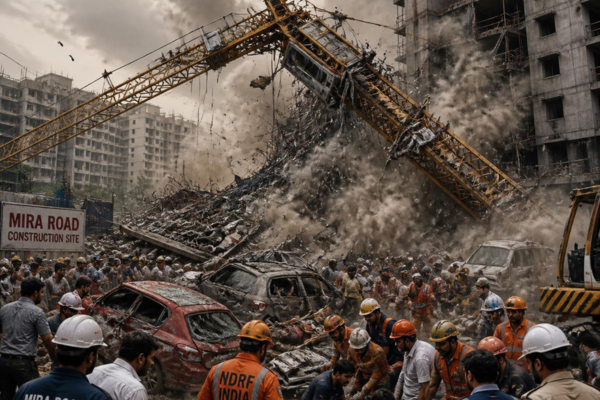
Traffic movement around Juhu Circle in Mumbai was disrupted after a crane involved in construction work for Metro Line 2B broke down, affecting commuters travelling through Juhu and Andheri West.
The incident occurred at a busy junction where road traffic is already substantial, and the presence of construction equipment created an obstruction for vehicles using the affected stretch. As the crane remained at the site, congestion spread to adjoining roads, resulting in delays for motorists travelling through the western suburbs.
The disruption was linked to ongoing construction of Mumbai Metro Line 2B, which is being developed as an important east-west public transport corridor. The line is planned to connect D.N. Nagar with Mandale, passing through several densely populated and commercially significant areas of Mumbai.
The corridor is expected to improve connectivity between the western suburbs and eastern parts of the city while providing links to other transport networks. However, its construction requires extensive civil work along existing urban roads, creating operational challenges in areas where there is limited space for construction activity without affecting regular traffic.
The Juhu Circle incident illustrates one of those challenges. Metro construction involves the movement and deployment of large cranes and other heavy machinery for activities such as structural work and the installation of elevated components. When such equipment develops a fault or becomes immobilised on a busy road corridor, the impact can extend well beyond the immediate construction site.
For commuters, the immediate consequence was increased travel time and difficulty moving through Juhu Circle and surrounding routes. Traffic congestion in one part of the western suburbs can quickly affect neighbouring roads as motorists attempt to divert around the affected location.
The episode also underlines the importance of traffic-management arrangements around major infrastructure sites. Construction agencies and traffic authorities have to coordinate equipment movement, road closures, diversions and emergency response so that unexpected incidents can be dealt with without prolonged disruption.
Metro Line 2B is being developed to provide an additional mass-transit option across Mumbai and reduce dependence on road-based travel along some of the city's busy corridors. Once operational, the line is expected to connect residential areas with major employment and commercial centres while integrating with other metro and transport systems.
Construction-related disruptions are nevertheless likely to remain a feature of the project until work is completed. Managing these disruptions becomes particularly important at junctions such as Juhu Circle, where traffic volumes are high and alternative routes can also become congested quickly.
The crane breakdown was a temporary incident, but it highlights a wider issue associated with Mumbai's infrastructure expansion: large projects must be executed within an already crowded urban environment while keeping existing transport routes functional for daily commuters.
Advertisement













 Facebook
 Whatsapp
