Advertisement






The Gulf conflict has disrupted global supply chains, pushed...
REITs have changed the way commercial real estate is owned a...

What does it take to preserve a real estate legacy while bui...
What really powers the cloud? Behind every Google search, A...
A lot of what defines a home isn’t visible at handover. I...
Across India, a growing number of homeowners have chosen restoration over redevelopment, breathing new life into abandoned havelis that once stood on the brink of collapse. From the narrow lanes of Old Delhi to the heritage precincts of Ahmedabad, the villages of Punjab and the Portuguese-era estates of Goa, these privately led conservation efforts have preserved architectural traditions while creating distinctive family homes. Their stories demonstrate how historic residences can remain relevant through careful restoration, ensuring that centuries-old craftsmanship and cultural heritage continue to survive in modern India.
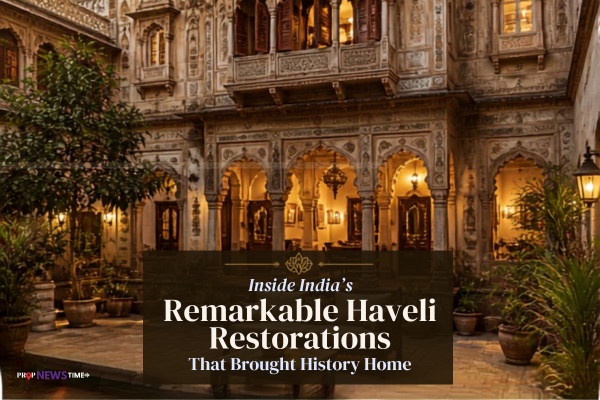
India's historic havelis have long been symbols of regional craftsmanship, social history and architectural excellence. Yet many of these residences have gradually fallen into neglect as families migrated to cities, maintenance costs rose and redevelopment pressures intensified. Rather than allowing these structures to disappear, a handful of homeowners have invested years of effort and substantial resources to restore them. Their projects go beyond preserving old buildings—they revive neighbourhood identities, safeguard traditional building techniques and prove that heritage homes can still serve as vibrant family residences.
Atul Khanna – Kathika Haveli, Old Delhi
Hidden within the historic lanes of Shahjahanabad, Kathika Haveli represents one of Delhi's most remarkable privately led heritage restorations. Antique collector and conservation enthusiast Atul Khanna rescued two adjoining late nineteenth-century Mughal-era havelis that had been abandoned for decades due to ownership disputes and structural deterioration. Through painstaking restoration, damaged sandstone columns, timber beams and decorative interiors were revived using traditional methods. Today, the restored property functions as both Khanna's residence and a cultural space showcasing antiques, classical music and Delhi's architectural legacy.
Vijay Goel and Siddhant Goel – Haveli Dharampura, Old Delhi
The restoration of Haveli Dharampura transformed a severely deteriorated nineteenth-century mansion into one of Old Delhi's best-known conservation projects. Once declared unsafe after years of neglect, the haveli underwent a multi-year restoration led by Vijay Goel and Siddhant Goel with the help of skilled traditional craftsmen. Original stone balconies, carved wooden ceilings and heritage courtyards were painstakingly revived while preserving the property's historic character. The restored haveli continues to retain its residential essence while contributing to heritage conservation in Shahjahanabad.
Chandrakant Dodhia – Dodhia Haveli, Ahmedabad
Art collector Chandrakant Dodhia chose to preserve rather than replace a deteriorating timber-framed haveli in Ahmedabad's UNESCO-listed walled city. Facing possible demolition, the traditional Gujarati residence was restored with the assistance of conservation specialists who revived its intricate wooden façades, lime-plastered interiors and central courtyard. The project reflects the growing movement among heritage enthusiasts to preserve the distinctive pol houses that define Ahmedabad's historic urban landscape.
Rajiv Patel – Deewanji ni Haveli, Ahmedabad
Builder and conservation advocate Rajiv Patel invested significantly more than the property's purchase price to restore the 150-year-old Deewanji ni Haveli after acquiring the neglected structure. Traditional lime mortar, reclaimed timber and historic masonry techniques were used to stabilise and revive the building while maintaining its original architectural features. The restored haveli now serves as Patel's workspace and as a symbol of community-led heritage conservation within Ahmedabad's old city.
Maria de Lourdes Figueiredo de Albuquerque – Figueiredo House, Goa
The Figueiredo House in South Goa is among India's finest surviving Indo-Portuguese mansions. Descendant Maria de Lourdes Figueiredo de Albuquerque undertook a decade-long restoration to preserve the centuries-old family residence after years of gradual decline. Historic wooden interiors, antique chandeliers, tiled halls and ceremonial spaces were carefully restored, allowing the mansion to remain a family home while also opening selected sections to visitors interested in Goa's architectural heritage.
The Sangha Family – Peepal Haveli, Punjab
The Sangha family's restoration of their 125-year-old ancestral haveli in Gurdaspur demonstrates how heritage conservation can be driven by personal commitment. Led by five sisters, the restoration relied on traditional Nanakshahi bricks, lime mortar and locally sourced materials to preserve the building's original character. The project later received international recognition through a UNESCO Asia-Pacific Award for Cultural Heritage Conservation, highlighting its contribution to preserving Punjab's vernacular architecture.
Kaushik, Rajendra and Tejas Majitha – Baghban Haveli, Ahmedabad
Driven by memories of growing up in Ahmedabad's old city, the Majitha brothers acquired the abandoned Baghban Haveli after years of searching for a heritage property. Traditional craftsmen restored its weathered wooden façade, internal courtyard and lime-plastered walls while retaining the building's historic identity. The haveli has since become a family residence that reconnects successive generations with the city's architectural heritage.
Kr. Randhir Daspan and family – Daspan House, Jodhpur
The Daspan family's sandstone haveli in Jodhpur had remained largely unused before extensive restoration returned it to its former character. Original stone masonry, intricately carved jaalis and period interiors were carefully repaired while preserving the home's architectural authenticity. Today, the restored property continues to function as a family residence while accommodating limited heritage hospitality, ensuring the building remains actively maintained for future generations.
These restoration projects demonstrate that heritage conservation is not solely the responsibility of governments or institutions. Individual homeowners and families have played an equally important role in preserving India's architectural legacy by investing time, resources and craftsmanship into historic residences that might otherwise have disappeared. Their efforts show that abandoned havelis can become contemporary homes without sacrificing their historic identity, offering a sustainable model for conserving India's built heritage while keeping it relevant for future generations.
Sources: Centre for Policy Research, World Resources Institute, IJURR, ICRIER
Advertisement













 Facebook
 Whatsapp
