Advertisement






The Gulf conflict has disrupted global supply chains, pushed...
REITs have changed the way commercial real estate is owned a...

What does it take to preserve a real estate legacy while bui...
What really powers the cloud? Behind every Google search, A...
A lot of what defines a home isn’t visible at handover. I...
Many of India's fastest-growing suburbs were once quiet villages surrounded by farms, lakes and open fields. Over the past two decades, expanding city limits, metro networks, IT parks and infrastructure projects have transformed these rural settlements into thriving residential and commercial hubs. While skyscrapers and expressways now dominate their skylines, traces of their village origins still remain in local markets, temples and street layouts. Here are nine Indian suburbs that underwent remarkable transformations and now represent some of the country's most dramatic urban success stories.
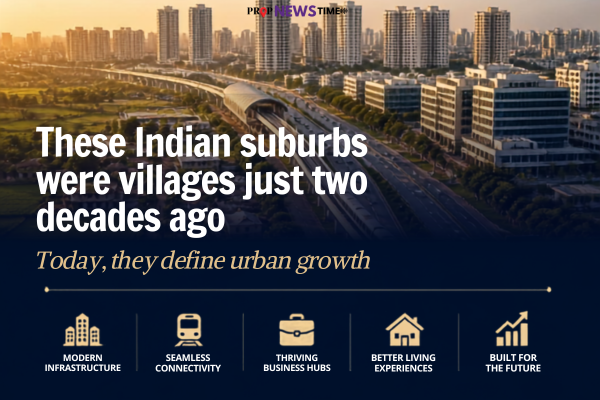
India's urban expansion has not only reshaped cities but also completely transformed the villages that once stood on their outskirts. As employment centres expanded and infrastructure improved, many rural settlements were absorbed into rapidly growing metropolitan regions. Agricultural land gave way to apartment complexes, village roads became arterial corridors and local economies shifted from farming to services and technology. Yet, despite their urban identity today, many of these suburbs continue to preserve fragments of their rural past. These neighbourhoods offer a fascinating glimpse into how India's cities have grown over the last two decades.
1. Gachibowli, Hyderabad
Twenty years ago, Gachibowli was largely characterised by agricultural land, rocky terrain and scattered village settlements on Hyderabad's western edge. The arrival of HITEC City, the Financial District and major multinational companies completely altered its trajectory, turning it into one of India's most prominent technology corridors.
According to Telangana Industrial Infrastructure Corporation (TGIIC) and Hyderabad Metropolitan Development Authority (HMDA) planning documents, the suburb witnessed unprecedented commercial and residential expansion after the early 2000s. Today, luxury apartments, international schools, global corporate campuses and sports infrastructure occupy land that was once cultivated farmland, making Gachibowli one of Hyderabad's most valuable real estate destinations. The Outer Ring Road and proximity to Rajiv Gandhi International Airport further strengthened its appeal among businesses and homebuyers. Despite rapid urbanisation, pockets of the original village, including temples and older residential clusters, still coexist with modern office towers, offering a glimpse into its rural past.
2. Kharadi, Pune
Not long ago, Kharadi was known primarily for sugarcane fields and small farming communities situated along the Mula-Mutha River. Its transformation accelerated after the establishment of EON IT Park and the World Trade Center, attracting thousands of professionals from across the country.
Real estate market studies by Knight Frank India and JLL India consistently identify Kharadi among Pune's fastest-growing residential micro-markets. Alongside IT campuses, the suburb has developed premium housing, co-living spaces, retail centres and entertainment hubs, making it one of Pune's strongest employment-led residential corridors. Improved road connectivity through Nagar Road and its proximity to Pune Airport have further enhanced its residential appeal. What was once a farming settlement has now become a preferred address for young professionals, while a few traditional village settlements continue to exist alongside modern gated communities.
3. New Town, Kolkata
Unlike most suburbs on this list, New Town emerged from a cluster of villages that were systematically planned into a modern township rather than expanding organically. Two decades ago, the area consisted largely of wetlands, agricultural land and rural settlements east of Kolkata.
The West Bengal Housing Infrastructure Development Corporation (HIDCO) has overseen its transformation into one of eastern India's most planned urban centres. Today, technology parks, convention centres, universities and smart-city infrastructure define New Town, while several village pockets continue to exist within the larger urban framework, reflecting its unique evolution. Eco Park, business districts and dedicated institutional zones have further strengthened its position as Kolkata's modern urban extension. Wide roads, cycling tracks and planned green spaces distinguish it from many organically developed suburbs across the country.
4. Panathur, Bengaluru
Panathur remained a relatively quiet agrarian village until Bengaluru's IT boom pushed development eastwards. As Whitefield, Marathahalli and Outer Ring Road expanded, Panathur gradually transformed into a preferred residential destination for technology professionals.
According to Bengaluru East property market reports published by Anarock, demand has increased significantly due to its proximity to major employment hubs. Modern apartment projects, co-living spaces and commercial developments now dominate the landscape, although older village roads and local temples still preserve reminders of its rural heritage. The suburb also benefits from its strategic location between Whitefield and Sarjapur Road, making daily commuting easier for thousands of IT employees. Over the last decade, educational institutions, supermarkets and healthcare facilities have rapidly expanded, creating a self-sustained residential ecosystem.
5. Ravet, Pune
For decades, Ravet functioned as a small village on Pune's northwestern outskirts. Its location near the Mumbai–Pune Expressway and Pimpri-Chinchwad industrial region later attracted large-scale residential development, particularly after improvements in regional connectivity.
Recent reports from the Pune Metropolitan Region Development Authority (PMRDA) highlight Ravet as one of the city's fastest-growing suburban residential zones. Educational institutions, integrated townships and retail developments have rapidly replaced agricultural land, making it especially attractive to first-time homebuyers and young families. The suburb's proximity to Hinjewadi's IT hub and the upcoming metro network has further increased housing demand. Despite its urban growth, remnants of its original village layout and local cultural festivals continue to reflect Ravet's agricultural heritage.
6. Tellapur, Hyderabad
Until the early 2000s, Tellapur was primarily an agricultural settlement known for paddy cultivation and open land. As Hyderabad's western growth corridor expanded beyond Gachibowli, Tellapur emerged as one of the city's fastest-appreciating residential markets.
Industry research by CBRE India notes that improved road connectivity, ORR access and proximity to the Financial District have significantly increased housing demand. The suburb now features premium gated communities, luxury villas and high-rise apartments while retaining pockets of its original village character. Large integrated township projects and improved civic infrastructure have accelerated its transformation over the past decade. Even today, stretches of open land and older village temples offer a visible reminder of the area's rural origins amid rapid urban development.
7. Ulwe, Navi Mumbai
A little over two decades ago, Ulwe consisted mainly of fishing villages, salt pans and marshland along Navi Mumbai's coastline. Its transformation gathered pace following CIDCO's planned development initiatives and major infrastructure announcements.
According to CIDCO's development plans, projects such as the Navi Mumbai International Airport, Atal Setu connectivity and suburban rail expansion have accelerated both residential and commercial growth. Today, Ulwe has become one of Navi Mumbai's most closely watched emerging property markets while still preserving parts of its original coastal landscape. The planned airport influence zone has attracted significant investment from both developers and homebuyers anticipating long-term appreciation. Traditional fishing communities continue to live alongside newly developed residential sectors, highlighting the suburb's unique transition from village to urban neighbourhood.
8. Jagatpura, Jaipur
Once known for agriculture and low-density settlements, Jagatpura has evolved into one of Jaipur's fastest-growing suburban locations. Educational institutions, improved connectivity and large residential townships have significantly altered the area's character over the past two decades.
Property market reports by Anarock and local planning updates from the Jaipur Development Authority (JDA) indicate sustained residential demand driven by infrastructure growth. Apartment complexes, commercial spaces and institutional campuses have steadily replaced farmland, making Jagatpura a preferred destination for both homebuyers and investors. The presence of universities, healthcare facilities and improved road networks has encouraged steady population growth. Although urbanisation has accelerated rapidly, several older neighbourhoods still retain the atmosphere of the village that once existed here.
9. Mullanpur, Chandigarh
Twenty years ago, New Chandigarh (Mullanpur) was largely a rural landscape made up of agricultural villages bordering Chandigarh. Today, it is emerging as one of North India's most ambitious planned urban extensions.
The Greater Mohali Area Development Authority (GMADA) has led the area's transformation through planned sectors, healthcare institutions, educational campuses and sports infrastructure. With new residential projects, wide road networks and expanding civic amenities, Mullanpur represents how carefully planned suburban development can completely redefine a former village while maintaining its regional identity. Landmark developments such as the Maharaja Yadavindra Singh International Cricket Stadium have further increased the area's visibility and investment potential. Even as modern townships continue to expand, agricultural land and long-established villages surrounding the township preserve a strong connection to the region's rural heritage.
India's suburban growth story is also the story of its villages adapting to changing economic realities. As infrastructure, employment opportunities and urban planning extended beyond traditional city limits, many rural settlements evolved into thriving residential and commercial hubs within a single generation. While glass towers and expressways now dominate these landscapes, their village origins continue to shape local culture, community networks and neighbourhood identities. Together, these suburbs illustrate how India's urban transformation is often built upon the foundations of its rural past.
Sources: Hyderabad Metropolitan Development Authority (HMDA), City and Industrial Development Corporation (CIDCO), Knight Frank India, Anarock Research, Ministry of Housing and Urban Affairs (MoHUA)
Advertisement













 Facebook
 Whatsapp
