Advertisement






What really powers the cloud? Behind every Google search, A...
A lot of what defines a home isn’t visible at handover. I...
Private equity has played a significant role in shaping Indi...
Luxury real estate is one of the most talked-about segments ...
Airports play a much bigger role than just enabling travel -...
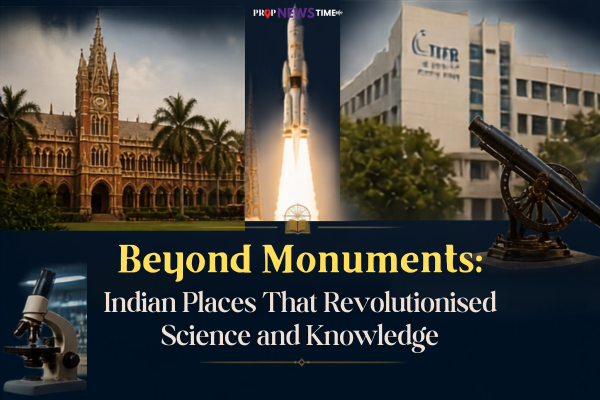
India's historical legacy extends far beyond monuments, kingdoms and battles. Across centuries, several places emerged as centres of scientific discovery, higher learning and technological innovation that shaped not only the country but also the world. From the ancient universities of Nalanda and the surgical breakthroughs of Varanasi to the laboratories of Bengaluru, Kolkata and Mumbai, these locations became milestones in humanity's pursuit of knowledge. Their contributions continue to influence mathematics, medicine, engineering, nuclear science and modern technology, leaving a lasting impact on global civilisation.
1. Kumhrar & Khagaul (Patna, Bihar) — The Birthplace of Mathematical Zero & Heliocentrism
Specific Physical Location: The Kumhrar archaeological site and the Khagaul suburban precinct on the western periphery of Patna (ancient Kusumapura/Pataliputra). Key Milestone (~499 CE): Astronomer and mathematician Aryabhata conducted his observations here and authored the groundbreaking treatise Aryabhatiya. He formally defined the concept of zero within place-value arithmetic, calculated $\pi$ accurately to four decimal places ($3.1416$), and proposed that the Earth rotates on its axis to produce day and night. Why It Changed History: This astronomical and mathematical framework laid the foundation for global algebra and trigonometry, eventually traveling to the Islamic Golden Age and defining modern computational science.
2. The Ghats of Varanasi (Uttar Pradesh) — The Cradle of Advanced Ancient Surgery
Specific Physical Location: The banks of the Ganges River near Dashashwamedh and Chet Singh Ghats in modern-day Varanasi. Key Milestone (~600 BCE): Sushruta, recognized as the "Father of Surgery," operated an ancient medical school here. He authored the Sushruta Samhita, detailing over 300 surgical techniques, 121 specialized surgical instruments, and systematic anatomical dissection procedures using dead bodies immersed in river currents. Why It Changed History: Sushruta pioneered rhinoplasty (plastic surgery), cataract couching, and skin grafting thousands of years before similar techniques gained ground in Western medical practice.
3. Nalanda Archaeological Complex (Nalanda District, Bihar) — The World's First Residential University
Specific Physical Location: Bargaon Village, 15 km north of Rajgir in Nalanda District, Bihar (a UNESCO World Heritage Site). Key Milestone (5th – 12th Century CE): Nalanda operated as a massive residential university housing over 10,000 students and 2,000 teachers. Its multi-story library complex (Dharmaganja) housed hundreds of thousands of manuscripts across formal logic, grammar, medicine, astronomy, and metallurgy. Why It Changed History: It established the global paradigm for structured higher education, peer-reviewed debate, entrance examinations, and cross-border academic research.
4. IISc Campus, Malleswaram (Bengaluru, Karnataka) — The Foundation of Modern R&D
Specific Physical Location: The 400-acre green estate along CV Raman Road, Malleswaram, marked by the historic Main Building and 150-foot Clock Tower. Key Milestone (Founded 1909): Conceptualized by industrialist Jamsetji Tata with land donated by Maharajah Krishnaraja Wadiyar IV, the Indian Institute of Science was established to pioneer indigenous scientific research, materials science, and engineering. Why It Changed History: IISc incubated India's earliest aerospace, metallurgy, and chemical engineering programs, serving as the talent furnace for the nation’s post-independence industrial and technological infrastructure.
5. 210 Bowbazar Street (Kolkata, West Bengal) — Discovery of the Raman Effect
Specific Physical Location: The original laboratory building of the Indian Association for the Cultivation of Science (IACS) at 210 Bowbazar Street (now BB Ganguly Street) in Central Kolkata. Key Milestone (February 28, 1928): Experimental physicist Sir C.V. Raman, utilizing modest laboratory equipment costing less than 500, discovered that scattered light changes its wavelength when traversing transparent media—the Raman Effect. Why It Changed History: The discovery earned Asia its first Nobel Prize in the sciences (1930) and led to Raman Spectroscopy, a primary analytical method used globally today in molecular physics, pharmacology, and material testing.
6. Town High School Road (Kumbakonam, Tamil Nadu) — Ramanujan’s Mathematical Revolutions
Specific Physical Location: The ancestral home on Sarangapani Sannidhi Street and Town High School in Kumbakonam, Thanjavur District. Key Milestone (1890s – 1913): Self-taught mathematical genius Srinivasa Ramanujan independently derived over 3,900 mathematical identities, infinite series, mock theta functions, and partition formulas without formal academic training. Why It Changed History: His notebooks revolutionized number theory and mathematical analysis, finding critical modern applications in string theory, quantum mechanics, and cryptographic algorithms.
7. TIFR Campus, Colaba (Mumbai, Maharashtra) — The Birthplace of Atomic Physics & Supercomputing
Specific Physical Location: Homi Bhabha Road, Navy Nagar, Colaba, overlooking the Arabian Sea in South Mumbai. Key Milestone (Founded 1945): Nuclear physicist Dr. Homi J. Bhabha, backed by the Sir Dorabji Tata Trust, established the Tata Institute of Fundamental Research (TIFR) to lead research in cosmic rays, nuclear physics, and digital computation. Why It Changed History: TIFR built TIFRAC (India's first digital computer in 1960) and served as the direct birthplace of India’s nuclear energy infrastructure and high-energy radio astronomy initiatives.
8. Thumba Coastal Village (Thiruvananthapuram, Kerala) — Dawn of Modern Space Exploration
Specific Physical Location: The Thumba Equatorial Rocket Launching Station (TERLS), situated along the Arabian Sea coastline near the Trivandrum International Airport. Key Milestone (November 21, 1963): Spearheaded by Dr. Vikram Sarabhai and Dr. A.P.J. Abdul Kalam, scientists launched India's first sounding rocket (Nike-Apache) from a beachside facility using a local church building as their improvised lab. Why It Changed History: This experiment gave birth to the Indian Space Research Organisation (ISRO), paving the way for low-cost satellite networks, indigenous satellite launch vehicles (PSLV/GSLV), and lunar/planetary missions like Chandrayaan and Mangalyaan.
9. Amul Dairy Complex (Anand, Gujarat) — The White Revolution & Industrial Cooperatives
Specific Physical Location: The central processing facility along Anand–Sojitra Road in Anand, Gujarat. Key Milestone (1946 – 1970): Dr. Verghese Kurien and H.M. Dalaya developed the technology to process buffalo milk into skimmed milk powder and condensed milk a world first and organized smallholder dairy farmers into a unified cooperative framework (Kaira District Co-operative Milk Producers' Union). Why It Changed History: Known as Operation Flood, this technological and supply-chain innovation transformed India from a milk-deficient nation into the world’s largest producer of milk, establishing a global model for rural cooperative empowerment.
10. Cyber Towers, HITEC City (Hyderabad, Telangana) & Electronic City (Bengaluru, Karnataka) — The IT Revolution
Specific Physical Location: Cyber Towers at Madhapur, HITEC City (Hyderabad) and Phase 1, Electronic City off Hosur Road (Bengaluru). Key Milestone (1990s – Present): These custom-built high-tech parks integrated satellite earth stations, dedicated fiber optic connectivity, and special economic zones to host global software engineering operations. Why It Changed History: These clusters transformed India into the software development capital of the world, positioning South Asia as an indispensable hub for enterprise software, cloud architecture, engineering R&D, and artificial intelligence development.
A legacy that continues to inspire
These seven locations represent far more than geographical landmarks. They are symbols of India's long tradition of inquiry, experimentation and knowledge creation. From ancient mathematicians and physicians to modern physicists and engineers, each place contributed ideas that continue to shape contemporary science and technology. Together, they demonstrate that India's historical influence extends beyond politics and architecture into discoveries that have benefited the world for centuries. Today, these centres remain reminders that investment in education, research and innovation can leave a legacy that endures across generations.
Sources UNESCO World Heritage Centre, Indian Academy of Sciences / NobelPrize, ISRO Archives, NDDB, Royal Society Publishing & Cambridge University Archives
Advertisement













 Facebook
 Whatsapp
