Advertisement






The Gulf conflict has disrupted global supply chains, pushed...
REITs have changed the way commercial real estate is owned a...

What does it take to preserve a real estate legacy while bui...
What really powers the cloud? Behind every Google search, A...
A lot of what defines a home isn’t visible at handover. I...
The Andhra Pradesh Capital Region Development Authority (APCRDA) has allotted 76 returnable plots to 33 farmers who voluntarily contributed land under the Amaravati Land Pooling Scheme (LPS). The allotment was carried out through an online e-lottery system to ensure transparency, followed by the distribution of provisional allotment certificates. The plots include both residential and commercial categories across multiple villages. Farmers have been advised to complete the registration process at the earliest, with APCRDA officials extending technical support for plot identification through GIS and survey teams.
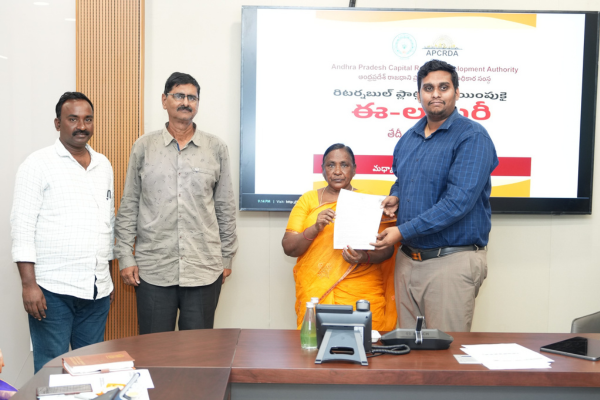
The Andhra Pradesh Capital Region Development Authority (APCRDA) allotted 76 returnable plots to 33 farmers who voluntarily pooled their land under the Land Pooling Scheme (LPS) for the development of Amaravati. The allotment process was carried out at the APCRDA office in Rayapudi through a transparent online e-lottery system in the presence of beneficiary farmers. Following the draw, APCRDA Additional Commissioner Kollabathula Karthik, IAS, distributed provisional allotment certificates to the beneficiaries.
To ensure transparency in the allotment process, APCRDA conducted a trial run of the online randomisation system for both residential and commercial plots before the live e-lottery. The exercise was aimed at demonstrating the fairness of the digital allotment process before the final draw was conducted.
A total of 76 returnable plots, comprising 46 residential and 30 commercial plots, were allotted under the exercise. Of the residential plots, 16 were allotted in the Dry category and 30 in the Jareebu category. Similarly, seven commercial plots were allotted in the Dry category, while 23 commercial plots were allotted in the Jareebu category.
The beneficiaries belonged to Nowluru-1, Krishnayapalem, Penumaka, Kuragallu-1 and Kuragallu-2, and Nowluru-2 villages. Village-wise, Penumaka accounted for the highest allocation with 38 returnable plots distributed among 19 farmers. Krishnayapalem and Nowluru-2 each received 14 plots, benefiting three and nine farmers respectively. One farmer from Kuragallu-1 and Kuragallu-2 received seven plots, while one farmer from Nowluru-1 was allotted three plots.
The farmers were advised to complete the registration process at the earliest. APCRDA stated that GIS personnel and village surveyors would assist beneficiaries in locating the exact geographical position of their allotted plots, helping them complete the registration process smoothly.
The Amaravati Land Pooling Scheme remains one of India's largest land pooling initiatives, under which thousands of farmers voluntarily contributed agricultural land in exchange for developed residential and commercial returnable plots, along with other benefits. The scheme has been central to the planned development of the Amaravati capital region, with APCRDA continuing phased allotments and registrations as infrastructure and planning activities progress.
Director (Lands–Capital City) K.S. Bhagya Rekha, Planning Division Director (FAC) B. Suresh Kumar, Special Deputy Collectors P. Krishna Rao (Kuragallu), G. Suryanarayana Reddy (Nowluru), K. Sudharani (Krishnayapalem and Penumaka), along with APCRDA officials and staff, were present during the programme.
Source APCRDA
Advertisement













 Facebook
 Whatsapp
