Advertisement






The Gulf conflict has disrupted global supply chains, pushed...
REITs have changed the way commercial real estate is owned a...

What does it take to preserve a real estate legacy while bui...
What really powers the cloud? Behind every Google search, A...
A lot of what defines a home isn’t visible at handover. I...
MMRDA has approved direct Foot Over Bridge (FOB) connectivity between a Metro Line 4 station and the Godrej commercial campus in Vikhroli as part of its initiative to strengthen last-mile connectivity across Mumbai's Metro network. The project is expected to improve commuter convenience, enhance pedestrian safety and encourage higher Metro ridership. Under MMRDA's policy, private developers bear the construction cost and pay a one-time development fee along with supervision charges. Following the Oberoi Mall connection on Metro Line 7, MMRDA is also evaluating similar proposals, including one for Bharat Diamond Bourse.
The Mumbai Metropolitan Region Development Authority (MMRDA) has expanded its efforts to improve last-mile connectivity across the Mumbai Metro network by facilitating direct access between Metro stations and adjoining commercial and residential developments. The initiative is aimed at making Metro travel more convenient, reducing pedestrian movement on busy roads and encouraging greater use of public transport.
In a recent development, MMRDA approved direct Foot Over Bridge (FOB) connectivity between a Metro Line 4 station and the Godrej commercial campus in Vikhroli. The approval marks another step in integrating major developments with the city's Metro network to provide seamless access for commuters.
The proposed FOB will allow employees, visitors and Metro passengers to travel directly between the Metro station and the Godrej campus without crossing the busy LBS Road. The dedicated connection is expected to improve pedestrian safety, reduce travel time and provide a more convenient commuting experience.
This is the second private development to receive a No Objection Certificate (NOC) from MMRDA for direct Metro connectivity through a Foot Over Bridge. Earlier, MMRDA had approved a similar connection to Oberoi Mall on Metro Line 7, allowing commuters to access the commercial complex directly from the Metro station without using the main road. The authority considers the project a successful example of integrated last-mile connectivity.
Under MMRDA's policy for direct Metro connectivity, commercial and residential developments seeking direct access to Metro stations are required to pay a one-time, non-refundable development fee. The applicant is responsible for the complete cost of designing and constructing the Foot Over Bridge and is also required to pay 6% of the total construction cost as supervision charges to MMRDA. The authority said these charges help ensure that the integration with Metro infrastructure meets all technical, structural and safety standards. Every proposal undergoes detailed engineering and safety evaluations before permission or an NOC is granted.
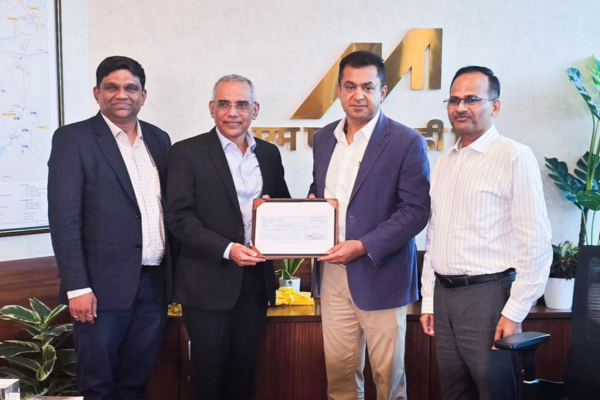
As part of the Vikhroli project, Godrej & Boyce has paid a one-time, non-refundable development fee of INR 10 crore to MMRDA. Besides the development fee, the company will also bear the full cost of constructing the Foot Over Bridge. The cheque was handed over by Anup Mathew, Executive Vice President and Business Head of the Godrej Enterprises Estates Division, Godrej Enterprises Group, to Dr. Sanjay Mukherjee, Metropolitan Commissioner, MMRDA, in the presence of senior officials.
MMRDA is also evaluating several similar proposals from private developments seeking direct Metro access. One of the key proposals under consideration is from Bharat Diamond Bourse on Metro Line 2B. Once implemented, the project is expected to benefit nearly 40,000 daily users by reducing pedestrian congestion on surrounding roads while encouraging greater reliance on Metro services.
The policy is also intended to strengthen the financial sustainability of the Metro network by generating non-fare revenue. Maharashtra Chief Minister Devendra Fadnavis said the government introduced the policy to provide direct Metro access to major commercial and residential developments while improving last-mile connectivity. He stated that the model benefits both commuters and the Metro system by increasing ridership and fare collections, while the one-time development fee and other non-fare revenue support long-term infrastructure development without placing the financial burden entirely on passengers.
Deputy Chief Minister and MMRDA Chairman Eknath Shinde said the authority has been receiving encouraging responses from commercial establishments and residential developments seeking direct Metro connectivity. He added that every proposal is subjected to detailed technical and safety assessments before approval, and such projects improve commuter convenience, reduce congestion around Metro stations and contribute to sustainable non-fare revenue for the Metro network.
Dr. Sanjay Mukherjee, Metropolitan Commissioner, MMRDA, said last-mile connectivity plays a key role in increasing public transport usage. He stated that the initiative is helping integrate Metro stations with major commercial and residential destinations while ensuring that the beneficiary institutions bear the cost of the connectivity infrastructure. He added that the approach improves the commuter experience, supports higher Metro ridership and strengthens the long-term financial sustainability of the Maha Mumbai Metro network, while maintaining high engineering and safety standards.
Source MMRDA
Advertisement













 Facebook
 Whatsapp
