Advertisement






The Gulf conflict has disrupted global supply chains, pushed...
REITs have changed the way commercial real estate is owned a...

What does it take to preserve a real estate legacy while bui...
What really powers the cloud? Behind every Google search, A...
A lot of what defines a home isn’t visible at handover. I...
Mumbai is a city where more than half of all daily journeys are made on foot, yet safe footpaths remain the exception rather than the norm. Across much of the city, pavements are missing, too narrow, encroached upon, or damaged, forcing pedestrians to walk alongside moving traffic. Although the Supreme Court has recognised access to safe and accessible footpaths as a fundamental right and BMC has introduced new policies and funding to improve pedestrian infrastructure, progress on the ground remains slow. While a few parts of South Mumbai and select suburban corridors have seen improvements, large sections of the city particularly the eastern suburbs and low-income neighbourhoods continue to lack basic walking infrastructure. The result is a city that depends on walking every day but has yet to make pedestrians a genuine priority in its urban planning.
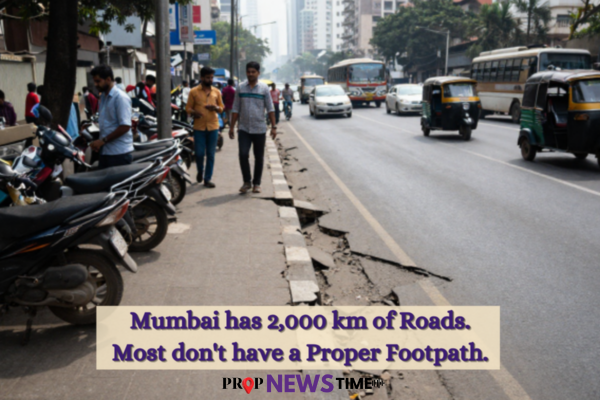
More than half of Mumbai's daily journeys are made on foot. Yet across much of the city, there is either no footpath at all or one that is broken, blocked, or too narrow to use safely.
Mumbai currently has around 2,175 roads under BMC's concretisation plan. More than 50% of daily journeys in the city are made on foot. In 2024, Mumbai recorded over 1,100 road accident deaths, while BMC allocated INR 5,100 crore to its roads and traffic department in FY 2025–26.
Step out of Andheri station on any weekday morning and watch what happens. Hundreds of commuters pour out at once. Some head for the footpath. Within twenty metres, most step off it because a vendor has set up on the pavement, a bus is idling on the kerb, or a utility box has been placed right in the middle of the walking path. The others never bother with the footpath at all. They walk on the road from the start, because that is simply easier.
This is not unusual in Mumbai. Across large parts of the city, footpaths are either missing, too narrow, or so blocked that most people find it more practical to walk on the road alongside moving traffic. In May 2025, the Supreme Court of India took note of this and ruled that access to safe footpaths is a fundamental right under Article 21 of the Constitution. So where does Mumbai actually stand?
The Legal Right to a Footpath
What the Supreme Court Said in 2025 - And What BMC's Own Policy Requires
In May 2025, a Supreme Court bench comprising Justice A.S. Oka and Justice Ujjal Bhuyan ruled that every citizen has the right to use safe, unobstructed, and accessible footpaths. The court said that without proper footpaths, pedestrians are forced onto roads, which puts their lives at risk. It directed all state governments to frame pedestrian safety guidelines based on Bombay High Court directions and submit compliance reports within two months.
By August 2025, the court found that the Union Government had still not framed national guidelines. The bench gave it four weeks to do so, saying the court would issue the guidelines itself if the government did not act. As of mid-2026, those national guidelines are still pending.
"Right to have unobstructed and disabled-friendly footpaths is guaranteed under Article 21. The safety of pedestrians is not a luxury, but a constitutional obligation of the state."
BMC has had its own "Pedestrian First" Footpath Policy for several years. It sets clear minimum widths at least 1.8 metres on roads up to 60 feet wide, and 3 metres on wider roads. The policy also says encroachments of any kind must be removed.
In its FY 2025-26 budget, BMC went further and announced a new Universal Footpath Policy, with INR 5,100 crore allocated to the roads and traffic department. In November 2025, it put out a tender worth over INR 100 crore to upgrade footpaths across 14 roads covering 16.55 km across the city.
To put that in context, BMC manages roughly 2,000 km of roads. The November 2025 revamp tender covers 16.55 km less than 1% of the network at a time.
Areas Where Footpaths Exist and Are Usable
South Mumbai and a Few Planned Corridors Are Ahead of the Rest
Mumbai's footpath coverage varies a great deal depending on where you are. The island city South Mumbai from Colaba to Sion has the best footpaths, largely because of colonial-era road planning. Fort, Churchgate, Nariman Point, Colaba Causeway, and Marine Drive all have footpaths that are reasonably wide, mostly continuous, and relatively well-maintained compared to the suburbs.
In the suburbs, there are a few areas that have improved in recent years. The Walking Project a civic group that has been auditing Mumbai's footpaths and has mapped 24 km of the network using open-source tools flagged the stretch along Andheri-Kurla Road between the Marol and J.B. Nagar metro stations as a notable improvement. The footpath was widened significantly as part of the metro infrastructure work and serves as a useful example of what the rest of the city could look like.
Urban Centre Mumbai is currently running demonstration street projects on four corridors Lady Jehangir Road in Wadala, Ali Yavar Jung Marg and S.D. Mandir Road in Andheri East, and M.G. Road in Goregaon to test better footpath designs that can be replicated citywide.
In terms of BMC's ongoing road concretisation project, ward R/Central (Borivali) leads with 179 of 182 roads complete across 50.77 km. Ward R/North (Dahisar) is the only ward to have fully completed all work 89 roads across 29.64 km.
Bandra West, Juhu, Vile Parle, and Santacruz have footpaths on main roads, but coverage becomes patchy on internal streets and many stretches remain heavily encroached.
Areas That Need Footpaths But Don't Have Them
The Eastern Suburbs, Slum Belts, and Dense Internal Roads
The areas with the weakest pedestrian infrastructure in Mumbai are, predictably, also the areas with the most residents who depend on walking.
M-East Ward covering Govandi, Mankhurd, Shivaji Nagar, and Deonar has the lowest Human Development Index of any ward in the city, with a recorded life expectancy of around 39–40 years according to MCGM data. Basic pedestrian infrastructure here is largely missing. The ward is also where Mumbai has sent many slum-displaced families over the years, who then end up in poorly planned housing without proper road or footpath networks.
The Mankhurd-Govandi belt, Kurla-Ghatkopar belt, Bhandup-Mulund corridor, and Dindoshi are among Mumbai's largest slum clusters, and all of them have internal lanes that are too narrow for a proper footpath and main arterial roads that often have no footpath on one or both sides.
Dharavi, spread across 2.1 sq km in central Mumbai, has no internal footpath network. The surrounding roads have some pedestrian space, but inside the settlement there is nothing.
Even in established commercial suburbs, the gaps are significant. The Walking Project's audits found that many streets with heavy foot traffic Ranade Road in Dadar West and the lanes around Crawford Market have no footpath at all. Pedestrians share the road with vehicles.
At Andheri station's western exit, the group found no organised pedestrian dispersal system, no infrastructure for visually impaired users, and footpaths that varied wildly in width every few metres.
Communities in Mankhurd, Shivaji Nagar, Deonar, Govandi, and Chembur already among Mumbai's poorest areas have some of the weakest pedestrian infrastructure in the city and the highest exposure to road risk.
The Bombay High Court has noted that pedestrian rights are being ignored in every ward of BMC. Not one of Mumbai's 24 wards has achieved full, compliant footpath coverage across its road network.
What Happens When There Is No Footpath
The daily consequences for ordinary residents are visible across the city.
Safety
People walk on roads and accident numbers show the cost.
Mumbai recorded over 1,100 road accident deaths in 2024, the highest in Maharashtra. Across the state, 70% of road deaths involved two-wheeler riders and pedestrians. When there is no footpath, pedestrians walk on the carriageway. There is no barrier, no margin, and no protection.
Exclusion
Disabled residents, the elderly, and parents with young children cannot move freely.
The Supreme Court's May 2025 order specifically noted that the absence of proper footpaths affects people with disabilities, senior citizens, and those who rely on mobility aids the most. In areas like Govandi or Mankhurd, or on internal lanes across many suburbs, a wheelchair user or a person with a visual impairment simply cannot travel independently and safely on foot.
Inequity
The poorest areas of the city have the worst walking conditions.
Missing footpaths are not spread evenly across Mumbai. The areas with the fewest and worst footpaths are largely the same areas with the lowest incomes M-East Ward, peripheral slum relocation colonies, and dense eastern suburbs.
Congestion
Pedestrians on roads add to traffic and get hurt in the process.
More than 50% of all journeys in Mumbai are made on foot. When those pedestrians have no footpath, they walk on the road. This slows vehicles, creates conflict at intersections, and contributes to congestion, especially near railway stations.
The city spent INR 17,000 crore on road concretisation, but a road that does not have a footpath still forces pedestrians into traffic. The problem has not been solved; it has been paved over.
Where Footpaths Exist But Are Not Maintained
Having a footpath on paper or even on the ground does not mean it is usable.
Urban Centre Mumbai's fieldwork found that across most of Mumbai, the footpath changes character every 50 to 100 metres: different material, different width, different surface height, and different obstructions. Most people walking this kind of footpath end up on the road within a few minutes.
Encroachment
A November 2025 report found that illegal hawker encroachment on footpaths has spread across the entire city from Dadar and Andheri to Bandra and Borivali. The Bombay High Court has repeatedly directed BMC to clear unlicensed vendors from footpaths, but enforcement remains inconsistent.
Construction Damage
One of the more frustrating patterns to emerge from BMC's INR 17,000 crore road concretisation project is the cycle of destruction and rebuilding. Freshly built footpaths are damaged when roads are dug up, followed by new tenders and another round of disruption.
Surface Quality
The Walking Project's neighbourhood audits found footpaths that are narrow, uneven, and broken by loose or cracked tiles. Electric poles, transformer boxes, signage stands, and cable bundles are often placed directly in the walking path.
Accessibility
BMC's Pedestrian First Policy requires footpaths to be wide enough for a wheelchair user and a sighted companion to walk side by side. Yet tactile paving, kerb cuts, and accessible crossings remain absent across much of the city.
Two-Wheelers
Even on recently improved stretches, two-wheelers are regularly seen riding on footpaths. Senior citizens and children are often forced to move aside. Enforcement remains weak.
Infrastructure Decisions
Some road projects are actively reducing pedestrian space. At Bandra Kurla Complex, 13 kilometres of cycle tracks were removed to widen roads for vehicles. Similar decisions elsewhere have reduced the amount of space available for walking even as overall road spending has increased.
What Is Being Done - And Where Things Stand
The Universal Footpath Policy announced in BMC's FY 2025–26 budget aims to make footpaths accessible and continuous across Greater Mumbai. However, implementation remains limited to a handful of demonstration stretches.
The INR 100 crore footpath revamp tender issued in November 2025 covers 14 roads and 16.55 km of upgrades. Work remains in the early stages.
Urban Centre Mumbai's demonstration street projects in Wadala, Andheri East, and Goregaon are testing designs that could eventually be replicated elsewhere.
Meanwhile, the road concretisation project covering 2,175 roads and around 714 km is over 80% complete, though footpath upgrades remain inconsistent.
The Supreme Court's directions on pedestrian safety remain partially unimplemented, with national guidelines still pending. Hawker eviction drives have taken place at several locations, but encroachments continue to return.
The Bigger Picture
A City That Runs on Walking - But Hasn't Built for It
More than 50% of all journeys in the Mumbai Metropolitan Region are made on foot every day. That is a larger share than almost any other major Indian city.
Mumbai's walkers include office-goers going from station to office, domestic workers travelling between jobs, schoolchildren, delivery workers, and elderly residents going to the pharmacy or the doctor. For most of them, the footpath when it exists is not a nice-to-have. It is how they get to work safely.
The Supreme Court's May 2025 ruling gave legal weight to something citizens in Mumbai have long known: the right to walk safely on a footpath is not separate from the right to life. It is part of it.
The gap between that legal right and what exists on the ground today is, frankly, large.
The policy steps being taken the Universal Footpath Policy, the revamp tender, and the demonstration streets are real. But a tender covering 16.55 km in a city with 2,000 km of roads, a road project that keeps damaging the footpaths it was supposed to fix, and enforcement that pauses predictably before every election are not yet the signs of a city that has made pedestrian infrastructure a genuine priority.
The question for BMC and the Maharashtra government heading into the next phase of Mumbai's urban development is straightforward: will the city be built around its walkers, or will its walkers keep adjusting around the city?
References
Advertisement













 Facebook
 Whatsapp
