Advertisement






What really powers the cloud? Behind every Google search, A...
A lot of what defines a home isn’t visible at handover. I...
Private equity has played a significant role in shaping Indi...
Luxury real estate is one of the most talked-about segments ...
Airports play a much bigger role than just enabling travel -...
Rapid urbanisation, rising vehicle ownership and shrinking land availability are intensifying parking challenges across India's major cities, particularly Mumbai. As conventional parking models become increasingly inefficient in high-density developments and redevelopment projects, Automated Parking Systems (APS) are emerging as a space-efficient alternative. By optimising land utilisation, improving traffic flow within buildings and enhancing safety and convenience, APS is gaining traction among developers and urban planners. With global cities already adopting advanced parking technologies, intelligent parking solutions are expected to play a growing role in supporting future urban development in India.
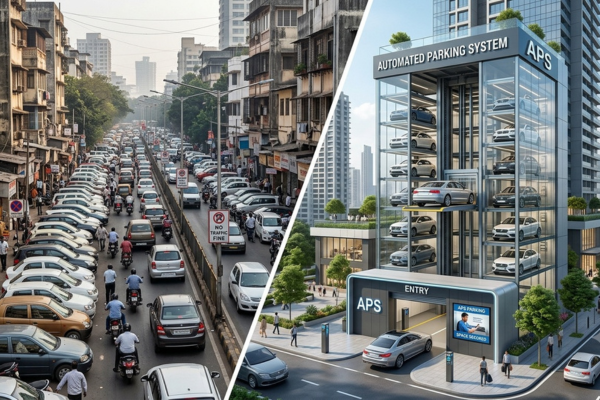
As India’s urban centres continue to grow vertically, one challenge that refuses to disappear is parking. Cities like Mumbai, Bengaluru, Pune, Delhi and Hyderabad are witnessing a massive rise in vehicle ownership while available land parcels continue to shrink. The result is visible every day — congested roads, illegal roadside parking, longer commuting delays and increasing frustration for residents and businesses alike.
In a city like Mumbai, where every square foot comes at a premium, conventional parking models are increasingly becoming inefficient. Developers, urban planners and infrastructure experts are now turning towards Automated Parking Systems (APS) as a smart and scalable solution to tackle the city’s growing parking crisis.
Automated Parking Systems use technology-driven mechanisms to park and retrieve vehicles without requiring drivers to navigate ramps or multiple basement levels. Vehicles are parked using lifts, pallets, conveyors etc. that maximize vertical and horizontal space utilization.
One of the biggest advantages of APS is space efficiency. Compared to conventional parking, automated systems can accommodate significantly more vehicles within the same footprint. This becomes particularly valuable in redevelopment projects, mixed-use developments, commercial hubs and high-density residential zones where land availability is limited.
The demand for automated parking is also being driven by redevelopment activity across Mumbai. Older buildings and societies undergoing redevelopment often struggle to accommodate modern parking requirements. Automated solutions allow developers to provide more parking slots while preserving usable space for amenities, landscaping and recreational infrastructure.
Apart from optimizing space, APS also improves traffic movement within buildings. Since drivers do not have to circulate across multiple parking floors searching for slots, internal congestion is minimized. The systems also reduce idle vehicle movement, helping lower fuel consumption and carbon emissions.
Safety and convenience are further adding to the appeal of automated parking. With minimal human intervention, risks related to scratches, theft, or parking damage are reduced considerably. In premium residential and commercial projects, automated parking is increasingly being marketed as a smart lifestyle feature that aligns with modern urban living.
Globally, cities such as Tokyo, Singapore and Dubai have already embraced advanced parking technologies to manage urban density. India too appears to be moving in that direction as developers and city planners increasingly focus on smart mobility infrastructure.
Experts believe that automated parking could soon become a standard feature in high-density developments, especially in metro cities where efficient land utilization is critical. As urban populations continue to rise and vehicle ownership increases, the future of parking may no longer lie in sprawling basements, but in intelligent, technology-driven vertical systems.
Disclaimer:
The views, opinions, and information expressed in this article are solely those of the author and do not necessarily reflect the views of Prop News Time. The content has not been independently verified or endorsed by Prop News Time. Readers are advised to exercise their own discretion and seek professional advice if required.
Advertisement













 Facebook
 Whatsapp
