Advertisement






What really powers the cloud? Behind every Google search, A...
A lot of what defines a home isn’t visible at handover. I...
Private equity has played a significant role in shaping Indi...
Luxury real estate is one of the most talked-about segments ...
Airports play a much bigger role than just enabling travel -...
The Mumbai Metropolitan Region Development Authority’s (MMRDA) recently launched ‘BKC Weekly Public Transport Day’ has brought renewed attention to last-mile connectivity issues in Bandra-Kurla Complex (BKC), one of Mumbai’s largest commercial districts. While the initiative aims to encourage greater use of public transport and reduce private vehicle dependence, feedback from commuters has highlighted gaps in feeder services, pedestrian connectivity and access between transit stations and workplaces. Industry stakeholders and mobility experts have stated that achieving meaningful shifts towards public transport will require integrated planning that combines mass transit infrastructure with efficient last-mile solutions, multimodal connectivity and commuter-focused mobility systems.
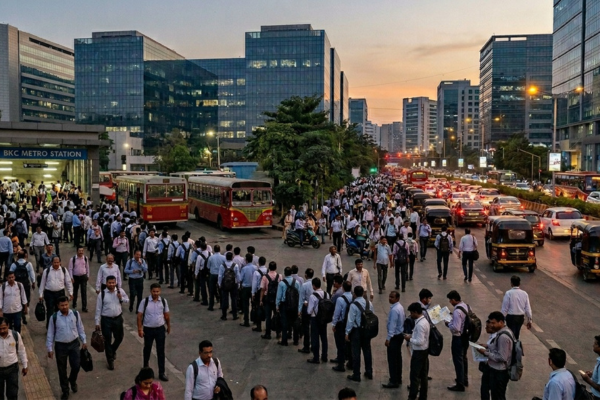
The Mumbai Metropolitan Region Development Authority’s (MMRDA) ‘BKC Weekly Public Transport Day’ initiative has renewed discussions around urban mobility planning, with commuter feedback highlighting the continuing challenge of last-mile connectivity within Bandra-Kurla Complex (BKC).
The initiative, launched to encourage office-goers to use public transport instead of private vehicles, is part of broader efforts to reduce congestion and support sustainable mobility across Mumbai’s commercial districts. However, responses from commuters during the initial implementation phase indicate that access between major transport nodes and workplace destinations remains a significant obstacle.
BKC, one of Mumbai’s largest business hubs, attracts nearly two lakh commuters daily. While recent years have seen substantial investments in metro rail, suburban rail and road infrastructure across the Mumbai Metropolitan Region, many commuters reported difficulties in completing the final stage of their journey due to limited feeder services, inadequate transport options and long walking distances between stations and offices.
One daily commuter travelling to BKC stated that although the initiative was a positive step towards promoting public transport, reaching workplaces from transit stations often remained time-consuming, particularly during peak hours. The commuter noted that improved feeder services and more seamless connectivity would encourage greater adoption of public transport.
Industry participants believe that addressing these concerns will require a more integrated approach to mobility planning. Ashish Majithia, Founder and Chief Executive Officer of Nextkraft Parking Technologies, said that the effectiveness of public transport initiatives depends on how efficiently commuters can complete both the first and last segments of their journeys.
He noted that while Mumbai has expanded its metro and rail networks considerably, last-mile connectivity continues to be a weak link. According to Majithia, future mobility ecosystems should integrate parking infrastructure, feeder transport services, pedestrian facilities and digital mobility solutions into a unified commuter experience. He added that automated parking systems near transit hubs could support park-and-ride models, enabling commuters to combine private vehicle use with public transport more effectively.
Urban mobility specialists have also emphasised that transit-oriented development requires more than investments in large-scale transport infrastructure. They argue that successful public transport systems depend on seamless integration between transit networks and localised mobility solutions that improve accessibility and convenience.
Navin Rajagopalan, Director of City Lifts India Limited, stated that as commercial districts become denser, mobility planning must increasingly focus on pedestrian movement and access between transport nodes and workplaces. He said that infrastructure such as elevators, escalators, skywalks and efficient people-movement systems can play an important role in improving commuter experiences within high-density business centres such as BKC.
From a real estate perspective, Khetsi Barot, Managing Director of The Guardians Real Estate Advisory, said that BKC’s continued growth as a commercial hub makes efficient public mobility increasingly important. He observed that while initiatives encouraging public transport adoption are beneficial, their long-term success will depend on stronger integration between metro networks, bus services, pedestrian infrastructure and last-mile transport options.
Experts believe that upcoming metro expansions and proposed mobility improvements in BKC present an opportunity to address many of these challenges. However, they stress that infrastructure development must be accompanied by coordinated planning centred on commuter convenience, accessibility and seamless connectivity.
As Mumbai continues to pursue a more transit-oriented urban development model, the experience of BKC’s Public Transport Day suggests that strengthening last-mile connectivity may prove critical to increasing public transport usage and reducing dependence on private vehicles across the city’s major business districts.
Advertisement













 Facebook
 Whatsapp
