Advertisement






What really powers the cloud? Behind every Google search, A...
A lot of what defines a home isn’t visible at handover. I...
Private equity has played a significant role in shaping Indi...
Luxury real estate is one of the most talked-about segments ...
Airports play a much bigger role than just enabling travel -...
Mumbai’s real estate sector is facing fresh challenges after the Brihanmumbai Municipal Corporation (BMC) suspended water supply to construction sites and imposed a 20% cut on commercial and industrial consumption amid declining reservoir levels. With water stocks in the city’s seven lakes dropping to 10.35% of total capacity, developers have warned that prolonged restrictions could affect construction schedules, increase project costs and impact housing deliveries. Industry stakeholders are urging authorities to facilitate access to treated water, streamline approvals for alternative sources and provide regulatory support to minimise disruption across ongoing projects in Mumbai and the Mumbai Metropolitan Region.
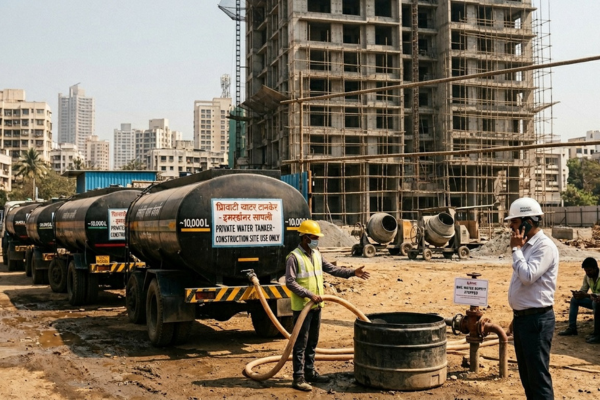
Mumbai’s real estate industry has expressed concerns over the potential impact of water supply restrictions imposed by the Brihanmumbai Municipal Corporation (BMC), warning that prolonged curbs could disrupt project execution and increase construction costs across the city and the Mumbai Metropolitan Region (MMR).
The civic body recently suspended water supply to construction sites and introduced a 20% reduction in water allocation for commercial and industrial users after water levels in Mumbai’s seven lakes fell to 10.35% of their total storage capacity. The measures have been implemented to prioritise drinking water requirements until reservoir levels improve.
Industry representatives acknowledged the need for conservation measures amid the ongoing shortage but cautioned that construction activities depend heavily on uninterrupted water availability for processes such as concreting, curing, plastering and finishing works.
Kamlesh Thakur, President of NAREDCO Maharashtra and Co-Founder and Managing Director of Srishti Group, said the industry understands the rationale behind the temporary restrictions and supports responsible water management during the current crisis. However, he noted that any extended disruption could affect construction schedules, labour productivity and project delivery timelines while increasing overall development costs.
According to Thakur, many developers have already adopted alternatives such as treated wastewater, recycled water, rainwater harvesting systems and private tanker supplies. However, the availability and affordability of these alternatives remain inconsistent across different parts of Mumbai, particularly for affordable and mid-income housing projects where margins are already under pressure.
He also highlighted the need for the development of a larger treated-water ecosystem dedicated to construction and other non-potable uses. Expanding recycling infrastructure and establishing dedicated treated-water distribution networks could reduce dependence on freshwater resources while ensuring continuity of development activity during periods of water stress.
Shilpin Tater, Managing Director of Superb Realty, said the restrictions have come at a time when residential activity remains strong across Mumbai and the MMR. He noted that increased reliance on tanker water and other alternative sources could place additional financial pressure on project budgets. Tater added that the situation reinforces the need for sustainable practices such as water recycling, treated water usage and efficient construction methods that minimise water consumption.
Shraddha Kedia Agarwal, Director of Transcon Developers, observed that water remains one of the most critical resources for project execution despite the sector’s ability to navigate other regulatory and infrastructure-related challenges. She stated that projects in advanced stages of construction are likely to face planning and scheduling challenges if restrictions continue for an extended period. Agarwal added that greater adoption of greywater recycling, treated water utilisation and enhanced rainwater harvesting systems will become increasingly important for future developments.
Dhruman Shah, Promoter of Ariha Group, said the current situation underscores the importance of building resilience into urban infrastructure planning. He warned that prolonged restrictions could have cascading effects throughout the development cycle, impacting project progress, possession timelines and commitments made to homebuyers. Shah also emphasised the need to accelerate sustainable water management practices and increase the use of recycled and treated water within the construction sector.
Industry stakeholders have urged the government and civic authorities to facilitate access to treated water supplies, ensure adequate tanker availability at reasonable rates and simplify approvals for alternative water sourcing arrangements. Developers have also sought consideration of project timeline relief where construction schedules are demonstrably affected by water shortages.
While the industry expects reservoir levels to improve with the arrival of the monsoon, developers maintain that the current situation highlights the need for long-term water management solutions capable of supporting both urban growth and resource conservation. They argue that balancing infrastructure development, housing delivery and sustainable water usage will remain critical as Mumbai continues to expand and urbanise.
Advertisement













 Facebook
 Whatsapp
