Advertisement






What really powers the cloud? Behind every Google search, A...
A lot of what defines a home isn’t visible at handover. I...
Private equity has played a significant role in shaping Indi...
Luxury real estate is one of the most talked-about segments ...
Airports play a much bigger role than just enabling travel -...
From high-speed rail corridors and international airports to metro expansions and railway upgrades, India is witnessing a period of sustained infrastructure development across multiple sectors. Several flagship projects have reported major construction milestones, received regulatory clearances or moved closer to operational readiness in recent months. Together, these developments reflect the scale of investment being directed towards improving mobility and connectivity across the country, while reshaping the physical networks that link cities, industries and regions.
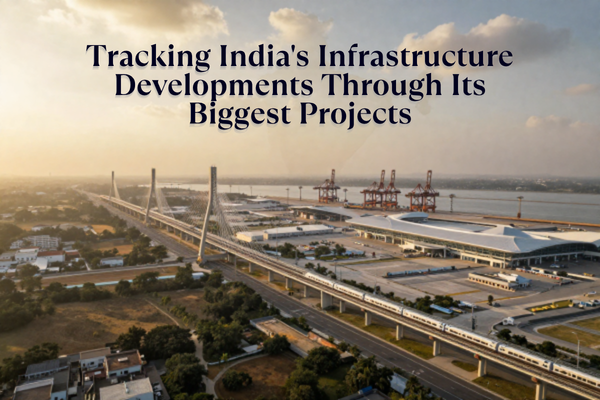
India's infrastructure landscape is being shaped by a new wave of transport projects aimed at improving connectivity and supporting economic growth. Across railways, aviation and urban transit, several flagship developments have recorded steady progress over the past year, reaching key milestones as construction advances.
Mumbai-Ahmedabad High-Speed Rail Corridor
Among the most closely watched projects is the Mumbai-Ahmedabad High-Speed Rail Corridor, India's first bullet train project. According to updates issued by the National High Speed Rail Corporation Limited (NHSRCL), construction activities have advanced across viaducts, stations, bridges and tunnel sections along the 508-kilometre route. Significant progress has also been reported on the underground tunnel package in Maharashtra, including work on shafts and tunnel excavation. The project remains one of the largest rail infrastructure initiatives currently under implementation in the country.
Noida International Airport
The aviation sector is witnessing a similarly transformative phase. Noida International Airport at Jewar achieved a major milestone after receiving its aerodrome licence from the Directorate General of Civil Aviation. Airport authorities subsequently confirmed the commencement of commercial flight operations from June 2026. Once operational, the airport will become one of the country's newest international aviation gateways and a key addition to the National Capital Region's aviation infrastructure network.
Navi Mumbai International Airport
On the western coast, work continues on the Navi Mumbai International Airport project. Developed to supplement the capacity of Mumbai's existing airport, the greenfield facility has recorded steady construction progress across terminal infrastructure, runways and associated facilities. The project remains one of India's most significant airport developments currently under execution.
Bengaluru Metro's Blue Line
Urban transit systems are also expanding rapidly. In Bengaluru, the Metro's Blue Line has moved forward with the arrival of its first driverless-capable trainset. Bengaluru Metro Phase 2A and 2B works remain among the country's largest ongoing urban transit projects. The Blue Line corridor is designed to improve connectivity between Central Silk Board, KR Puram, Hebbal and the airport region.
Mumbai metro
Mumbai's metro network is undergoing one of its largest phases of growth, with multiple corridors under construction or nearing completion across the Mumbai Metropolitan Region. New lines are intended to strengthen connectivity between residential areas, commercial districts and transport hubs, adding to the city's expanding public transit infrastructure.
Indian Railways
Railway Capacity Expansion Projects are boosting national connectivity. Recently approved multitracking projects such as the Kasara-Manmad corridor in Maharashtra, Delhi-Ambala corridor and Ballari-Hosapete route in Karnataka are expected to increase network capacity, reduce congestion and improve freight and passenger movement across key economic regions.
Delhi-Mumbai Expressway
Delhi-Mumbai Expressway is reshaping India's logistics network. Once fully operational, the expressway will connect Delhi and Mumbai through Haryana, Rajasthan, Madhya Pradesh, Gujarat and Maharashtra. The corridor is expected to reduce travel time significantly while unlocking industrial, warehousing and real estate opportunities along its route.
The government has also initiated preparatory work for additional high-speed rail corridors beyond the Mumbai-Ahmedabad route. Reports indicate that detailed project reports are being prepared for several proposed corridors connecting major cities, reflecting continued interest in expanding India's high-speed rail network.
Taken together, these projects highlight the breadth of infrastructure activity underway across the country. While differing in scale and purpose, they share a common objective: strengthening connectivity through investments in rail, aviation and urban transport. As construction advances and new facilities move towards operation, these developments are steadily altering the infrastructure landscape that supports India's economic and urban growth.
Advertisement













 Facebook
 Whatsapp
