Advertisement






What really powers the cloud? Behind every Google search, A...
A lot of what defines a home isn’t visible at handover. I...
Private equity has played a significant role in shaping Indi...
Luxury real estate is one of the most talked-about segments ...
Airports play a much bigger role than just enabling travel -...
Some monuments are remembered for their beauty, while others are remembered for the ideas they introduced. Across different centuries, a select group of Indian landmarks transformed construction techniques, architectural styles, and urban planning. From carving an entire mountain into a temple to designing buildings that naturally cooled themselves, these structures became milestones that influenced generations of architects. This journey explores the monuments that didn't just stand the test of time they changed the way India was built.
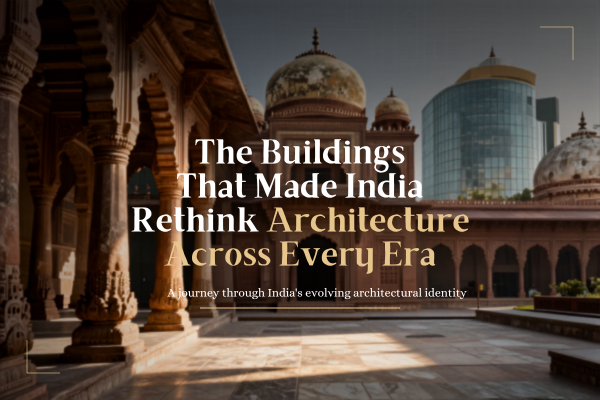
Architecture is a reflection of innovation. Every great civilization has buildings that mark turning points, where new materials, engineering methods, or design philosophies changed what was possible. India's architectural story spans more than two thousand years, and along the way, several monuments introduced groundbreaking concepts that inspired everything built after them. Whether through remarkable craftsmanship, scientific planning, or artistic vision, these landmarks shaped the country's architectural identity and continue to influence modern design. Here are the monuments that transformed India's architectural journey.
The Great Stupa at Sanchi: When Sacred Spaces Became Eternal
Long before massive stone monuments dominated the landscape, many religious structures were built using wood and brick. The Great Stupa at Sanchi changed that narrative by transforming Buddhist architecture into something permanent. Its iconic hemispherical dome became a template that would influence stupa construction across Asia, proving that spiritual monuments could also stand the test of time.
Kailash Temple, Ellora: The Mountain That Became a Temple
Imagine constructing a massive temple not by stacking stones, but by removing them. That is exactly what the builders of the Kailash Temple achieved. Carved from a single mountain cliff, the entire multi-story complex was sculpted from the top down, making it one of the greatest feats of monolithic rock-cut engineering in history. Even today, the scale of the achievement continues to astonish architects and historians alike.
Brihadisvara Temple, Thanjavur: The Towering Legacy of Chola Ingenuity
Building towering structures from granite is difficult because of the stone's immense weight. Yet the Brihadisvara Temple pushed engineering boundaries by using interlocking granite blocks without mortar to create a magnificent 216-foot vimana. Its precision and stability showcased the remarkable sophistication of South Indian Dravidian architecture and influenced temple construction for generations.
Qutb Minar, Delhi: The Tower That Changed the Skyline
At a time when India's architectural landscape was largely horizontal, the Qutb Minar introduced an entirely new visual language. Rising dramatically above its surroundings, it reflected Indo-Islamic engineering through the use of corbeled arches, vaults, and monumental vertical design. It marked the beginning of a new architectural chapter that blended different cultural traditions.
Humayun's Tomb, Delhi: A Dream in Red Sandstone and White Marble
Humayun's Tomb was more than a royal resting place; it introduced ideas that would define Mughal architecture. Its Persian-inspired Charbagh garden divided the landscape into four symmetrical sections, while its grand alcoves and double-dome construction created a sense of balance and scale rarely seen before. The design later became the foundation for many Mughal masterpieces.
Taj Mahal, Agra: A Monument Suspended Between Love and Eternity
The Taj Mahal did more than become a global symbol of love. It transformed imperial architecture by shifting from the dominant use of red sandstone to luminous white Makrana marble. Combined with flawless geometric symmetry and intricate pietra dura stone inlay work, it elevated craftsmanship into an art form that continues to define architectural excellence worldwide.
Hawa Mahal, Jaipur: The Pink City's Most Graceful Silhouette
Centuries before air conditioners existed, Hawa Mahal demonstrated climate-responsive architecture at its finest. Its famous facade of 953 stone windows allowed cool air to circulate through the structure using the natural Venturi effect while maintaining privacy for royal women. It remains an ingenious example of design working in harmony with the desert environment.
Chhatrapati Shivaji Maharaj Terminus, Mumbai: Where East Met West
As railways transformed India, architecture evolved alongside them. Chhatrapati Shivaji Maharaj Terminus blended Victorian Gothic styling and British industrial steel technology with traditional Indian domes and decorative elements, creating the defining example of Indo-Saracenic architecture. It proved that innovation could emerge from the fusion of different design traditions.
Rashtrapati Bhavan, New Delhi: The Building That Shaped a Capital
Rashtrapati Bhavan was not simply a residence; it established the visual identity of India's administrative heart. Combining monumental Western Neoclassical planning with Indian architectural details, it influenced the grand axial layout of New Delhi and demonstrated how global and local design philosophies could coexist within a single monumental structure.
Palace of Assembly, Chandigarh (1963 CE): The Moment India Chose the Future
After independence, India sought an architectural language that looked forward rather than backward. The Palace of Assembly in Chandigarh embraced Modernist Brutalism, using raw exposed concrete and bold geometric forms instead of historical ornamentation. It represented a decisive break from tradition and symbolized the aspirations of a modern nation ready to define its own identity.
From the stone dome of Sanchi to the concrete geometry of Chandigarh, these structures did more than decorate histor —they introduced new ideas that changed how India built its temples, cities, institutions, and monuments. Their influence extends far beyond their walls, making them milestones in the country's architectural journey.
Advertisement













 Facebook
 Whatsapp
