Advertisement






What really powers the cloud? Behind every Google search, A...
A lot of what defines a home isn’t visible at handover. I...
Private equity has played a significant role in shaping Indi...
Luxury real estate is one of the most talked-about segments ...
Airports play a much bigger role than just enabling travel -...
Mumbai’s sea-facing housing landscape is undergoing a structural shift driven by major infrastructure additions such as the Coastal Road, Mumbai Trans Harbour Link (Atal Setu), and the proposed Versova-Bandra Sea Link. These projects are gradually dissolving long-standing geographic constraints, bringing new coastal pockets into residential consideration and expanding the idea of waterfront living beyond traditional luxury zones. While South Mumbai’s ultra-prime belt continues to operate on scarcity-led demand and legacy value, emerging corridors are introducing relatively accessible entry points for sea or creek-facing homes. In 2026, the pricing gap between established luxury neighbourhoods and new coastal micro-markets is widening significantly, with emerging locations offering entry levels that are nearly one-tenth to half of prime South Mumbai rates.
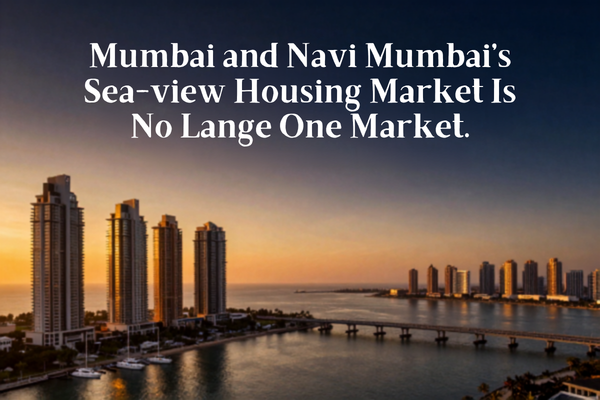
South Mumbai’s sea-view housing market remains largely insulated from broader infrastructure-led revaluation trends. Here, pricing is still dictated by heritage value, emotional capital, and extreme supply scarcity rather than connectivity upgrades.
Marine Drive
Marine Drive continues to represent Mumbai’s most recognisable coastal residential stretch, defined by its curved Art Deco skyline and uninterrupted view of the Arabian Sea. Homes here are not just residences but legacy assets, with many buildings dating back several decades and rarely changing hands. The absence of fresh development opportunities keeps inventory permanently constrained, reinforcing pricing in the range of INR 1–1.5 lakh per sq ft. Beyond numbers, the value here is tied to lifestyle continuity morning promenades, the Queen’s Necklace view at night, and proximity to South Mumbai’s business core, including Churchgate and CST.
Malabar Hill
Malabar Hill sits at the very top of Mumbai’s residential hierarchy, both literally and figuratively. Perched above the coastline, it offers a rare combination of elevation, greenery, and multi-directional sea views that remain unmatched in the city. The locality is characterised by quiet lanes, institutional residences, and tightly controlled redevelopment. Pricing, often INR 1–1.5 lakh per sq ft and higher, reflects not just exclusivity but also the near-impossibility of replicating its spatial advantages elsewhere in Mumbai. Demand here is largely generational, with homes often held for decades.
Cuffe Parade
Cuffe Parade represents South Mumbai’s coastal edge in its most formal, institutionalised form. The locality blends high-rise residential towers with colonial-era architecture and diplomatic precincts, all overlooking the Arabian Sea. Unlike other luxury pockets, its appeal lies in its strategic centrality — close to Nariman Point, Fort, and the port district. Prices remain among the highest in the city, supported by stable demand from legacy buyers and limited redevelopment pipelines. The sea view here is expansive and open, reinforcing its position as one of Mumbai’s most premium addresses.
The western coastal belt has evolved into Mumbai’s most dynamic luxury residential arc, where newer towers, improved infrastructure, and lifestyle-led demand converge. Unlike South Mumbai, this corridor reflects a mix of old exclusivity and new vertical luxury.
Worli
Worli has emerged as the defining benchmark for luxury high-rise living outside South Mumbai. With prices ranging between INR 65,000–1,00,000 per sq ft, it effectively trades at nearly half the levels of Malabar Hill while offering far more modern residential stock. The area is shaped by skyline-driven sea views, where towers directly face the Worli Sea Face and the Arabian Sea beyond. Developments such as premium branded residences have reinforced its status. Connectivity improvements via the Coastal Road and Bandra–Worli Sea Link have further strengthened its position, though congestion during peak hours remains a lived reality for residents.
Bandra West
Bandra West continues to operate as Mumbai’s most culturally layered coastal suburb, where sea-facing apartments coexist with heritage bungalows, cafes, and entertainment hubs. Its appeal is not just residential but experiential, attracting celebrities, entrepreneurs, and long-term city residents. Limited coastal inventory ensures sustained pricing pressure, even in older buildings. Despite infrastructure upgrades, internal congestion and constrained road widths remain persistent challenges. The locality’s strength lies in its vibrancy rather than uniform housing stock.
Juhu
Juhu remains one of Mumbai’s most aspirational beachfront addresses, defined by its direct beach access and a mix of luxury apartments and sprawling bungalows. The area’s residential profile is shaped heavily by privacy and celebrity ownership patterns. While pricing remains among the highest in the suburbs, daily livability is influenced by traffic congestion, seasonal monsoon conditions, and high visitor inflow due to the beach. Despite this, demand remains consistently strong due to its limited coastal inventory and airport proximity.
Mahalaxmi
Mahalaxmi has steadily emerged as a central luxury alternative to Worli, largely driven by large-scale redevelopment projects. Its defining characteristic is the rare dual view — the Arabian Sea on one side and the Mahalaxmi Racecourse green expanse on the other. Projects such as Piramal Mahalaxmi have reshaped its skyline with modern towers and premium amenities. Pricing typically trades at a slight discount to Worli, making it a preferred option for buyers seeking centrality with a visual advantage of both greenery and coastal proximity.
Versova
Versova represents the entry point into sea-facing living within the western suburbs, where pockets of coastal housing coexist with older fishing settlements. The arrival of Metro connectivity has improved accessibility, making it more viable for working professionals compared to earlier years. However, the locality still reflects a transitional character — part upgraded urban suburb, part traditional coastal community. This duality keeps prices lower than Bandra or Juhu, positioning it as a relative value option within the luxury corridor.
The emerging frontier reflects the most visible impact of infrastructure-led urban expansion. These markets are not defined by legacy prestige but by connectivity-led price discovery and long-term repositioning potential.
Sewri
Sewri has moved into prominence largely due to the Mumbai Trans Harbour Link, which has redefined its accessibility to both South Mumbai and Navi Mumbai. Once considered an industrial-leaning zone, it is now attracting residential interest due to emerging sea views and improved east-west connectivity. Prices of INR 35,000–45,000 per sq ft position it as nearly half the cost of Worli, making it one of the most closely watched transformation corridors in the city’s real estate landscape.
Mira Road-Bhayandar
Mira Road-Bhayandar is gradually evolving into a mass-market waterfront housing destination, driven by creek-facing developments and infrastructure extensions under the Coastal Road North expansion. The area is characterised by large housing stock, relatively newer construction, and improving connectivity into the western suburbs. Pricing remains significantly accessible at INR 15,000–20,000 per sq ft, making it a realistic entry point for first-time waterfront buyers.
Ulwe
Ulwe stands out as the most affordable coastal housing market in the Mumbai metropolitan region, shaped almost entirely by infrastructure-led development. With proximity to the Navi Mumbai International Airport and expanding road and rail links, the locality is transitioning from a peripheral node to a structured residential hub. Prices of INR 10,000–18,000 per sq ft place it at nearly one-tenth of Malabar Hill levels, yet it is increasingly positioned as a long-horizon coastal alternative for aspirational homebuyers.
Market outlook
According to Square Yards, Mumbai’s sea-view housing market is now clearly split across three price bands. At the top end, Malabar Hill is averaging about INR 71,399 per sq ft, with premium listings going up to INR 1.34 lakh per sq ft, while Worli has emerged as the most active luxury coastal market at roughly INR 65,000–75,000 per sq ft and has seen over 700 sales on one recent listings dataset. Bandra West is also trading strongly, with average rates of about INR 57,456 to 62,700 per sq ft, and luxury demand remains supported by deeper inventory and strong absorption. At the emerging end, Ulwe is still priced far lower at roughly INR 8,500–14,000 per sq ft, with one published dataset showing 5,000 units sold out of 6,606 launched, underscoring how infrastructure-led growth is reshaping the market beyond traditional luxury enclaves. Together, these figures show that Mumbai’s sea-facing housing is no longer one market but a spectrum, from legacy scarcity-driven prestige to newly accessible coastal expansion.
Advertisement













 Facebook
 Whatsapp
