Advertisement






What really powers the cloud? Behind every Google search, A...
A lot of what defines a home isn’t visible at handover. I...
Private equity has played a significant role in shaping Indi...
Luxury real estate is one of the most talked-about segments ...
Airports play a much bigger role than just enabling travel -...
The CSIR-Central Road Research Institute (CSIR-CRRI), New Delhi, signed a Memorandum of Agreement with the Government of Haryana on 8 June 2026 to implement a structured framework for paving and greening of urban roads across the state. The project, developed under the Commission for Air Quality Management's guidance and jointly executed with the School of Planning and Architecture, New Delhi, directly targets road dust a primary contributor to particulate pollution in the National Capital Region. The initiative covers four work packages spanning road design standards, greening measures, asset management, and construction technology adoption.
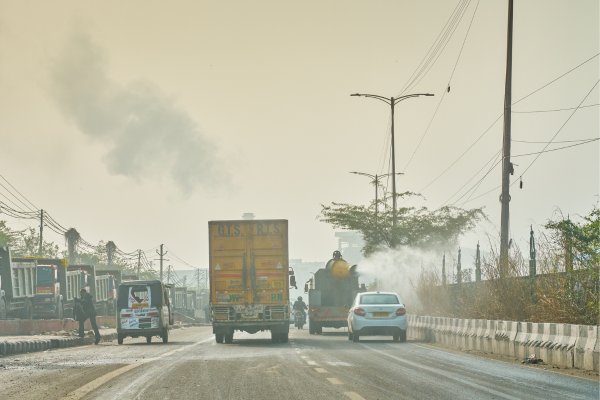
The CSIR-Central Road Research Institute (CSIR-CRRI), New Delhi, formalised an agreement with the Government of Haryana earlier this week to implement a science-backed urban road dust mitigation programme across the National Capital Region, marking the first structured operationalisation of a framework developed under the Commission for Air Quality Management.
The Memorandum of Agreement, signed at CSIR-CRRI's New Delhi campus on 8 June 2026, covers the implementation of the project titled "The Implementation of the Standard Framework for Paving and Greening of Urban Roads (Haryana State)." The project will be executed jointly by CSIR-CRRI and the School of Planning and Architecture (SPA), New Delhi, in collaboration with the Government of Haryana, under the technical oversight of the Commission for Air Quality Management (CAQM).
Road dust has long been identified as one of the principal contributors to particulate matter pollution across the NCR. CAQM had previously issued its Standard Framework and Detailed Guidance Document for Paving and Greening of Urban Roads, which drew directly on research recommendations developed by CSIR-CRRI. The present agreement converts those recommendations into a structured, state-level implementation programme, with Haryana serving as the first state to formally adopt the framework.
The project is organised around four major work packages: development of space standards and road cross-sections; mitigation of road dust through greening measures within the road right-of-way; improvement of road maintenance practices through a Road Asset Management System (RAMS); and adoption of innovative technologies for road construction and maintenance.
At the signing ceremony, Dr. Ch. Ravi Sekhar, Director of CSIR-CRRI, underlined the role of technology-driven interventions in addressing road dust and improving urban air quality, stressing the institute's focus on developing solutions that are both practical and replicable across urban environments. Prof. Virendra Kumar Paul, Director of SPA New Delhi, drew attention to the necessity of integrated urban planning approaches in building cleaner road networks, noting that collaborative implementation across agencies was central to the programme's success.
Representing the state government, Ashok Kumar, IAS, Commissioner and Secretary of the Urban Local Bodies Department, Government of Haryana, acknowledged the efforts of CSIR-CRRI, SPA New Delhi, and CAQM in constructing a comprehensive dust mitigation framework, and reaffirmed Haryana's commitment to its effective rollout across urban roads in the state.
Dr. S.D. Atri, Member (Technical) at CAQM, emphasised that road dust emissions remained one of the most significant and underaddressed contributors to particulate air pollution in the NCR, and stressed the need for coordinated action across research institutions, state agencies, and urban local bodies to ensure the framework's on-ground effectiveness.
The agreement was formally exchanged between all participating organisations in the presence of senior officials from CAQM, the Government of Haryana, CSIR-CRRI, and SPA New Delhi. The programme concluded with a vote of thanks by Dr. Vinod Karar, Scientist-G and Head of the Planning, Monitoring and Evaluation Division at CSIR-CRRI.
Source- PIB
Advertisement













 Facebook
 Whatsapp
