Advertisement






What really powers the cloud? Behind every Google search, A...
A lot of what defines a home isn’t visible at handover. I...
Private equity has played a significant role in shaping Indi...
Luxury real estate is one of the most talked-about segments ...
Airports play a much bigger role than just enabling travel -...
The Andhra Pradesh Capital Region Development Authority (APCRDA) conducted a Gram Sabha in Undavalli village to discuss land acquisition and land pooling activities linked to the development of Amaravati. Senior APCRDA officials informed villagers that landowners named in the recent acquisition notification still have an opportunity to join the Land Pooling Scheme within the stipulated timeframe. The authority also assured residents that concerns related to assigned lands, Lankan lands and local infrastructure needs would be addressed as per government guidelines. APCRDA sought continued cooperation from farmers as development works across the capital region gather pace.
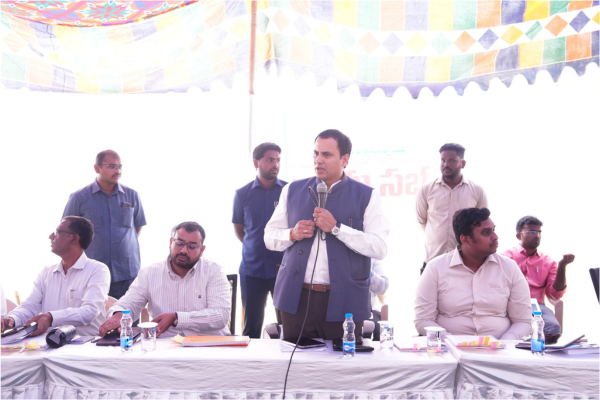
The Andhra Pradesh Capital Region Development Authority (APCRDA) recently conducted a Gram Sabha in Undavalli village as part of the ongoing land acquisition and development process for Amaravati, the state's capital city project.
The meeting was attended by APCRDA Commissioner V. Vijayarama Raju, IAS, along with Additional Commissioners A. Bhargava Teja, IAS, and Kollabathula Karthik, IAS. Officials interacted with villagers and addressed concerns related to land acquisition, land pooling and infrastructure development planned in the region.
During the Gram Sabha, the Commissioner explained that land pooling has been undertaken to facilitate key infrastructure projects in Amaravati, including road networks, Land Pooling Scheme (LPS) zones, pumping stations and other public infrastructure. He noted that while a large number of landowners had previously participated in the pooling process, some farmers and landowners had not joined the scheme, leading APCRDA to issue a land acquisition notification in accordance with the prescribed procedures after multiple rounds of discussions with stakeholders.
Officials clarified that farmers whose names appear in the recently issued land acquisition notification still have an opportunity to participate in the Land Pooling Scheme within the stipulated timeframe. The Commissioner also informed residents that several farmers from Undavalli had recently come forward to pool their lands following discussions with APCRDA officials.
Villagers raised concerns regarding assigned lands and Lankan lands during the meeting. Responding to these issues, APCRDA assured residents that such matters would be addressed in line with government orders and applicable regulations.
Residents also requested the establishment of educational institutions, healthcare facilities and other important public amenities in Undavalli. The Commissioner indicated that these demands would be taken into consideration as part of future planning for the area.
The authority further highlighted that infrastructure development plans are being prepared and implemented across villages within the Amaravati capital region. With construction activities progressing across several parts of the capital city, APCRDA urged farmers and local stakeholders to continue cooperating with officials to facilitate the timely execution of development works.
Officials also advised beneficiaries who have received returnable plots under the Land Pooling Scheme to complete the required registration formalities at the designated local offices. Representatives from various APCRDA departments participated in the Gram Sabha and responded to queries raised by villagers.
Amaravati's development has largely been driven through the Land Pooling Scheme, under which farmers voluntarily contribute land in exchange for developed returnable plots and supporting infrastructure. The model has been a key component of the capital city's planning framework since its inception.
Source APCRDA
Advertisement













 Facebook
 Whatsapp
