Advertisement






What really powers the cloud? Behind every Google search, A...
A lot of what defines a home isn’t visible at handover. I...
Private equity has played a significant role in shaping Indi...
Luxury real estate is one of the most talked-about segments ...
Airports play a much bigger role than just enabling travel -...
The Navi Mumbai Municipal Corporation (NMMC) highlighted the role of textile waste recycling in promoting environmental sustainability and women's empowerment during a World Environment Day programme held at the Textile Recovery Facility (TRF) in CBD Belapur. The facility, established through a partnership involving the Ministry of Textiles' Textile Committee, NMMC, Tisser Artisan Trust, IDH and SBI Foundation, focuses on recycling discarded textiles into usable products while creating livelihood opportunities for women. Municipal Commissioner Dr Kailas Shinde said the initiative demonstrates how circular economy practices can help address fabric waste, develop new skills among women and generate employment. The event also brought together government officials, industry representatives and self-help groups to discuss sustainable livelihood opportunities linked to textile recycling.
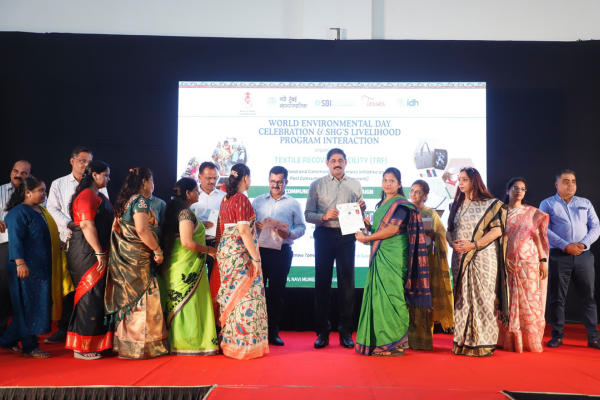
The Navi Mumbai Municipal Corporation (NMMC) has highlighted textile recycling as a practical solution for reducing fabric waste while creating livelihood opportunities for women through its Textile Recovery Facility (TRF) in CBD Belapur.
Speaking at a women’s self-help group livelihood dialogue programme organised on the occasion of World Environment Day, Municipal Commissioner Dr Kailas Shinde said environmental challenges arising from climate change require the implementation of multiple sustainable solutions. He noted that the textile recycling initiative had successfully transformed used clothing into attractive and reusable products, while simultaneously enabling women to acquire new skills and access employment opportunities.
The programme was organised at the Textile Recovery Facility, which has been established through a collaborative effort between the Textile Committee under the Ministry of Textiles, Government of India, and NMMC. The initiative is being supported by Tisser Artisan Trust, IDH and SBI Foundation.
Dr Shinde stated that the project demonstrates how waste materials can be integrated into a circular economy model instead of being discarded. By recovering and reprocessing textile waste, the facility is helping reduce the environmental burden associated with fabric disposal while generating economic opportunities for local communities.
The event was attended by Additional Municipal Commissioner Sunil Pawar, Textile Committee Director Tapan Kumar Raut, Deputy Commissioner Smita Kale, who heads the TRF centre, DC Handicrafts Regional Director Dipanshu Haldar, Tisser Founder Dr Megha Phansalkar, Zone 1 Deputy Commissioner Somnath Potre, Tisser Chief Executive Officer K.D. Ganapathy, TRF Project Director Prakash Saini and Chief Designer Nutan Kajbaje, along with other officials and stakeholders associated with the project.
During the interaction, participants discussed the role of textile recycling in sustainable development, waste reduction and livelihood generation. The programme also focused on strengthening the participation of women’s self-help groups in value-added activities linked to textile recovery and upcycling.
According to the civic administration, the facility has emerged as an example of how environmental management and social development objectives can be pursued simultaneously. Used garments and textile waste collected through the programme are processed and repurposed into new products, reducing waste generation while creating opportunities for skill development and income generation.
The initiative aligns with broader efforts to promote sustainable consumption, responsible waste management and community-based employment models. Officials noted that textile waste is an increasingly significant component of urban solid waste streams, making recycling and reuse critical components of long-term environmental management strategies.
Highlighting the importance of such initiatives, Dr Shinde said the success of the project lies not only in diverting textile waste from disposal but also in enabling women to participate in productive economic activities. He added that integrating environmental sustainability with livelihood creation offers a practical pathway towards inclusive and resilient urban development.
Advertisement













 Facebook
 Whatsapp
