Advertisement






What really powers the cloud? Behind every Google search, A...
A lot of what defines a home isn’t visible at handover. I...
Private equity has played a significant role in shaping Indi...
Luxury real estate is one of the most talked-about segments ...
Airports play a much bigger role than just enabling travel -...
The Goregaon-Mulund Link Road (GMLR) is a key infrastructure project aimed at improving east-west connectivity in Mumbai. Spanning 12.2 km and costing INR 10,100-14,000 crore, the project is set for completion by 2028, reducing travel time between Goregaon and Mulund from 75-90 minutes to just 15-25 minutes. Featuring twin tunnels and advanced Tunnel Boring Machines (TBMs), GMLR will enhance connectivity while minimizing environmental impact. Real estate experts predict a rise in property demand in Mulund and surrounding areas, driven by improved accessibility to business hubs in the western suburbs. The project is expected to boost Mumbai's urban development.
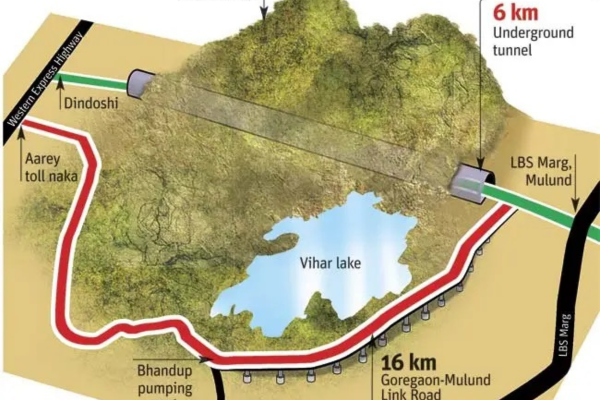
The Goregaon-Mulund Link Road (GMLR) is a major infrastructure development aimed at providing east-west connectivity in Mumbai. The 12.2-kilometer-long road will connect the Western Express Highway (WEH) at Goregaon to the Eastern Express Highway (EEH) at Mulund. Built at an estimated cost of INR 10,100-14,00 crores, the GMLR is scheduled for completion by 2028. Once operational, the route is expected to cut travel time between Goregaon and Mulund from the existing 75-90 minutes to a mere 15-25 minutes. Advertisement






East-west connectivity has always been a challenge in Mumbai. Given that the west is predominantly residential whereas the east holds most business and industrial centres, connectivity between the two regions is essential for everyday workers and office goers. At present, the city relies on two major link roads; the Santacruz-Chembur Link Road (SCLR) and the Jogeshwari-Vikhroli Link Road (JVLR) for east-west connectivity. Both routes have helped in alleviating some of the traffic woes but remain congested during rush hours, especially at major intersections. The twin tunnel bypass in the GMLR has been designed to bypass connected routes and offer seamless and quicker connectivity.
The project is employing state-of-the-art Tunnel Boring Machines (TBMs) with 13-14.5 meter diameters for accurate tunneling. To cause minimal disturbance to wildlife, GMLR does not include above-ground ventilation shafts within the Sanjay Gandhi National Park. Moreover, pipelines within the tunnels will augment the city's water supply system, making the project an important infrastructure development with environmental and utility advantages.
The GMLR is being developed in four phases. Phase 1 and 2 entail road widening works at Nahur Railway Overbridge, Goregaon East and Mulund West. Phase 3 will incorporate the construction of the main flyover and twin tunnels. Phase 4 will add more flyovers and underpasses to complete the link.
Mr. Nishant Deshmukh, founder and managing partner of Sugee Group believes the GMLR will greatly improve Mulund's residential appeal. According to him, "With better east-west connectivity, Mulund will be preferred by homebuyers seeking convenient commuting options to the western suburbs. The travel time reduction will increase its appeal among professionals working in Goregaon, Malad, and Andheri. We also foresee increased demand for high-end residential projects as Mulund transforms into a well-connected urban node."
Mulund's strategic position and enhanced connectivity via GMLR are poised to make it more desirable as a residential center. With shorter travel times to major western suburbs such as Goregaon, Malad, and Andheri, working professionals looking for improved commute facilities might find Mulund an appealing option. This expected demand is poised to fuel growth in the high-end residential segment, further establishing the area as a desirable urban hub.
Mr. Rohan Khatau, Director, CCI Projects, echoes the same upbeat perspective of the Malad to Borivali corridor. He believes "The GMLR will ease congestion on existing corridors and give a hassle-free travel experience to residents traveling to the eastern suburbs. With enhanced connectivity to business hubs and job centers, real estate in these locations will see increased demand, especially for mid-segment and premium residential complexes."
According to a report published by Knight Frank India, in January 2025, property registrations were the highest in the Western and Central suburbs of Mumbai, accounting for 85 percent of the total registrations clocked in. This growth reflects a growing interest in the area. Infrastructure projects such as the GMLR are likely to further add to its appeal.

5th Jun, 2025

25th May, 2023

11th May, 2023

27th Apr, 2023
Advertisement









 Facebook
 Whatsapp
