Advertisement










Private equity has played a significant role in shaping Indi...
In today’s real estate landscape, fitness is often treated...
In this episode of Prop Personalities, we sit down with Hars...
Luxury real estate is one of the most talked-about segments ...
Welcome to Prop Personalities by Prop News Time - a podcast ...
Mumbai’s western suburbs are witnessing a shift in residential demand as homebuyers increasingly prioritise proximity to daily essentials, workplaces, and transit networks. The concept of “15-minute living” is gaining traction, supported by infrastructure upgrades and metro expansion. Data from Knight Frank indicated that the city recorded over 97,000 home sales in 2025, alongside more than 1.5 lakh property registrations, with suburban locations accounting for over 80% of activity. Developers and industry stakeholders report growing end-user preference for micro-markets offering integrated social infrastructure, connectivity, and reduced commute times.
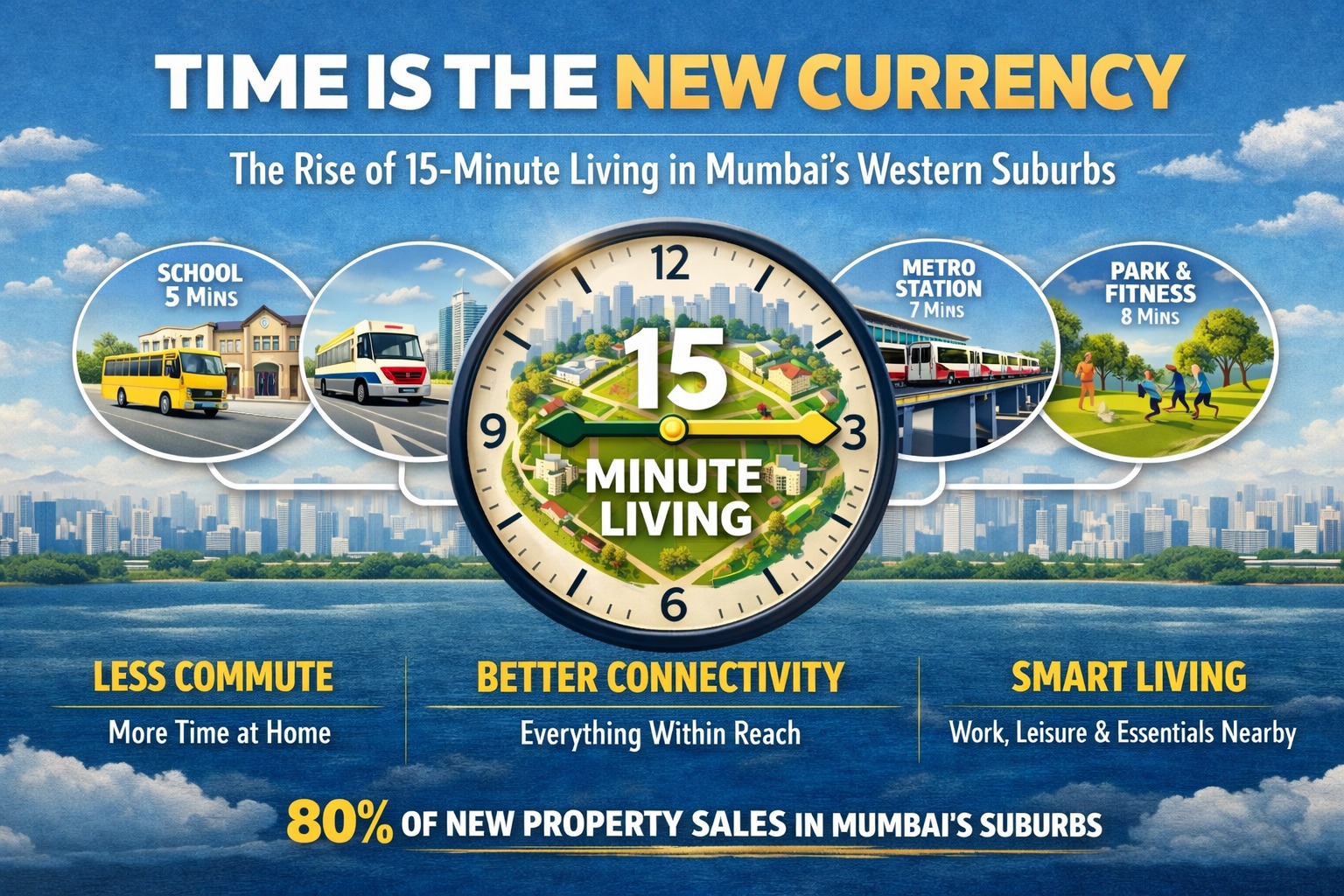
Residential demand across Mumbai’s western suburbs has shifted in the past year towards locations offering proximity-driven living, with homebuyers prioritising access to workplaces, transit systems, and social infrastructure within short travel distances. The trend, often described as “15-minute living”, reflects a growing preference for neighbourhoods where daily requirements can be met within a limited radius, reducing commute time and improving routine efficiency. Advertisement


According to data released by Knight Frank, Mumbai recorded over 97,000 residential sales during 2025, despite a year-on-year price increase of approximately 7%. The city also registered more than 1.5 lakh property transactions, marking the highest level in over a decade. A significant share of this activity has been concentrated in suburban markets, which account for over 80% of total registrations.
This shift has been particularly visible across western suburban micro-markets such as Andheri, Vile Parle, Goregaon, Malad, and Borivali, where established residential ecosystems are supported by improving metro connectivity and existing civic infrastructure. These locations offer a combination of accessibility, educational institutions, healthcare facilities, and retail options within short travel distances, aligning with changing buyer preferences.
Developers and consultants indicated that homebuyers are assessing residential options beyond unit specifications, with increased focus on how efficiently daily routines can be managed within a neighbourhood. Industry stakeholders observed that buyers are evaluating the integration of social infrastructure, transit access, and community amenities before making purchase decisions.
Mr Dhruman Shah, promoter of Ariha Group, noted that buyers were no longer limiting their assessment to the physical attributes of a property, but were instead examining how well their day-to-day activities could be accommodated within the surrounding area. He indicated that established residential pockets with existing infrastructure were gaining traction, as they offered familiarity and reduced dependency on long-distance travel.
Similarly, Mr Nihar Jayesh Thakkar, founder of The Mandate House Pvt. Ltd., stated that the focus had shifted from location as a static parameter to the overall living experience offered by a neighbourhood. He added that environments where work, leisure, and essential services coexist were attracting higher interest, as they allowed residents to structure their day with minimal travel.
Developers have also begun repositioning projects to align with this demand pattern. Connectivity is increasingly being treated as a central factor in project planning, particularly in areas benefiting from ongoing metro network expansion. Projects are being designed as integrated ecosystems where residential units are supported by accessible infrastructure and shared spaces.
A spokesperson from Chandak Group stated that there had been a visible shift in how value is defined by homebuyers, extending beyond connectivity to include the ease with which daily life can be managed within a locality. The spokesperson added that developments are being planned as cohesive environments that reduce friction in everyday routines.
The developer further reported sustained end-user interest across its projects in western suburbs, driven by proximity to metro corridors and established infrastructure networks.
The trend indicates a broader recalibration of housing demand in Mumbai, where time efficiency is emerging as a key determinant of residential value. As infrastructure improvements continue across suburban markets, demand is expected to remain concentrated in locations that offer integrated, proximity-led living environments.

5th Jun, 2025

25th May, 2023

11th May, 2023

27th Apr, 2023
Advertisement





 Facebook
 Whatsapp
