Advertisement






What really powers the cloud? Behind every Google search, A...
A lot of what defines a home isn’t visible at handover. I...
Private equity has played a significant role in shaping Indi...
Luxury real estate is one of the most talked-about segments ...
Airports play a much bigger role than just enabling travel -...
• The 134-km Sarkhej-Dholera semi high-speed rail corridor in Gujarat has been approved at an estimated cost of INR 20,667 crore.
• Railway officials said the project will cost much less per kilometre than the Delhi-Meerut Namo Bharat RRTS despite supporting higher train speeds.
• The corridor will use Indian Railways’ broad gauge network and the indigenous Kavach signalling system, helping reduce construction and technology costs.
• Lower land acquisition requirements and the absence of tunnel construction have also contributed to lower project costs.
• The rail line is expected to improve connectivity to Dholera Special Investment Region and support industrial and infrastructure growth in Gujarat.
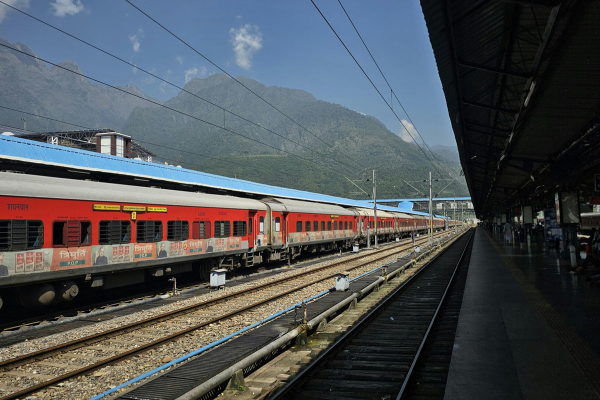
The proposed Sarkhej-Dholera semi high-speed rail corridor in Gujarat is expected to cost significantly less than the Delhi-Meerut Namo Bharat Regional Rapid Transit System (RRTS), according to railway officials involved with the project. Advertisement






The Union Cabinet recently approved the 134-km double-line rail corridor connecting Sarkhej near Ahmedabad with Dholera at an estimated cost of around INR 20,667 crore. The corridor is being developed as Indian Railways’ first semi high-speed rail project designed for operations on the existing broad gauge network.
Officials said the Ahmedabad-Dholera rail corridor has been planned for train speeds of up to 220 kmph, while operational speeds are expected to reach 200 kmph. In comparison, the Delhi-Meerut RRTS corridor was designed for speeds of 180 kmph.
Despite the higher speed capability, railway authorities said the Gujarat project would be much cheaper on a per-kilometre basis because of lower technology and construction costs.
According to officials, the construction cost of a standard broad gauge railway line capable of supporting speeds up to 160 kmph generally comes to around INR 50 crore per kilometre, excluding trainsets but including signalling systems.
The Sarkhej-Dholera semi high-speed rail project is estimated to cost nearly INR 154 crore per kilometre. In comparison, the Mumbai-Ahmedabad bullet train project has an estimated construction cost of around INR 358 crore per kilometre.
Officials said the difference in costs is mainly due to engineering complexity, land acquisition requirements, tunnel construction and the type of technology being used.
Unlike the Delhi-Meerut RRTS and Mumbai-Ahmedabad High-Speed Rail project, which use the globally adopted 1435 mm standard gauge system, the Gujarat corridor will operate on the 1676 mm broad gauge network used by Indian Railways. This allows the project to use existing railway standards and infrastructure more efficiently.
Railway officials also said the Ahmedabad-Dholera corridor will not require tunnels, which has helped reduce civil construction expenses. Large portions of the Delhi-Meerut RRTS corridor had to be developed through densely populated urban areas, increasing both land and engineering costs.
Another major cost-saving factor is the use of the indigenous Kavach automatic train protection system instead of the European Train Control System (ETCS) Level-II technology used in the Delhi-Meerut corridor.
Officials stated that ETCS Level-II technology costs nearly INR 17.74 crore per kilometre, while the Kavach system costs around INR 4.53 crore per kilometre. Indian Railways has been expanding Kavach deployment across major rail routes over the past few years as part of its railway safety modernisation programme.
The Ahmedabad-Dholera corridor will also have lower land acquisition expenses compared to urban rapid rail systems. As per the approved alignment, around 71 km of the total 134-km corridor will be constructed on viaducts.
The semi high-speed rail project is expected to strengthen connectivity to Dholera Special Investment Region (SIR), which is being developed under the Delhi-Mumbai Industrial Corridor programme. Over the past few years, the region has seen major infrastructure development, including the upcoming Dholera International Airport, expressway connectivity and industrial zone expansion.
Indian Railways has also been increasing its focus on faster rail systems beyond the current Vande Bharat platform. Earlier, the national transporter approved plans for new-generation trainsets capable of operating at speeds up to 220 kmph as part of its long-term rail modernisation strategy.
Source PTI

5th Jun, 2025

25th May, 2023

11th May, 2023

27th Apr, 2023
Advertisement









 Facebook
 Whatsapp
