Advertisement










Private equity has played a significant role in shaping Indi...
In today’s real estate landscape, fitness is often treated...
In this episode of Prop Personalities, we sit down with Hars...
Luxury real estate is one of the most talked-about segments ...
Welcome to Prop Personalities by Prop News Time - a podcast ...
The upcoming Missing Link project on the Mumbai–Pune Expressway is expected to enhance connectivity and reduce travel time between the two cities, bringing emerging locations such as Karjat, Neral, and Lonavala into sharper focus for real estate development. The infrastructure upgrade, alongside projects like the Mumbai Trans Harbour Link and Navi Mumbai International Airport, is contributing to the growth of the Mumbai 3.0 region. Developers and industry bodies indicate rising interest in plotted developments, villa projects, and second homes, supported by relatively lower land costs and improving infrastructure in peripheral markets.
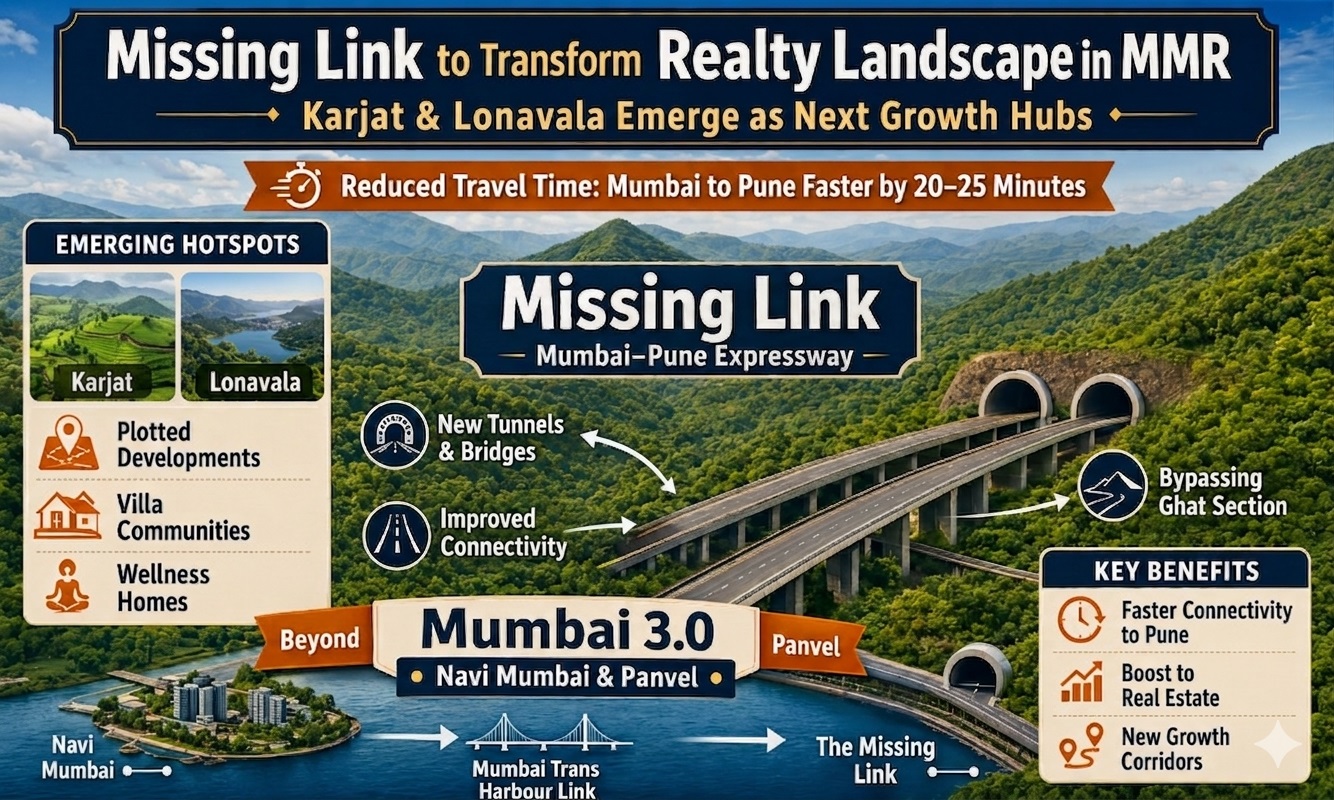
The Missing Link project on the Mumbai–Pune Expressway is expected to improve connectivity between Mumbai and Pune while supporting real estate development across emerging locations such as Karjat, Neral, and Lonavala, which are increasingly being positioned within the extended Mumbai Metropolitan Region (MMR) growth corridor. Advertisement


The infrastructure project, currently under development, is designed to bypass the ghat section of the expressway and reduce travel time between the two cities by approximately 20–25 minutes. The improvement in connectivity is also expected to ease congestion along one of the country’s busiest expressways while enabling better access to peripheral micro-markets.
Industry stakeholders indicate that improved accessibility is already influencing buyer interest in areas such as Karjat and nearby regions, where real estate activity has been gradually increasing. These locations are witnessing development across plotted layouts, villa communities, and second-home projects, driven by a combination of lower entry costs, natural surroundings, and incremental infrastructure improvements.
Developers stated that the reduction in travel time is likely to make such locations more viable for both end-users and investors seeking alternatives beyond the core city and established suburban markets. It was conveyed that homebuyers are increasingly looking for residential options that combine connectivity with improved living conditions, particularly in less dense environments.
The emerging concept of “Mumbai 3.0” — referring to peripheral growth zones beyond Navi Mumbai and Panvel — is gaining traction alongside multiple infrastructure developments. Projects such as the Mumbai Trans Harbour Link (MTHL) and the Navi Mumbai International Airport are contributing to a broader shift in development patterns across the region.
Industry representatives indicated that the Missing Link project is expected to enhance connectivity between Mumbai and Pune while opening up additional development corridors. It was noted that improved mobility could support the decentralisation of demand, reduce pressure on established urban centres, and create new opportunities for residential and commercial projects in underdeveloped locations.
Stakeholders also highlighted that improved connectivity is attracting interest from developers and homebuyers based in Pune, who may now view locations such as Neral and Karjat as accessible investment and residential options. The increased inter-city linkage is expected to support cross-market demand dynamics.
According to industry observations, the availability of comparatively lower-priced land in these locations, combined with rising lifestyle aspirations, is likely to sustain demand for second homes and plotted developments. However, the pace of growth will remain linked to continued infrastructure delivery and policy support.
The Missing Link project is part of a wider infrastructure-led expansion across the MMR, which is gradually reshaping real estate activity by extending development into peripheral corridors and creating new urban clusters beyond the traditional city limits.

5th Jun, 2025

25th May, 2023

11th May, 2023

27th Apr, 2023
Advertisement





 Facebook
 Whatsapp
