Advertisement










Private equity has played a significant role in shaping Indi...
In today’s real estate landscape, fitness is often treated...
In this episode of Prop Personalities, we sit down with Hars...
Luxury real estate is one of the most talked-about segments ...
Welcome to Prop Personalities by Prop News Time - a podcast ...
Mumbai recorded its strongest February performance in over a decade in 2026, with 13,029 property registrations logged within the Brihanmumbai Municipal Corporation limits, generating stamp duty revenue of more than INR 1,134 crore, according to data released by Knight Frank India. Registrations rose 8 per cent year-on-year, while stamp duty collections increased by a sharper 21 per cent, reflecting a clear shift towards higher-value residential transactions. Homes accounted for close to 80 per cent of all registrations. The share of properties priced above INR 5 crore and in the INR 2-5 crore bracket expanded, while the sub-INR 1 crore segment declined. Industry participants said the data points to sustained end-user demand, rising purchasing power and an upgrade cycle driven by preferences for better connectivity, amenities and long-term value.
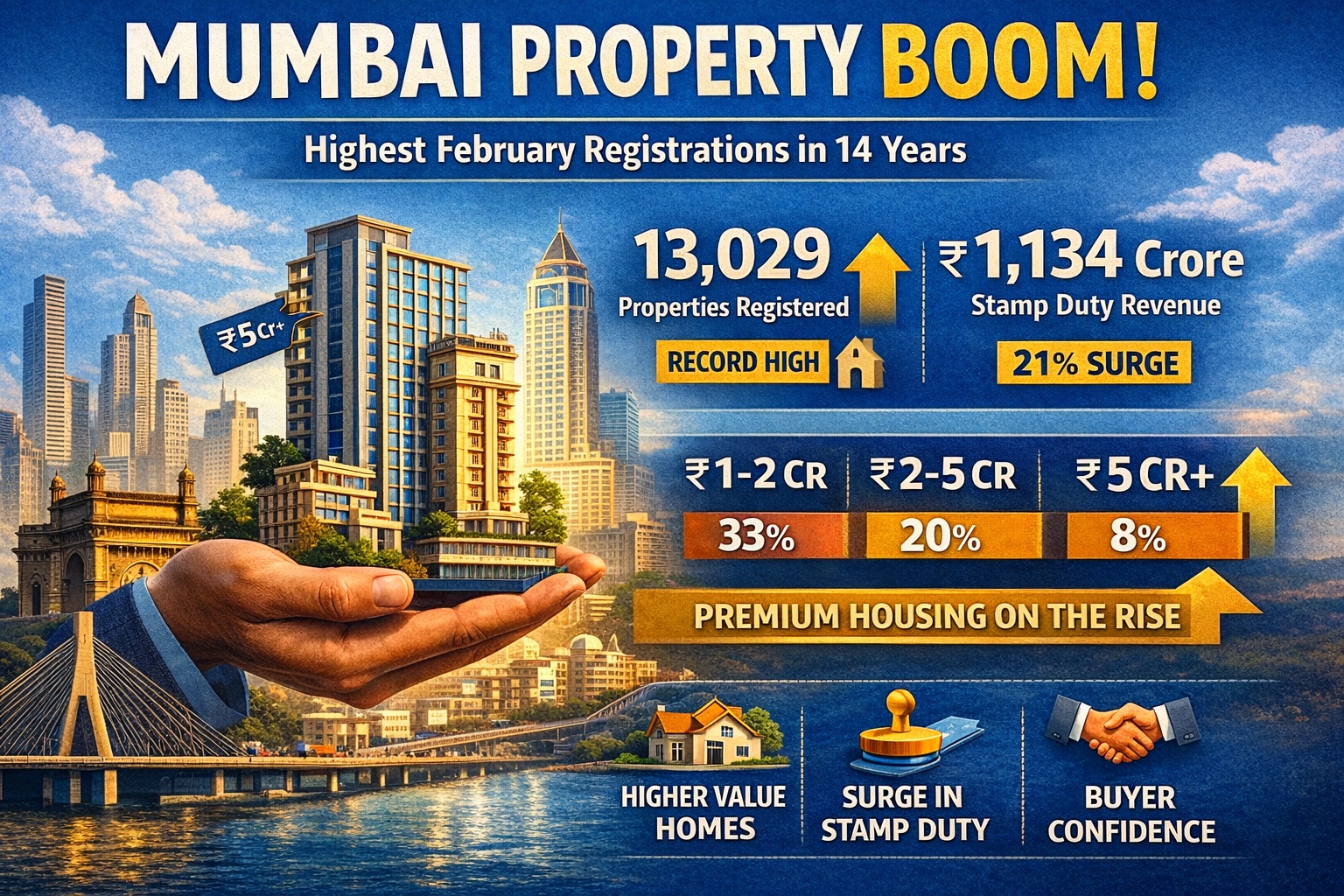
Mumbai's residential real estate market delivered its highest February performance in 14 years in 2026, underlining sustained end-user demand and a steady move towards higher-value housing. As per data compiled for areas under the Brihanmumbai Municipal Corporation, a total of 13,029 property registrations were recorded during the month, generating stamp duty collections of over INR 1,134 crore for the Maharashtra government. Advertisement


On a year-on-year basis, registrations increased by 8 per cent compared to February 2025. However, stamp duty collections grew by a sharper 21 per cent, signalling a rise in average ticket sizes rather than a pure volume-led expansion. Residential assets continued to dominate transaction activity, contributing nearly 80 per cent of total registrations during the month.
A closer look at the ticket-size distribution shows a clear premiumisation trend. Properties priced above INR 5 crore accounted for 8 per cent of registrations, up from 6 per cent a year earlier. The INR 2-5 crore segment expanded to 20 per cent from 17 per cent, while the INR 1-2 crore category rose to 33 per cent from 31 per cent. In contrast, the share of homes priced below INR 1 crore declined to 40 per cent from 46 per cent in February 2025.
Industry bodies and developers said the divergence between registration growth and revenue growth highlights a structurally healthier market. Prashant Sharma, President of NAREDCO Maharashtra, indicated that the data reflects buyer confidence and a preference for quality housing in well-connected locations, with the higher contribution from INR 1-5 crore and above-INR 5 crore segments pointing to stronger purchasing power and market maturity.
Advisory firms and developers also noted that while apartments up to 1,000 sq ft continue to account for a large share of transactions, there is a gradual shift towards larger and more lifestyle-oriented homes. Ram Naik, Co-founder and Chief Executive Officer of The Guardians Real Estate Advisory, observed that the growing share of premium segments suggests an ongoing upgrade cycle among homebuyers.
Developers including Srishti Group, Superb Realty and Transcon Developers said the February data reflects resilient end-user demand supported by stable macroeconomic conditions and ongoing infrastructure investments. They added that buyer interest remains concentrated in established micro-markets, particularly in the western suburbs, where connectivity and social infrastructure continue to support higher-value transactions.
Taken together, the February numbers indicate that Mumbai's housing market is being driven less by speculative volume and more by quality-led demand, reinforcing its long-term stability despite pricing pressures at the lower end of the market.

5th Jun, 2025

25th May, 2023

11th May, 2023

27th Apr, 2023
Advertisement





 Facebook
 Whatsapp
