Advertisement










Private equity has played a significant role in shaping Indi...
In today’s real estate landscape, fitness is often treated...
In this episode of Prop Personalities, we sit down with Hars...
Luxury real estate is one of the most talked-about segments ...
Welcome to Prop Personalities by Prop News Time - a podcast ...
The 162-km Khammam Devarapalle access-controlled greenfield expressway, being developed by the National Highways Authority of India under the Bharatmala Pariyojana, is nearing completion. Built at an estimated cost of INR 3,700 crore, the four-lane corridor will be Telangana's first access-controlled highway. The project is expected to reduce the distance between Hyderabad and Rajahmundry by around 56 km and cut travel time by two to four hours. Despite delays due to land acquisition, utility shifting and monsoons, most of the construction has now been completed.
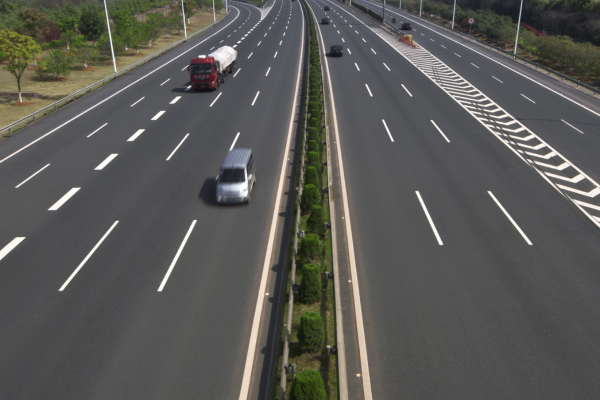
The 162-km Khammam-Devarapalle greenfield expressway, developed by the National Highways Authority of India (NHAI) under the Bharatmala Pariyojana, is in its final stages of construction. The four-lane, access-controlled highway is expected to be fully ready by May, with the majority of civil works already completed. Once operational, it will become Telangana's first access-controlled expressway. Advertisement


The project connects Thallampadu in Telangana to Devarapalle in Andhra Pradesh. Of the total stretch, about 105.24 km lies in Telangana and 56.89 km in Andhra Pradesh. The expressway has been divided into five construction packages for execution. It has been developed at an estimated cost of INR 3,700 crore with the objective of improving regional connectivity and easing traffic pressure on existing highways such as NH-65 and NH-16.
Currently, around 116 km of the corridor has been completed. The remaining works, including finishing activities, interchanges and associated infrastructure, are progressing. Once open to traffic, the new alignment is expected to shorten the road distance between Hyderabad and Rajahmundry by nearly 56 km. Travel time between the two cities could reduce by two to four hours, particularly benefiting long-distance passenger and freight movement towards the Andhra Pradesh coast.
The expressway has been designed with controlled entry and exit points to ensure uninterrupted traffic flow. It includes major bridges, over 170 culverts across streams and water bodies, service roads at select stretches, grade separators, interchanges, toll plazas and truck lay-bys. Solar-powered lighting, landscaped medians, crash barriers and modern traffic management systems have also been incorporated to improve safety and operational efficiency.
The project was originally proposed in 2017 as a plan to widen existing two-lane roads over approximately 182 km. However, in 2018, authorities decided to develop a new greenfield alignment passing largely through less populated areas to allow better speed design and future expansion. During implementation, the project faced several challenges, including acquisition of around 554 hectares of land in Telangana, arbitration proceedings related to compensation, relocation of high-tension power transmission lines and shortage of soil for embankment works. Fly ash was used as an alternative material in certain stretches to address construction constraints.
Work was also affected during two monsoon seasons, slowing down progress at multiple locations. Despite these issues, construction advanced steadily across packages, bringing the project close to completion. Officials have indicated that the corridor will play a key role in strengthening the Hyderabad-Visakhapatnam connectivity corridor and supporting smoother interstate movement between Telangana and Andhra Pradesh.

5th Jun, 2025

25th May, 2023

11th May, 2023

27th Apr, 2023
Advertisement





 Facebook
 Whatsapp
