Advertisement










Private equity has played a significant role in shaping Indi...
In today’s real estate landscape, fitness is often treated...
In this episode of Prop Personalities, we sit down with Hars...
Luxury real estate is one of the most talked-about segments ...
Welcome to Prop Personalities by Prop News Time - a podcast ...
India's housing market is witnessing a generational reset, with Millennials emerging as the dominant force in urban home buying. Once associated with renting and lifestyle flexibility, this cohort is now driving a strong shift toward ownership, particularly in affordable and mid-income segments across Mumbai, Bengaluru and NCR. Post-pandemic priorities, hybrid work models and rising rental costs have accelerated this transition. Millennials and Gen Z together account for over half of home-loan demand in major cities, reshaping how homes are designed, marketed and delivered. Digital-first research, preference for efficient layouts, smart-home technology and sustainability-focused living have become defining purchase criteria. As this demographic is projected to form nearly 60 per cent of new homebuyers by 2030, their evolving preferences are fundamentally redefining India's residential real estate landscape.
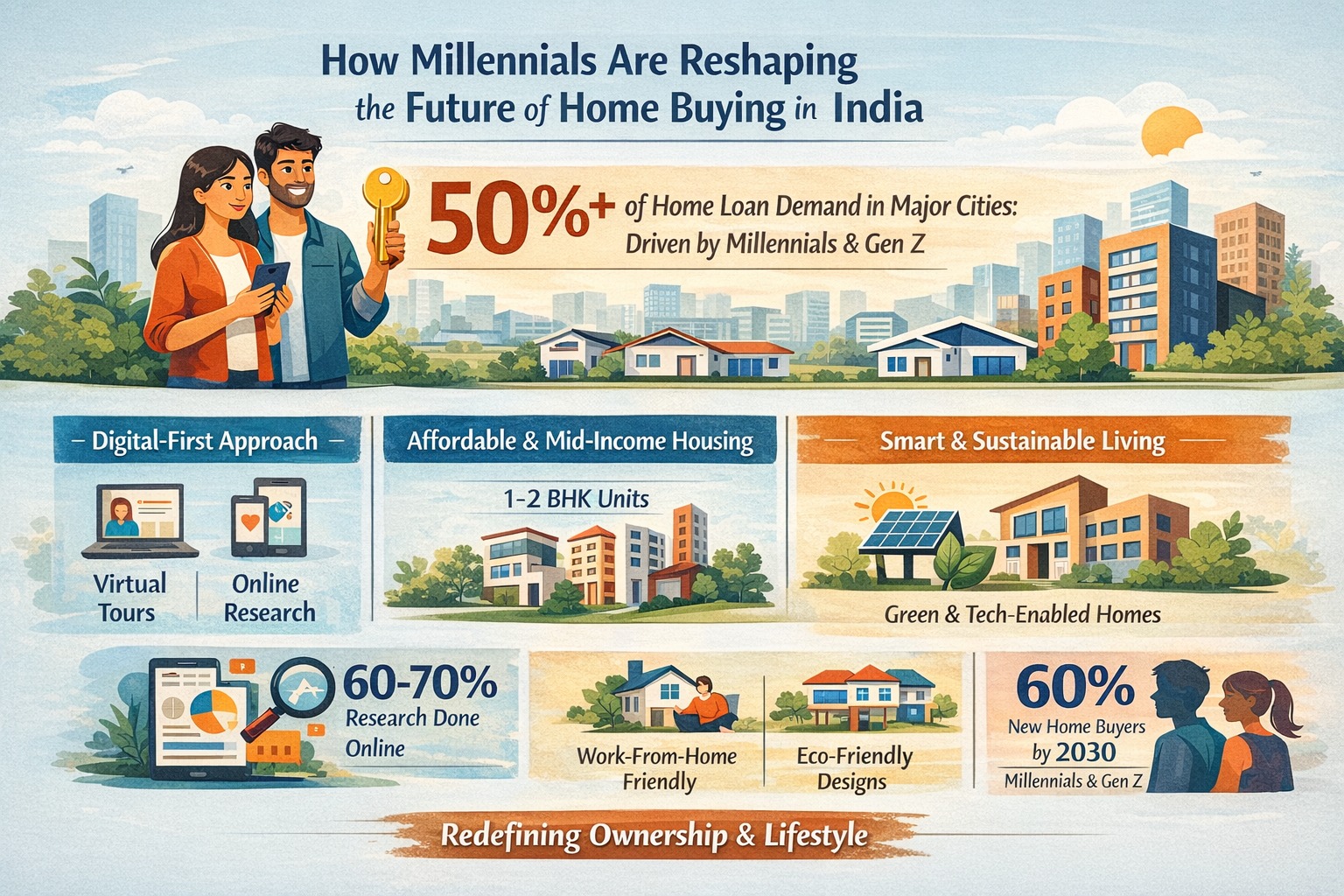
India's housing market is undergoing a profound generational transformation, with Millennials emerging as the most influential home-buying cohort in urban India. Once perceived as a generation inclined toward renting and experience-led living, Millennials are now actively driving a decisive shift toward ownership, reshaping demand patterns as well as how homes are conceptualised and delivered. Advertisement


Over the past few years, the share of first-time homebuyers in their late 20s and early 30s has risen sharply. Post-pandemic lifestyle recalibration, improved income stability, hybrid work arrangements and the desire for long-term financial security have accelerated this transition. Industry data indicates that Millennials and Gen Z together account for over 50 per cent of total home-loan demand across key cities, making them the single largest force in mortgage activity. Much of this demand is concentrated in affordable and mid-income housing across Tier-I markets such as Mumbai, Bengaluru and NCR.
Jayesh Rathod, Co-Founder and Director at The Guardians Real Estate Advisory, notes that Millennials are displaying unprecedented confidence in property ownership. He observes that this generation seeks flexible layouts, smart-home integration and wellness-centric spaces, prompting developers to rethink conventional design models.
A defining characteristic of Millennial buyers is their digital-first approach. Property research today begins well before a site visit. Buyers actively compare projects, evaluate price benchmarks, study neighbourhood infrastructure, access virtual walkthroughs and assess long-term appreciation prospects online. Industry surveys suggest that nearly 60-70 per cent of the decision-making journey now happens digitally, compelling developers to adopt greater transparency and faster, data-backed communication.
Shraddha Kedia-Agarwal, Director at Transcon Developers, highlights that by the time Millennials visit a sales office, they are already well-informed about pricing, specifications and location dynamics. This preparedness has elevated expectations around clarity, efficiency and service quality throughout the buying process.
Practicality also defines Millennial preferences. One- and two-bedroom configurations account for more than half of residential demand, reflecting a focus on efficient, adaptable spaces suited to nuclear families and work-from-home needs. Buyers are scrutinising layouts, material quality and maintenance considerations before committing.
Technology has moved from a premium feature to a baseline requirement. Smart access systems, app-enabled property management and integrated security are now standard expectations. Sustainability has likewise become central, with growing demand for green-certified developments featuring solar power, efficient water management and eco-friendly materials.
For Millennials, a home is both an asset and a lifestyle statement. Integrated townships and community-oriented developments that blend convenience with wellness are gaining traction. As Millennials and Gen Z are projected to account for nearly 60 per cent of new homebuyers by 2030, their priorities are set to define the next growth cycle of India's residential real estate sector.
Disclaimer:
The views, opinions, and information expressed in this article are solely those of the author and do not necessarily reflect the views of Prop News Time. The content has not been independently verified or endorsed by Prop News Time. Readers are advised to exercise their own discretion and seek professional advice if required.

5th Jun, 2025

25th May, 2023

11th May, 2023

27th Apr, 2023
Advertisement





 Facebook
 Whatsapp
