Advertisement










Private equity has played a significant role in shaping Indi...
In today’s real estate landscape, fitness is often treated...
In this episode of Prop Personalities, we sit down with Hars...
Luxury real estate is one of the most talked-about segments ...
Welcome to Prop Personalities by Prop News Time - a podcast ...
India's real estate sector could drive significant climate gains by adopting net-zero building practices, according to the NIUA-RMI report 'Build Right for the First Time.' The report estimates that integrating net-zero principles in new construction could cut up to 8 gigatons of CO? by 2050. Though this transition adds INR 4,566 per sq. m, benefits include lower emissions, reduced operational costs, and healthier living spaces. Developers like Signature Global and Krisumi Corporation are embedding sustainability through energy-efficient designs, low-carbon materials, and advanced cooling systems. Market demand for eco-friendly homes is growing, with certifications like EDGE and IGBC gaining traction. The report calls for supportive policies, incentives, and updates to the National Building Code. States like Gujarat and Maharashtra are leading the way with net-zero codes. As regulations evolve, India's real estate industry is poised to be a cornerstone of the nation's green transition.
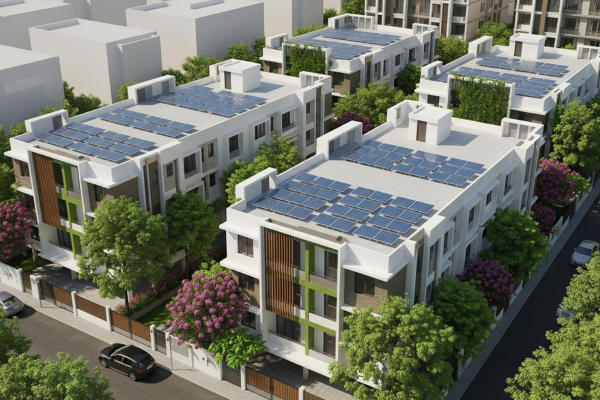
India's real estate sector has emerged as a central player in the country's escalating climate commitments, positioning itself as a vital driver of the green transition. A recent collaborative report by the National Institute of Urban Affairs (NIUA) and Rocky Mountain Institute (RMI), titled 'Build Right for the First Time: Scaling Adoption of Net-Zero Carbon Buildings in India,' underscores the indispensable role developers must embrace to meet national net-zero targets. Advertisement


The report estimates that by integrating net-zero principles into new construction, India could cut as much as 8 gigatons of CO? emissions by 2050. Although this transition necessitates an additional investment of INR 4,566 per sq. m, the long-term advantages-including lower emissions, operational cost savings, and healthier living environments-strongly justify the expense.
Lalit Kumar Aggarwal, Co-founder and Vice Chairman of Signature Global (India) Ltd., conveyed that the findings reaffirmed a conviction long held by forward-thinking developers: building green is both environmentally responsible and economically prudent. He mentioned that Signature Global has embedded sustainability as a fundamental aspect of their business strategy, employing energy-efficient designs, low-carbon materials, and advanced cooling systems to contribute substantially to India's net-zero aspirations.
Developers across all market segments are recalibrating their approach. From affordable housing to premium projects, many are integrating passive design features, utilising low-carbon construction materials, and incorporating on-site renewable energy generation. Net-zero is rapidly evolving from a lofty goal into an essential business imperative.
Ashok Kapur, Chairman of Krishna Group and Krisumi Corporation, observed that sustainability has transitioned from being optional to inevitable in real estate development. He highlighted that homebuyers increasingly favour projects that feature eco-conscious designs and materials. As buyer priorities shift, embedding sustainability at the core of real estate development is not only a response to market demand but a necessity to ensure long-term value and relevance.
Technological advancements are further accelerating this shift. The report draws attention to cutting-edge cooling technologies, such as air conditioning systems up to five times more efficient than conventional models, which offer both environmental benefits and cost reductions for homeowners. However, the success of this transformation hinges on more than developer initiatives alone. The report stresses the need for a supportive ecosystem involving green construction incentives, streamlined regulatory approvals, and timely revisions to the National Building Code. Notably, states like Gujarat and Maharashtra are pioneering net-zero building codes within urban expansion zones, setting benchmarks for others.
Experts emphasise that India's affordable and mid-income housing sectors-expected to lead urban residential growth-hold tremendous potential for emissions reductions if net-zero standards are adopted from the outset. Moreover, post-pandemic shifts in buyer preferences demonstrate a growing demand for healthier, energy-efficient living spaces. Certification programmes such as EDGE and IGBC are gaining prominence as consumers seek homes that offer lower utility costs and a reduced environmental footprint.
The NIUA-RMI report acts as both a warning and a guide. What was once seen as a contributor to urban emissions is now recognised as a critical ally in India's climate mission. The path forward demands concerted efforts in scaling up sustainable practices, fostering innovation, and aligning policy, finance, technology, and consumer behaviour. With sustained momentum, the real estate sector could become the foundation of a net-zero India, built brick by green brick.
As regulations evolve and market demand for sustainable homes intensifies, developers are compelled to innovate continuously, fostering resilience in the face of climate challenges. Ultimately, the real estate industry's embrace of net-zero practices signals a broader cultural and industrial awakening, setting a precedent for other sectors and reinforcing India's leadership in the global climate arena.

5th Jun, 2025

25th May, 2023

11th May, 2023

27th Apr, 2023
Advertisement





 Facebook
 Whatsapp
