Advertisement










Private equity has played a significant role in shaping Indi...
In today’s real estate landscape, fitness is often treated...
In this episode of Prop Personalities, we sit down with Hars...
Luxury real estate is one of the most talked-about segments ...
Welcome to Prop Personalities by Prop News Time - a podcast ...
The Uttan-Virar Sea Link (UVSL) Phase-1, spearheaded by the Mumbai Metropolitan Region Development Authority (MMRDA), is progressing rapidly with a revised layout that promises to revolutionise northern Mumbai's infrastructure. Originally conceptualised as the Versova-Virar Sea Link, the project was reorganised into phases after being handed over from MSRDC to MMRDA in late 2022. The first phase, connecting Uttan to Virar, was approved for implementation earlier this week, while the second phase awaits feasibility clearance. With modern engineering features, international funding, and socio-economic benefits spanning connectivity, investment, safety, and sustainability, UVSL is poised to become a transformative link in the region.
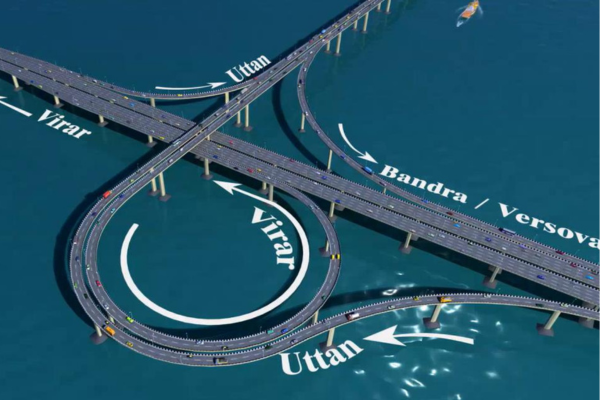
Under the leadership of Chief Minister Shri Devendra Fadnavis and the chairmanship of Deputy Chief Minister Shri Eknath Shinde, the Mumbai Metropolitan Region Development Authority (MMRDA), led by Metropolitan Commissioner Dr Sanjay Mukherjee, has accelerated the development of the Uttan-Virar Sea Link (UVSL) Phase-1. The initiative is being positioned as a transformative intervention for the Mumbai Metropolitan Region (MMR), focusing on economic integration, urban mobility, and quality of life. Advertisement


The revised Phase-1 proposal received approval during the 159th Authority Meeting held earlier this week. Originally planned as the Versova-Virar Sea Link (VVSL) by MSRDC, the project was transferred to MMRDA in the latter half of 2022. It was subsequently reorganised into two phases in early 2024. Phase-1, stretching from Uttan to Virar, was cleared for implementation, while Phase-2, which would extend the corridor to Palghar, remains under feasibility evaluation. The Versova-Uttan section has been excluded due to overlaps with the BMC's North Coastal Road initiative.
The UVSL is expected to establish an eight-lane, high-speed corridor within the MMR, seamlessly connecting to the Delhi-Mumbai Expressway. It is intended to function as a key access-controlled route for intercity transit. The corridor is anticipated to alleviate congestion on existing major roads such as the Western Express Highway, S.V. Road, and Link Road. In doing so, it is set to reduce travel times, enhance road safety, and significantly cut down on noise and air pollution, thereby uplifting the standard of living in surrounding areas.
Beyond mobility, the sea link is forecasted to streamline access to residential, industrial, and commercial zones across northern MMR. It is also likely to strengthen economic connections between Maharashtra and neighbouring states by linking strategic logistics and industrial hubs. These improvements are expected to draw substantial investment into the region, prompting the growth of industrial clusters and business centres. Additionally, the construction and subsequent operation of UVSL will create direct and indirect employment, bolstering income levels and economic resilience across local communities.
Phase-1 of the UVSL spans a total length of 55.12 km, inclusive of the 24.35-km sea link and connecting roads such as the Uttan road (9.32 km), the Vasai connector (2.5 km), and the Virar road (18.95 km). The project incorporates various infrastructure upgrades. These include a strategic corridor realignment to reduce land acquisition complications, new ramps for smoother access to important residential and industrial hubs, and the use of in-situ Orthotropic Steel Deck (OSD) spans similar to those used in landmark projects like MTHL and Atal Setu for greater durability and seismic resistance. Structural stability is further ensured by deep foundations reaching 30 to 35 metres.
Financially, the project follows a hybrid funding model, with 72% support from the Japan International Cooperation Agency (JICA) and 28% contribution from the Government of Maharashtra and MMRDA. This blend of international and state partnership underlines its strategic importance. The total revised cost stands at INR 87,427.17 crore, approved after thorough technical and financial assessment during the recent Authority Meeting.
As the groundwork is laid and execution begins, this corridor has the potential to recast the northern Mumbai Metropolitan Region as a well-connected, investment-ready, and future-focused zone. The UVSL is no longer just a transport project, it is a bold declaration of Mumbai's intent to grow beyond its historic core and embrace a wider, smarter future.

5th Jun, 2025

25th May, 2023

11th May, 2023

27th Apr, 2023
Advertisement





 Facebook
 Whatsapp
